






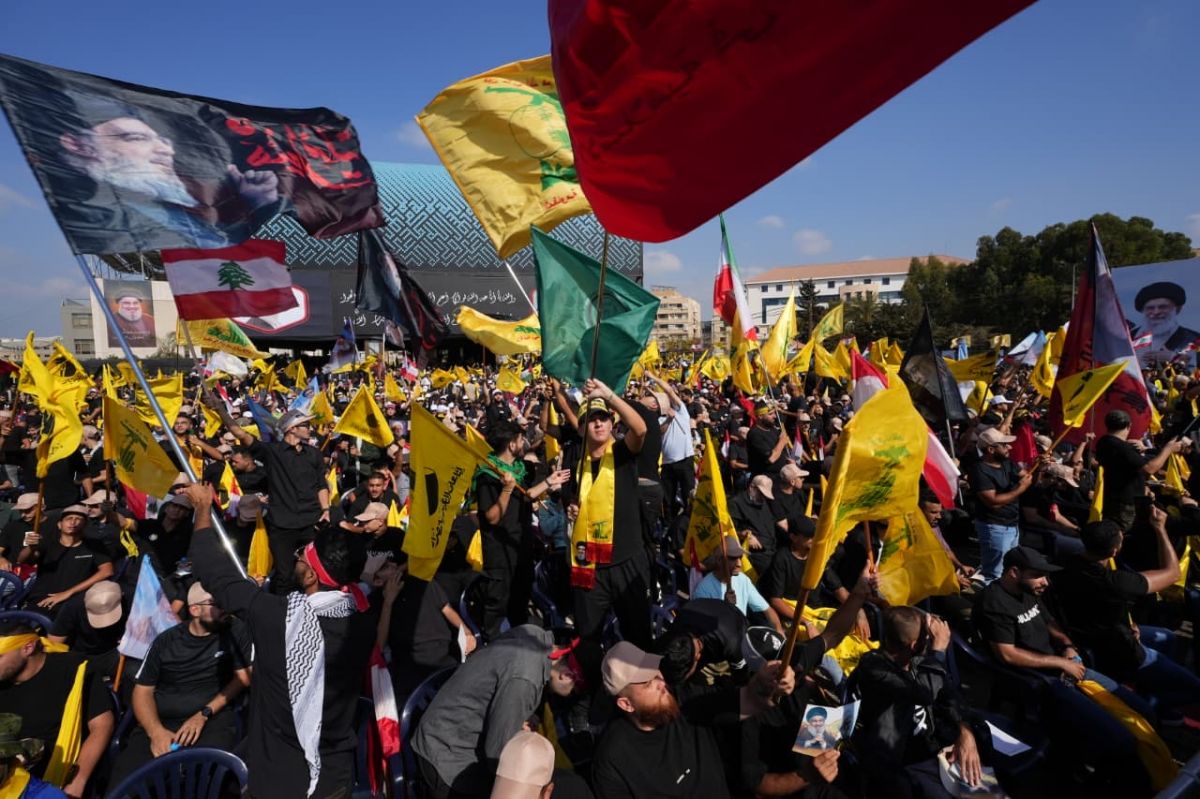
The crowd gathered in Beirut’s southern suburbs for the commemoration of Hassan Nasrallah’s assassination on Sept. 27, 2025. (Credit: Mohammad Yassin/L’Orient-Le Jour)






Once again, Lebanon is torn between those who believe the law must be strictly enforced at any cost and those who support compromise, even if it means bending the rules. The country faces a very delicate situation, similar to what occurred between Aug. 5 and 7 during crucial government decisions about the transfer of Hezbollah's weapons to the state.
According to a security source, despite the current tensions and complications — which appear to indicate internal clashes — the most likely scenario remains a last-minute compromise that would let both sides save face.
The same source believes Lebanon is destined to follow this path, as an all-out internal confrontation would be disastrous for the country and its state institutions, especially the military and security forces.

The source recalls that on Sept. 5, tensions in Lebanon were also very high, and the Cabinet's decision had a miraculous effect. In reality, it just repeated previous decisions but avoided giving a specific timetable for their implementation, which eased the tension.
Nevertheless, the external climate remains almost unchanged, prompting Lebanon to defend itself as much as possible while awaiting a clearer regional and international situation.
The source reports that regional developments have been accelerating lately, especially since Oct. 7, 2023. In addition to the events in Gaza and the West Bank, there is also the fall of the Syrian regime, which has yet to reveal its secrets fully.
What was Turkey’s actual role, and what about Russia’s, in the Syrian army receiving specific orders not to fight, without it being clear who issued those orders?
In light of the earthquake that was the fall of Assad’s regime in Syria, every country in the region has had to reassess its stance.
Turkey has undoubtedly played a crucial role, but Saudi Arabia quickly tried to absorb the new regime. Now, it has shifted from that phase to one of full partnership with Ahmad al-Sharaa's Syria.

Furthermore, Israel has played a significant role in the new Syria, clearly indicating that its goal is to divide the country into small confessional states — or at least confessional entities under outside influence.
In this sense, the Israeli and Turkish projects in Syria are conflicting, with Saudi Arabia supporting Turkey. For the first time in decades, a coalition is forming between Turkey, Saudi Arabia, Qatar and Egypt against Israel's plan. Israeli airstrikes targeting Turkish radars in Syria clearly show these shifts.
It is also in this very context that Saudi Arabia has begun to move closer to Iran; in recent weeks, there have been three meetings between the leaders of the two countries, starting with the foreign ministers, then the crown prince and the Iranian president and finally a meeting between the crown prince and Ali Larijani, the secretary general of Iran’s Supreme National Security Council.
Yet, at this exact moment, Iran faces the threat of reinstated sanctions from the pre-2015 nuclear deal. There are even discussions of Israeli strikes against the country.
Immediately following the Iran-Saudi meetings, Hezbollah Secretary-General Naim Qassem called on the Saudis to open a new page in their relations.
According to sources close to the party, this move by Qassem was coordinated with the Iranians after the Israeli strike on Doha, which paved the way for stronger ties between Gulf states and Tehran, as well as between Saudi Arabia and Pakistan, which is a rival of India, an Israeli ally.
These changes could be the beginning of a major regional realignment.
The Saudis have not entirely shut the door on Hezbollah’s offer, but prefer to discuss it with Parliament Speaker Nabih Berri. It is no coincidence that former minister and Berri’s aide Ali Hassan Khalil had an extensive discussion a few days ago with Ambassador Walid Boukhari.
All these factors together suggest that the region — and possibly the world — is going through a turbulent time. As a result, small, vulnerable countries like Lebanon have every reason to unify internally and safeguard themselves as much as possible from external changes.
For this reason, the security source mentioned earlier believes that, just like with the decisions of Aug. 5 and 7, official Lebanon should avoid inflaming the crisis caused by Hezbollah over the Raouche's rocks, especially since it has an emotional significance for its supporters.
On Sept. 5, the army commander was handed a hot potato and turned it into a workable solution. Lebanon should follow the same approach to prevent the country from falling into a crisis that would be disastrous for everyone, especially at a time when the world's attention is elsewhere.
This article was translated from L'Orient-Le Jour.
