


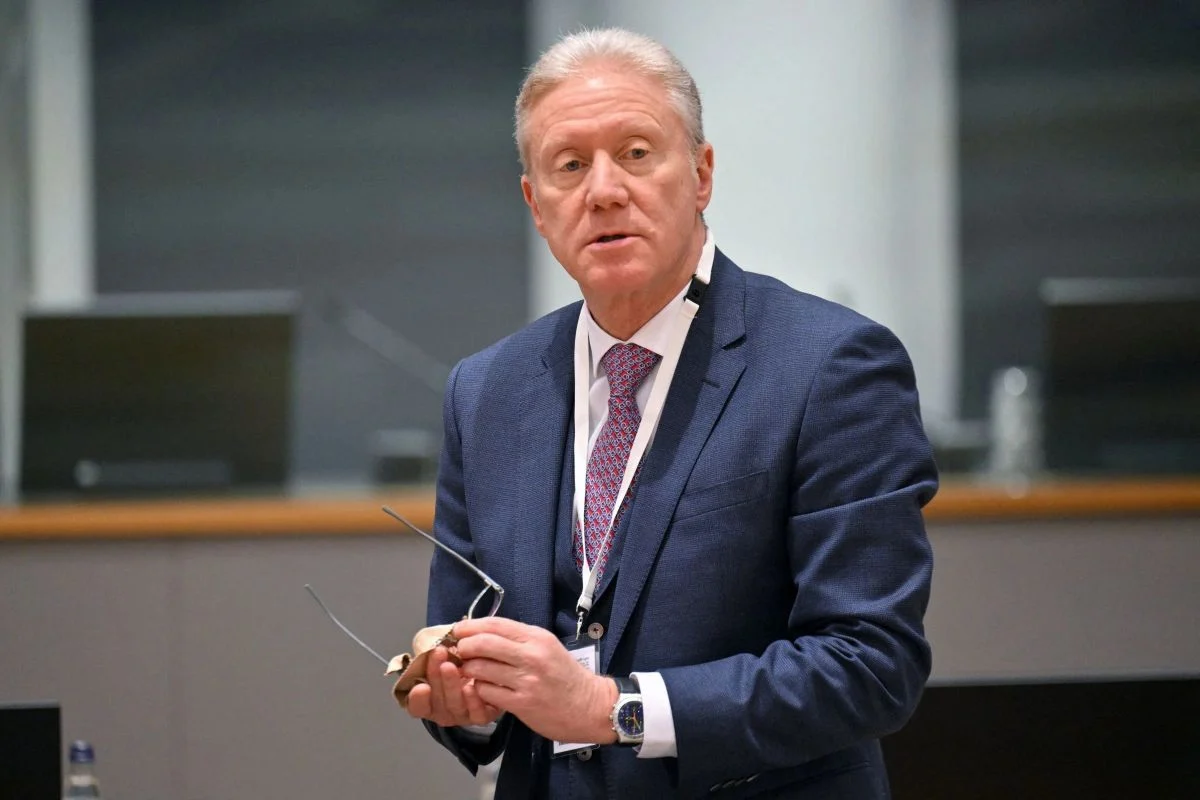
Lebanese Foreign Minister Joe Rajji. (Credit: AFP archive photo)






BEIRUT — During a visit to France, Lebanese Foreign Minister Joe Rajji said Wednesday in an interview with French channel LCI that direct negotiations with Israel were "the most effective" way to end the war, before calling for an end to the distinction between "the political and military wings of Hezbollah," which he accuses of obstructing these negotiations.
"Direct negotiations between the Lebanese government and Israel are the only possible way to restore peace in Lebanon. The military option has proven ineffective," the Lebanese diplomatic chief said during the interview, while praising "the rare courage" shown by President Joseph Aoun and Prime Minister Nawaf Salam in opening this diplomatic path with Tel Aviv.
The minister, who is affiliated with the Lebanese Forces party (LF) and a staunch opponent of Hezbollah, also stated that continuing to distinguish "between the political and military wings" of Hezbollah was "absolutely unrealistic."
"Hezbollah is a whole. It is an illegal organization in Lebanon, it is an armed wing of Iran, which Iran uses to control Lebanon and destabilize the Middle East," he said.
France's traditional diplomatic position is to distinguish between the two components of the militia-party in order to maintain communication channels with some of its political representatives, while its military wing is considered a "terrorist organization," in alignment with the position of the European Union.
Asked about the possibility of a handshake between President Joseph Aoun and Israeli Prime Minister Benjamin Netanyahu, as wished for by U.S. President Donald Trump, Rajji replied that it is premature as long as the Israeli army occupies more than 600 km² of Lebanese territory in south Lebanon. "We have to dream of peace, but peace requires conditions. Mainly, Israel must withdraw from the South and stop its attacks, because unfortunately, besides the Hezbollah fighters and positions, there are many innocent civilians who are being killed. After that, we'll see," he responded.
The health ministry announced Wednesday that it had recorded 30 dead and 82 more wounded in the past 24 hours, bringing to at least 3,696 dead and 11,403 wounded the total number of victims from Israeli bombings since the war in Lebanon resumed on March 2.
'We are in a vicious circle'
Regarding the current state of the war, which continues in south Lebanon between Israel and Hezbollah despite the announcement of a new ceasefire agreement after the fourth round of Israeli-Lebanese-American negotiations in Washington on June 3, the minister said that "Hezbollah has dragged Lebanon into a war from which we cannot escape," alluding to the "support front" for Gaza opened by Hezbollah on Oct. 8, 2023, as well as the rocket fire on March 2 after the assassination of Iran's supreme leader Ali Khamenei on Feb. 28 at the start of the Israeli-American offensive against Iran.
"Our priority in these negotiations is to achieve a ceasefire so that displaced people can return home. It is quite difficult, because we are in a vicious circle: as long as Hezbollah launches attacks, Israel says it is legitimate for it to defend itself. On the other hand, Hezbollah believes that as long as there is Israeli occupation, it is its duty to continue the 'resistance', which I put in quotation marks, because it is not a Lebanese resistance, but an 'Islamic resistance in Lebanon,' as they themselves define it," he also said during a hearing before the French National Assembly's Foreign Affairs Committee.
He finally took this opportunity to express "the greatest tribute to the French soldiers of UNIFIL, who have served for nearly fifty years in southern Lebanon and who have been killed, by the dozens, in the course of their mission, including most recently just a few hours ago ... Lebanon will never forget the sacrifices of these soldiers."
Two French peacekeepers were killed in an attack attributed to Hezbollah on April 17 near the village of Ghandouriyé in southern Lebanon. A third French soldier was killed this Wednesday by an "accidental shooting," the origin of which has not yet been determined. "Several factions and parties bear responsibility," the minister emphasized, noting that several deadly attacks against UNIFIL soldiers have also been carried out by the Israeli army in recent months.
Barrot: 'Courageous' decisions
Rajji also met with his French counterpart, Jean-Noël Barrot, who described the decisions and positions taken by the political authorities since last summer as "courageous," according to the state-run National News Agency (NNA). He also reaffirmed "France's unwavering support for Lebanon and its solidarity with the negotiation process initiated by Beirut, even though Paris is not a direct party to these talks."
For his part, Rajji emphasized “the active role played by France,” praising “its consistent positions,” and expressing his hope that “the Washington negotiations will lead to a cease-fire and a complete Israeli withdrawal, ending the daily suffering of the inhabitants of the South.” The Lebanese foreign minister insisted that “Lebanon will not accept anyone negotiating on its behalf,” affirming that “the decision to monopolize arms in the hands of the state has been made definitively and irreversibly.”
The two officials also agreed on “the importance of supporting the Lebanese Army and strengthening its capabilities, as an essential pillar for consolidating Lebanon’s position in the negotiations.” Barrot announced his country’s readiness to organize an international conference to support the military institution, given the strategic importance of this issue.
Finally, the discussion addressed the phase following the end of the UNIFIL peacekeeping mission, as well as Lebanese-Syrian relations. The French side emphasized "the importance of continuing the demarcation of the land borders between the two countries, in order to strengthen security, better control borders, and limit smuggling."

 1 p.m. recap: Salam in Nabatieh; up to 10,000 more US troops heading to Middle East