






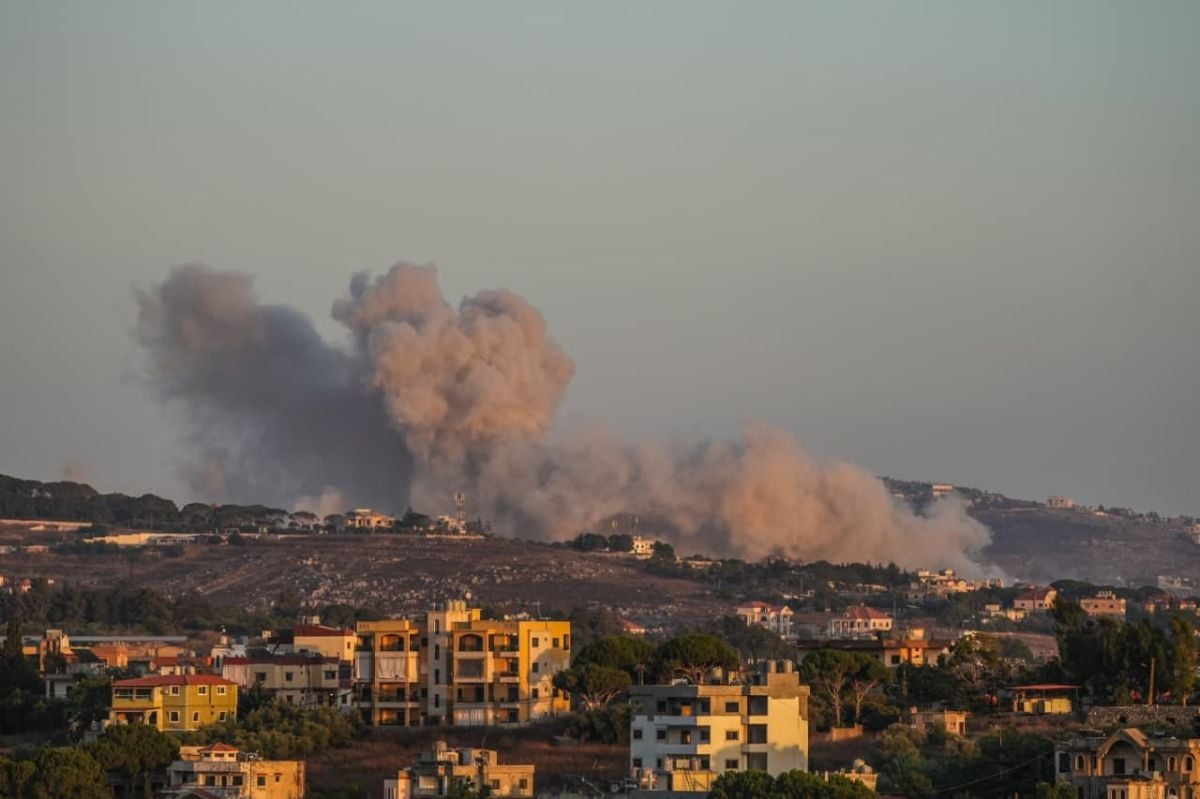
A demolition in Kfar Tebnit, in the Nabatiyeh district, on July 24, 2026. (Credit: Mohammad Yassine / L'Orient-Le Jour)






The Israeli army continued its attacks Saturday in and around the ‘’buffer zone’’ it occupies in southern Lebanon, setting olive groves on fire, carrying out demolitions in several villages, including the destruction of water infrastructure, and establishing a new position opposite the Lebanese Army near Mansouri.
According to information from our correspondent in the region, Israeli forces set vast olive groves ablaze in Ainata in the afternoon, with the fire spreading toward Aitaroun. In the Bint Jbeil district, troops twice demolished homes in Haddatha, while armored vehicles were seen between the village and neighboring Tiri. Artillery shelling also targeted Kounine and Braasheet.
Farther west, in the Sour district, Israeli military vehicles advanced into the area linking Majdal Zoun and Mansouri, where troops established a position facing a Lebanese Army checkpoint. In the Marjayoun district, Israeli forces carried out explosions in Taybeh and destroyed the Markaba water supply network with explosives.
Meanwhile, north of the Litani River in the Nabatieh district, Israeli artillery shelled the outskirts of Kfar Tebnit, Nabatieh al-Fawqa and the heights of Ali Taher, where Israel accuses Hezbollah of digging tunnels housing a regional command center.
In Zawtar al-Gharbieh, one of the ‘’pilot zones’’ outlined under the framework agreement between Lebanon and Israel for an Israeli withdrawal and Hezbollah’s disarmament, Civil Defense teams continued clearing operations and recovered four bodies from beneath the rubble. Two days after the Lebanese Army deployed to the village on the northern bank of the Litani River, an area previously controlled by Israeli firepower, residents were able to begin returning to their land Friday.
Demolition of houses
Overnight Friday into Saturday, Israeli forces set fire to and demolished several homes in the city of Bint Jbeil, much of which has been devastated by Israeli attacks, particularly in the Saf al-Hawa neighborhood and along the road leading to Ainata. Artillery shelling was also reported in Kfar Tebnit, while demolitions continued in the Majdal Zoun and Mansouri areas.
Amid the widespread destruction in the ‘’buffer zone,’’ the Bint Jbeil municipality on Friday night condemned what it described as Israel’s ‘’systematic destruction of public facilities and civilian infrastructure,’’ accusing it of violating international humanitarian law.
In a statement, the municipality said Israeli forces destroyed three public institutions in the al-Oueini neighborhood: The Second Official Mixed Public School of Bint Jbeil, a Social Affairs center housing a daycare and medical clinic, and a local Water Authority office.
The municipality said previous Israeli attacks had damaged or destroyed schools, a Lebanese Red Cross center, a Lebanese University building, emergency health centers, two hospitals, mosques and other public facilities. It added that electrical and water infrastructure, roads, government buildings, a municipal stadium, and thousands of homes and businesses had also been damaged or destroyed.
The municipality argued that the scale of the destruction, combined with Israeli statements calling for large parts of southern Lebanon to be made uninhabitable, reflected a systematic policy aimed at displacing residents and imposing a new reality by force, describing such acts as ‘’potential war crimes.’’