






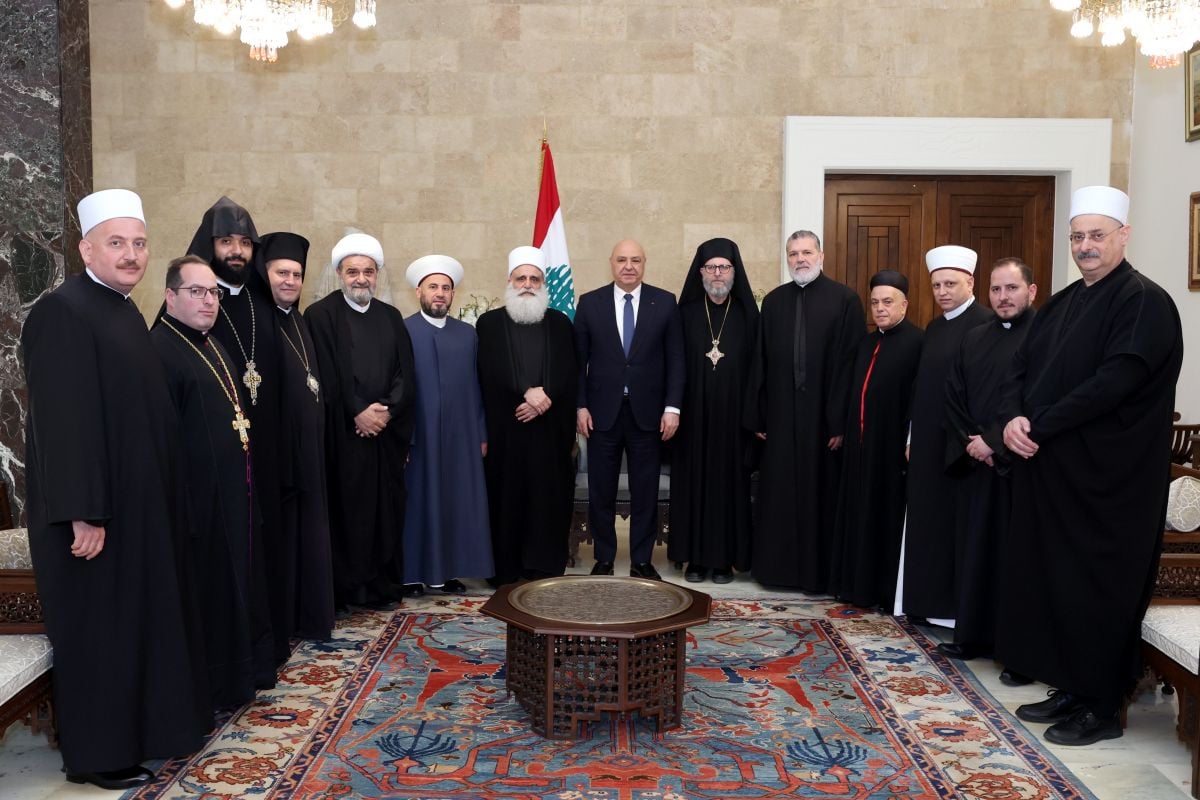
President Joseph Aoun, receiving at sheikh Akl of the Druze community, Sami Abi al-Mona, at the head of a delegation of religious leaders, on June 10, 2026. (Credit: X/Lebanese Presidency)






BEIRUT — President Joseph Aoun received Wednesday at Baabda Presidential Palace the Druze community's sheikh Akl, Sami Abi al-Mona, at the head of a delegation of religious leaders, and reaffirmed his adherence to the conclusions of the spiritual summit held earlier in June.
On this occasion, the head of state stated that "it is impossible to live outside the framework of the state," adding that any other choice is equivalent to a "sin." He insisted that national unity is Lebanon's true strength, affirming: "Our weapon is not the traditional weapon, but our unity."
Aoun emphasized that the spiritual summit represents "a response to those who suggest there is a conflict between religions and sects in Lebanon," considering these insinuations baseless and saying they will not materialize.
He called for building "an unbreachable rampart" against sectarianism and confessional divisions, reminding that "no one can claim to be patriotic while attacking his brother in the homeland." The president was thus implicitly responding to Hezbollah’s rhetoric, which continues to defend the legitimacy of so-called armed "resistance" and warns that any questioning of it could lead to a serious internal explosion.
The president also stated that "if one part of Lebanon is attacked, the whole country is attacked," stressing that no region can be separated from the national whole. He said the state’s priorities remain ending the aggression, Israel’s withdrawal, the return of displaced persons and prisoners, the exclusive deployment of the army in the south, and reconstruction.
Considering that "the objective is singular but the method is different," he advocated the continuation of negotiations with Israel, recalling that "the experience of war has not allowed us to achieve our goal" and asking: "Why not give negotiations a chance to see what they can accomplish?"
For his part, al-Mona stated that "national unity remains the real source of Lebanon’s strength, and that the protection of civil peace and the consolidation of the national partnership among all Lebanese components constitute the fundamental guarantee for getting through this difficult period." At the beginning of the month in Beirut, at al-Mona’s initiative, Muslim and Christian religious leaders had called for national unity.
Aoun also said he was "in perfect agreement" with Parliament Speaker Nabih Berri and Prime Minister Nawaf Salam. "If there are differences of opinion, that's completely normal, but communication is good and our shared goal is the general interest. The relationship between us is more than excellent," he assured.
Also on Wednesday, Egyptian Ambassador to Lebanon Alaa Moussa was received in Ain al-Tineh by Berri, and stated after the meeting: "What I heard from President Berry does not differ from the positions of Presidents Aoun and Salam."
On March 2, Hezbollah drew Lebanon into the war in support of Iran, following attacks carried out by the United States and Israel. Israeli strikes have since killed 3,666 people, according to the latest figures from Lebanese authorities.
Israel still occupies part of southern Lebanon along the border and has advanced more deeply into Lebanese territory than at any time in nearly the past 30 years since the beginning of this new conflict. A cease-fire agreement had been reached after the fourth round of negotiations between Lebanon and Israel in Washington, on June 2 and 3.
Berri, along with ally Hezbollah, rejected this agreement, calling it "unjust." Hezbollah is adamantly opposed to the principle of direct negotiations with the Israeli state, and has repeatedly criticized President Aoun. The delegations from the two countries are due to meet again on June 22.
