






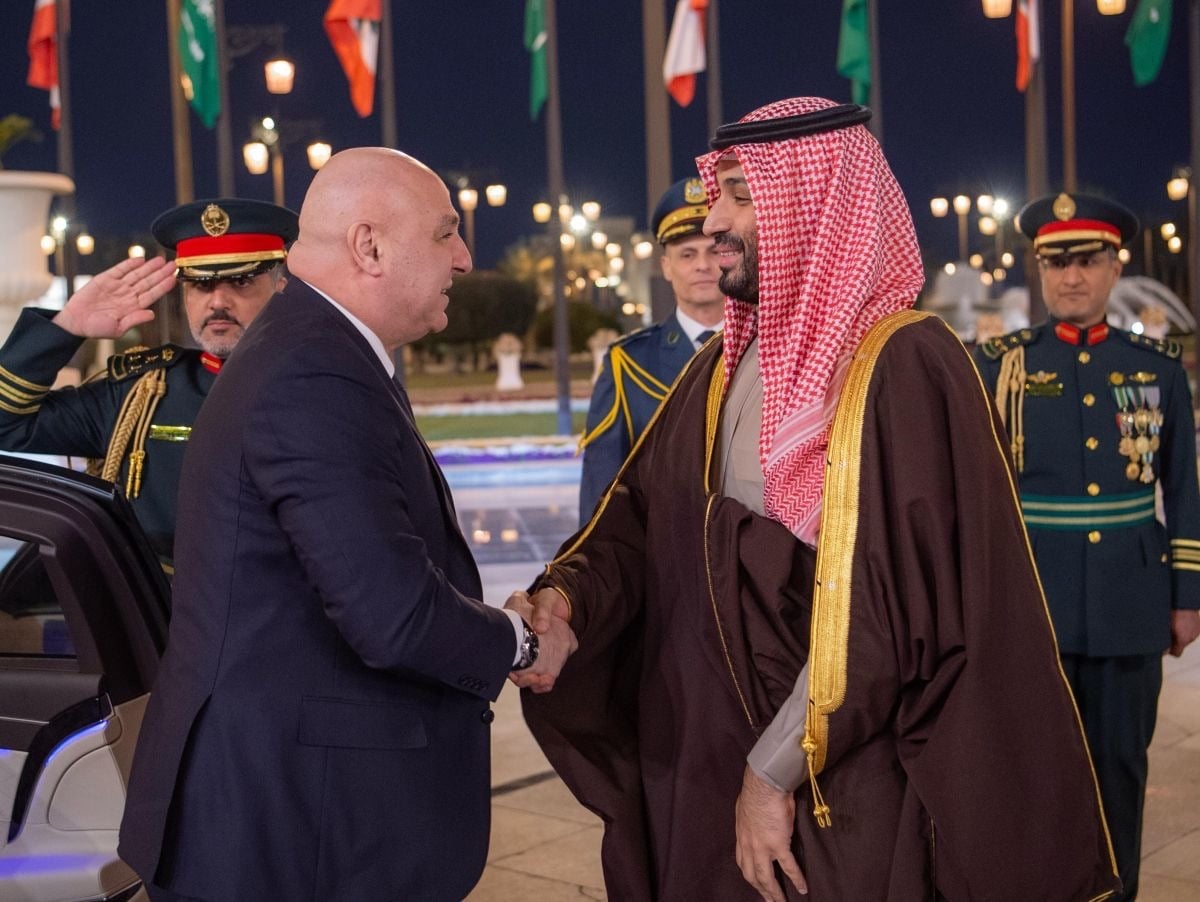
Lebanese President Joseph Aoun and Crown Prince Mohammad bin Salman, March 3, 2025, in Riyadh. (Credit: X/Saudi Press Agency)






BEIRUT — Beirut had been waiting years for such an announcement.
On Wednesday, the official Saudi Press Agency (SPA) announced the resumption of Lebanese exports to Saudi Arabia. According to the agency, Saudi Minister of Foreign Affairs Prince Faisal bin Farhan bin Abdullah informed Lebanese Prime Minister Nawaf Salam of the decision during a phone call. This decision comes under a "directive from Crown Prince Mohammed bin Salman," SPA said.
The agency stated that the measure follows a request from Lebanese President Joseph Aoun and Prime Minister Nawaf Salam. It comes "in recognition of the positive steps taken by the Lebanese government to rebuild state institutions, as well as the progress made by technical teams over the past year and the cooperation of the Lebanese side, notably the fulfillment of the required commitments."
In 2021, Gulf states, including Saudi Arabia, recalled their ambassadors from Beirut after a Lebanese minister criticized the Saudi military intervention in Yemen. Riyadh also suspended imports of Lebanese fruits and vegetables in April of that year, claiming that shipments were being used for drug trafficking and accusing Beirut of failing to take action.
The Saudi press agency also said that the Saudi foreign minister "reaffirmed the kingdom's support for the stability of Lebanon, its sovereignty over its entire territory and the well-being of its brotherly people." "He also expressed his confidence in Lebanon continuing to take all necessary measures to prevent its territory from being used as a platform to harm its neighbors," the agency added.
Relations between Lebanon and Saudi Arabia deteriorated after 2016, when Riyadh canceled its $3 billion aid package to the Lebanese Army in protest against positions it said were influenced by Hezbollah. In November 2017, then-Prime Minister Saad Hariri unexpectedly announced his resignation from Riyadh, accusing Hezbollah and Iran of exercising "tight control" over Lebanon. Saudi Arabia denied forcing Hariri to resign or holding him against his will.
Since the election of Joseph Aoun as president in January 2025 and the appointment of Nawaf Salam as Prime Minister, ties between Beirut and Riyadh have markedly improved. The Lebanese president chose Saudi Arabia for his first official foreign visit in March 2025.
Five days ago, Aoun called on Saudi Arabia to resume imports of Lebanese products and expressed "his deep gratitude and high regard" for the Saudi Crown Prince. He described this decision as "a sincere expression of the depth of Arab brotherhood" linking the two countries, and "an embodiment of the wise Saudi leadership's commitment to supporting Lebanon and its people during their recovery period."
The head of state stressed that the measure would have "a tangible impact on the revival of the national economy" and supporting Lebanese producers and exporters. He added that "the entire Lebanese people" welcomed the initiative with "deep gratitude and great appreciation," viewing it as "a gesture that strengthens the path of Lebanese-Saudi relations, rooted in bonds of history and shared destiny."
For his part, Salam offered "on behalf of the Lebanese state and in his own name" his "highest expressions of thanks and appreciation" to the Saudi Crown Prince. He said that the move "reflects the depth of the fraternal and historical relations" between the two countries and "demonstrates the kingdom's trust in Lebanon" as well as the shared determination to strengthen economic and commercial cooperation for the benefit of both peoples.
Salam said the decision marks "an important step" that could support the Lebanese economy and open new opportunities for producers and exporters, thus helping to "promote growth and stability in Lebanon."
He also reaffirmed the Lebanese state's commitment to continued coordination with Saudi Arabia to strengthen bilateral partnerships across various fields.
Finally, Salam thanked Saudi Foreign Minister Prince Faisal bin Farhan for his "close attention" to the matter until its successful conclusion.
In the evening, the state-run National News Agency reported that Salam chaired a security meeting focused on exports. He stressed the need to “maintain the highest level of vigilance and take all necessary preventative measures to preserve the rebuilt trust, strengthen the credibility of the Lebanese state, and ensure the smooth flow of exports to the Kingdom of Saudi Arabia.” He also emphasized that “any negligence or shortcomings in this area constitute a threat to the higher national interest,” adding, “We will not accept any form of laxity on this matter.”
Reactions
The Minister of Information, Paul Morcos, for his part, said in an interview with the Al-Hadath channel that Riyadh’s decision “reflects renewed confidence in Lebanese institutions” under President Aoun's mandate and Prime Minister Nawaf Salam’s government.
“The workings of a sovereign state are gradually returning, notably with the opening a few days ago of the René Moawad Airport in Qleiaat, despite the war,” he added.
Reacting to this decision, the Ministry of Agriculture said that “the reopening of the Saudi market represents a decisive opportunity to relaunch the agricultural recovery process, restore Lebanon’s position in external markets, stimulate local production, and strengthen the competitiveness of Lebanese products.”
It also noted that “data shows that before 2020, the Gulf Cooperation Council countries constituted the main market for Lebanese agricultural exports, absorbing around 45% of the total of these exports.”
“The volume of Lebanese exports of vegetables, fruit, and their preparations to Gulf countries reached around 200,000 tons per year, including nearly 60,000 tons destined for the Kingdom of Saudi Arabia. With reduced access to Gulf markets, and after the Kingdom of Saudi Arabia stopped imports as of April 25, 2021, ... total Lebanese agricultural exports to Gulf countries fell to around only 77,000 tons, which had negative repercussions on agricultural production, farmers’ incomes, and the sustainability of value chains in the sector,” the ministry added.
The Progressive Socialist Party (PSP) said that “this decision constitutes further proof of the kingdom’s continued willingness to stand by Lebanon and its people, and to support the process of recovery and the restoration of stability, reflecting a sustained Arab commitment to backing Lebanon in the face of the challenges it is going through.”
The Free Patriotic Movement (FPM) welcomed what it described as “a renewed confirmation of the depth of relations between Lebanon and Saudi Arabia,” adding that it should encourage “greater coordination and integration among Arab countries.”