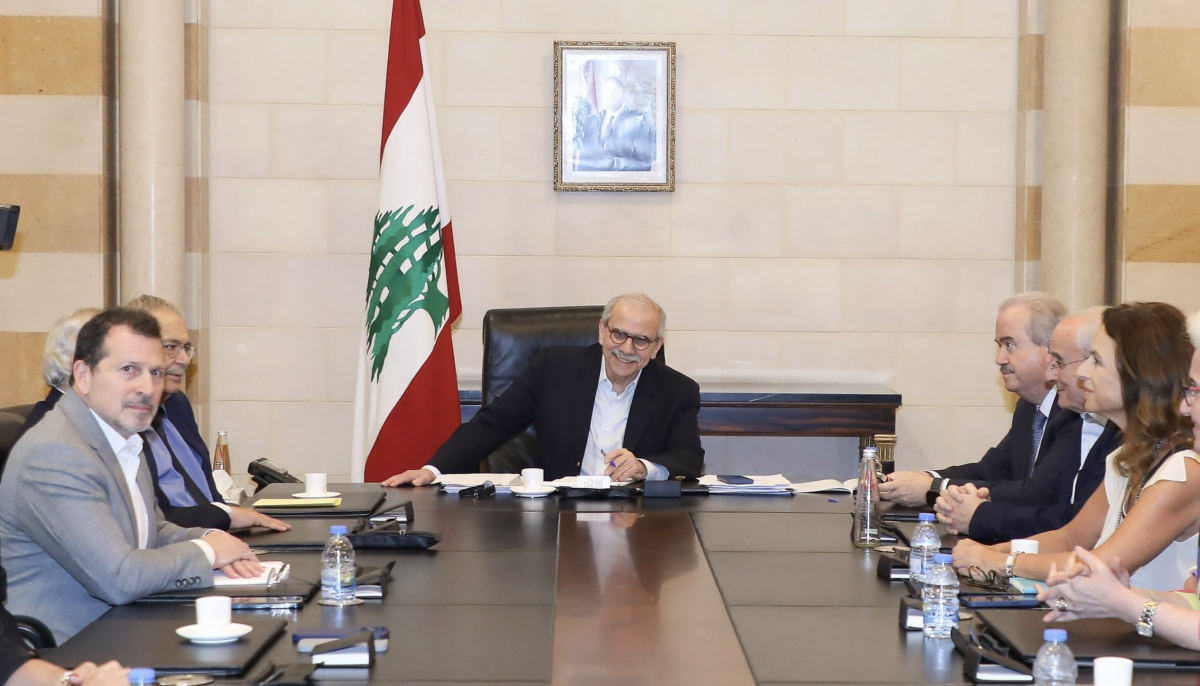
Prime Minister Nawaf Salam at an informal ministerial meeting at the Grand Serail, Friday. (Credit: Grand Serail/X)






The mood appears to be one of reconciliation: Prime Minister Nawaf Salam held a "consultative ministerial meeting" on Friday afternoon to discuss recent developments in the country, mainly following Hezbollah’s unauthorized projection of images of the party’s former leader Hassan Nasrallah on the Pigeon Rocks, a symbolic site on Beirut’s coast.
This is a challenge to the prime minister, who earlier in the week had called on authorities to forbid this "illegal" projection. After the rally was held — during which defamatory chants against Salam were heard — tensions in the country escalated, with some even suggesting the prime minister considered suspending his work.
However, this ministerial meeting, which saw broad participation (including two Shiite ministers), seems to indicate a way out of the crisis. Deputy Prime Minister Tarek Mitri said the meeting was convened "to reaffirm the government’s cohesion … and to emphasize the policy embodied in its ministerial statement, namely to extend the sovereignty of the Lebanese state by its own forces over the entire territory."
"We also insisted on the importance of enforcing laws for all citizens without exception, which places great responsibility on the security forces to achieve that," he added. "Lebanese are equal before the law, and the state makes no distinction between one citizen and another, or between groups of citizens."
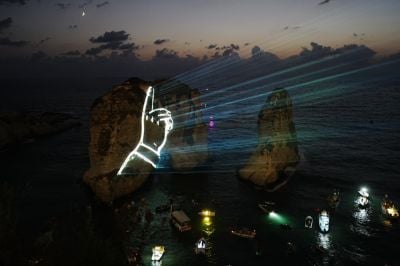
According to Mitri, "the flagrant violation of the terms of the permit granted for the Raouche rally forces us to take the necessary legal measures to preserve the authority of the state and respect for its decisions." "It goes without saying that the government is concerned for the country’s stability, for the unity of its citizens and is determined to put an end to incitement as well as campaigns of hatred that undermine our national coexistence," he concluded.
Earlier in the day, several ministers and MPs visited the prime minister at his home, after he canceled all appointments to focus on following up on this matter, insisting on the need to sanction those who overstepped the decision of the Lebanese state and the authorization granted by the governor of Beirut for Hezbollah to hold its event in the Raouche area.
Circles close to Salam said what the prime minister did was not a "sulk," but rather a way to "focus on how to handle the crisis and to reaffirm the authority of the state." In this context, contacts are underway with the justice, interior and defense ministers to enforce the law and apprehend violators, including possibly sanctioning the organization that called for the rally. According to our sources, Parliament Speaker Nabih Berri is also involved in these efforts.
Army 'prevents situation from slipping into abyss of confrontation'
For his part, Defense Minister Michel Menassa defended, in a statement on Friday, the army's decision not to intervene and halt the projection. "The Lebanese Army’s primary national mission is to prevent disturbances, avoid the situation sliding toward the abyss of confrontation, deter those who threaten civil peace, and reinforce the foundations of national unity," he said.
He added that the army "rejects unjust accusations" and "regrets having to bear the burden of the street while others shirk their responsibilities."
While this statement appears mainly in response to some media outlets that accused the army of failure on Friday, others view it as a means for the minister to address any potential criticism from Salam.
Since the fragile cease-fire between Hezbollah and Israel on Nov. 27, 2024, the Lebanese Army has been tasked with dismantling Hezbollah’s arsenal south of the Litani River in line with the cease-fire agreement. Disarming Hezbollah remains Lebanon's strategic priority and a central factor shaping the international community’s perception of the country. Foreign positions are indeed clear: No aid or investment will be granted to Lebanon as long as Hezbollah remains armed.
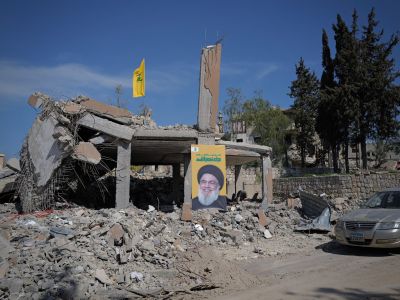
Thousands of supporters of the party gathered Thursday in the Raouche district to commemorate the killing of Nasrallah, who died on Sept. 27, 2024, in a series of massive Israeli airstrikes that flattened several residential buildings in Beirut’s southern suburbs.
Despite the governor’s order, Nasrallah’s image was projected on the landmark site, as well as on nearby buildings, alongside his late successor Hachem Safieddine, Berri and former prime ministers Saad Hariri and his father Rafik Hariri, sparking controversy and reactions.
Rafik Hariri was assassinated in a car bombing in February 2005, and the Special Tribunal for Lebanon convicted several alleged Hezbollah members for their role in the crime, which killed 21 others as well.
This article was translated from L'Orient-Le Jour.