







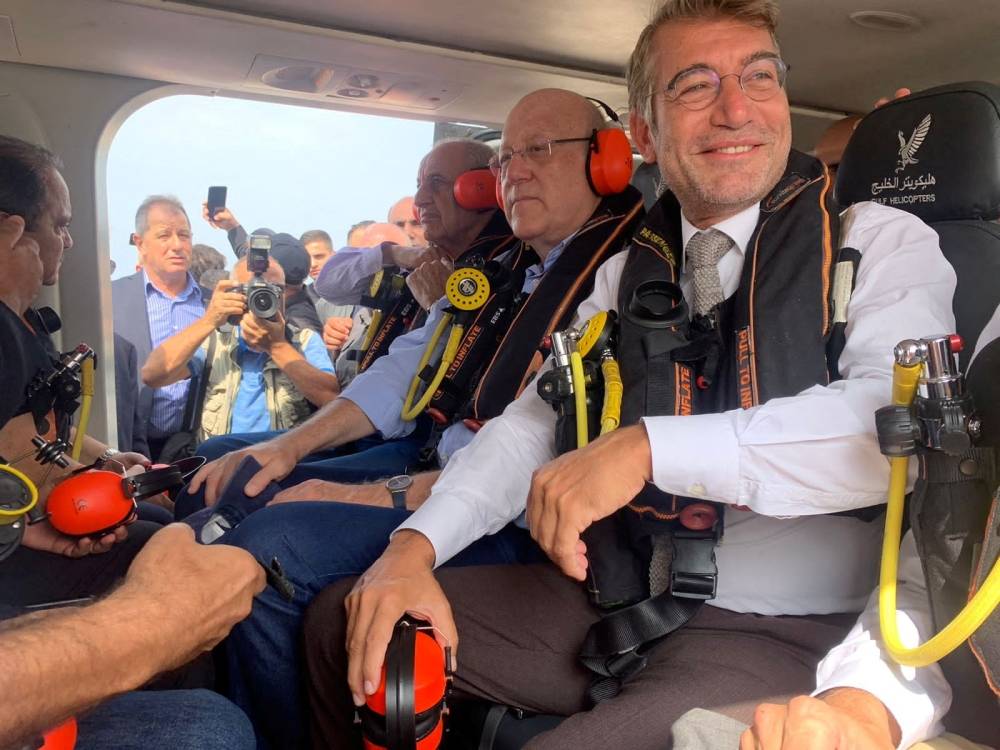
Lebanon's Parliament Speaker Nabih Berri, caretaker Prime Minister Najib Mikati and caretaker Energy Minister Walid Fayad are pictured in a helicopter transporting them to the drilling rig at Lebanon's offshore Block 9 on Aug. 22, 2023. (Credit: Dalati Nohra/Handout via Reuters)






Lebanon is expected to know whether offshore Block 9 contains commercially viable amounts of hydrocarbons within “67 days” from the scheduled start of exploratory drilling tomorrow, caretaker Energy Minister Walid Fayad said yesterday. The announcement came after a visit to the TransOcean Barents drilling rig, which arrived last Wednesday after being chartered by the TotalEnergies-ENI-QatarEnergy consortium. The exploratory drilling aims to reveal whether Lebanon “can start extracting and producing natural gas from the block,” a source at the Lebanese Petroleum Administration previously told L’Orient Today. Last October, an indirect maritime border delineation deal between Lebanon and Israel cleared the way for exploration of Block 9.
Activist William Noun yesterday told L'Orient Today around 70 MPs had signed a petition, “specifically meant for presentation to the UN,” calling for an international fact finding mission into the Beirut port blast. “We have asked all deputies to sign a petition requesting the creation of an international fact-finding commission,” the blast victims’ relatives said in a statement. The petition will be presented to “Lebanese officials at the United Nations, embassies and members of the UN Security Council,” the statement continued. In March, Australian Ambassador to the United Nations Amanda Gorely called, on behalf of 38 states, for a “prompt, impartial, independent, credible and transparent investigation” after her country launched a petition to urge UN Human Rights Council members to approve the establishment of an independent fact-finding mission. Two-year-old Australian Isaac Oehlers was among the victims of the Aug. 4, 2020, explosion. Hundreds of people earlier this month commemorated the blast’s third anniversary while the Lebanese investigation into the catastrophe continued to stall.
Representatives of Palestinian political factions called for those allegedly involved in the deadly recent Ain al-Hilweh clashes to be handed over to authorities. The clashes last month in the Palestinian refugee camp killed at least 13 people and displaced hundreds of families. The Joint Palestinian Action Committee’s statement emphasized “the need to ensure security inside the camp and in its vicinity.” The fighting erupted with the assassination of Fatah official Abu Ahmed al-Armoushi and four of his bodyguards, after which several days of gun and RPG fire left at least eight other people dead, dozens injured and thousands still displaced. Armoushi’s successor, Abu Ayad al-Chaalan, earlier this month accused Islamist militant and alleged Islamic State affiliate Bilal Badr of killing the late Fatah official. In March, clashes between Fatah and Islamist groups in Ain al-Hilweh, sparked by the killing of a Fatah member, left one dead and seven injured.
Firefighters extinguished a blaze caused by a generator malfunction at the Smallville Hotel, located in Beirut’s Badaro neighborhood. The fire caused only material damage. Private generators are prevalent across Lebanon to mend gaps left by the state’s electricity coverage. In June, a generator fire in Beirut’s Zoqaq al-Blatt neighborhood spread to two diesel tanks, damaging three apartments, a shop and six cars. The following month, Beirut governor Marwan Abboud announced a series of fire mitigation measures, including the placement of firefighters on “maximum alert” amid a heightened fire risk incurred by rising temperatures.
In case you missed it, here’s our must-read story from yesterday: “Forensic audit: Diving into BDL’s inappropriate expenses”
Compiled by Abbas Mahfouz