






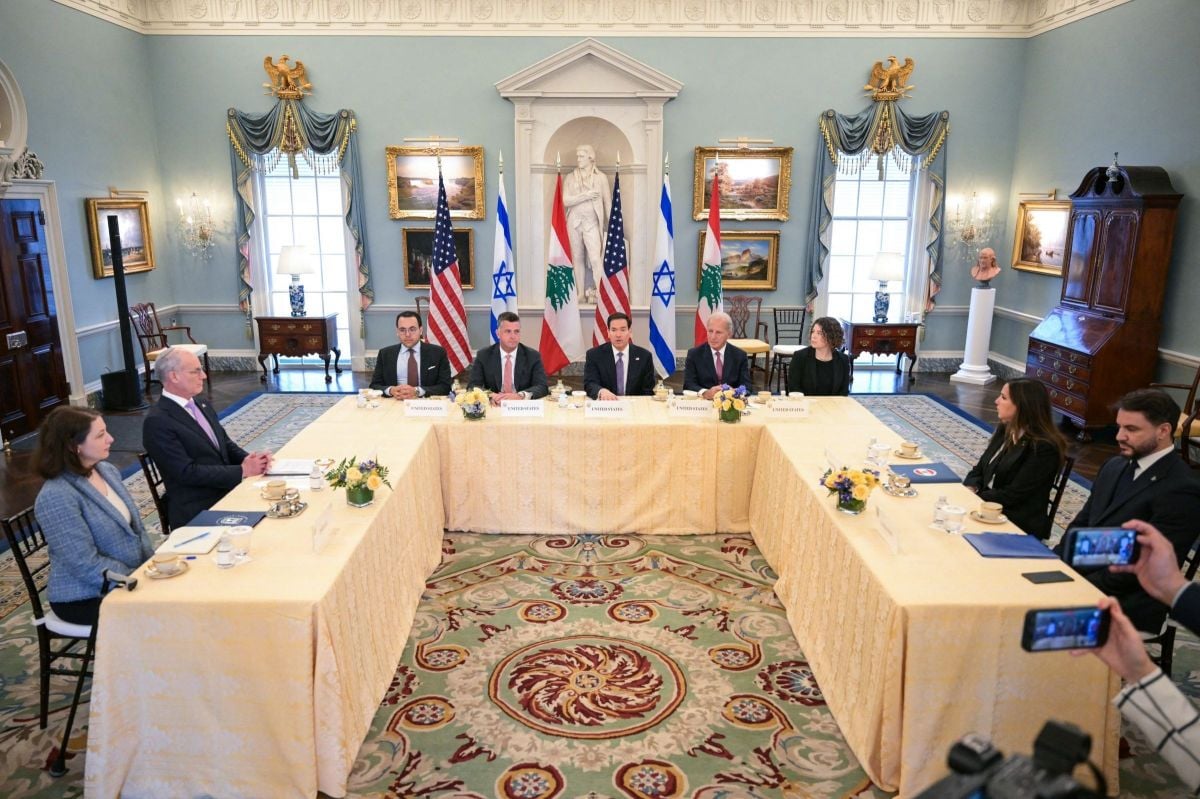
U.S. Secretary of State Marco Rubio (C) speaking during a meeting with the Lebanese Ambassador to the United States, Nada Hamadé Mouawad (2nd from right), and the Israeli Ambassador to the United States, Yechiel Leiter (2nd from left), at the State Department in Washington, April 14, 2026. (Credit: Oliver Contreras / AFP)






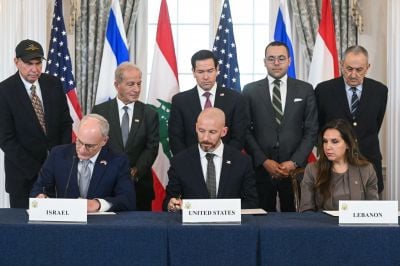
BEIRUT — The framework agreement signed last Friday by Lebanese and Israeli delegations during direct negotiations in Washington continued on Thursday to draw sharply contrasting reactions from Lebanon’s political class, underscoring deep divisions over the latest conflict initiated by Hezbollah in south Lebanon and its consequences for the country.
On the so-called sovereignist side, the agreement is firmly defended. Lebanese Forces (LF) leader Samir Geagea said the "framework agreement paves the way for the restoration of a genuine state and the end of a long-standing conflict that has exhausted Lebanon for decades." According to him, the text "establishes a clear equation based on a full Israeli withdrawal and the end of a military situation imposed by Hezbollah."
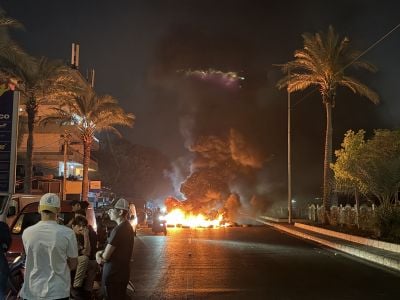
Hezbollah opened a front in support of Iran by launching missiles against northern Israel on March 2, less than three years after opening a front in support of Gaza in 2023. These two wars have left the country drained, with much of south Lebanon now destroyed and partially occupied by the Israeli army.
In an interview with the Italian newspaper Corriere della Sera, Geagea said the “tangible change brought by this agreement is the definitive closure of the southern border,” recalling that the Lebanese state had been sidelined when the South became a battleground for non-state armed groups. Asked about the possibility of Hezbollah’s disarmament under current circumstances, the LF leader said the agreement “represents a serious and credible opportunity to close the file on this party’s illegal weapons.”
Gemayel and Moawad in Baabda
Two other sovereignist leaders also defended the direct negotiation process and the resulting agreement, on the sidelines of meetings with President Joseph Aoun at Baabda Palace.
Kataeb leader Samy Gemayel said his delegation’s visit “aims to support the legitimacy embodied by President Joseph Aoun and Prime Minister Nawaf Salam, with a view to restoring the state’s sovereignty.” For him, the framework agreement “launches a process of Israeli withdrawal from the South and the recovery of Lebanese sovereignty, without war.”
"Those who reject this agreement, therefore, do not seek the liberation of the South, and call for the state to remain hostage to perpetual war," he added.
On the question of submitting the framework agreement to Parliament, Gemayel argued that the text “contains only provisions that comply with the Constitution and the law, such as Israeli withdrawal and the restoration of Lebanese sovereignty, and not issues requiring institutional debate, such as border changes or a peace treaty.”
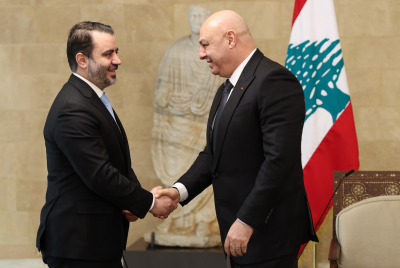
MP Michel Moawad, head of the Independence Movement, also visited Baabda at the head of a delegation, voicing “support for Lebanese legitimacy, which under the leadership of President Joseph Aoun and the government is waging a difficult and complex national battle aimed at Israeli withdrawal and the restoration of sovereignty.”
According to Moawad, “this is not a time for one-upmanship. The Lebanese state is simply correcting course through negotiations, after past mistakes,” in reference to wars launched by Hezbollah since 2023.
Fadlallah accuses authorities of having 'sold out sovereignty'
On the opposing side, Hezbollah MP Hassan Fadlallah renewed his criticism of the framework agreement, which his party has outright rejected, arguing instead that any negotiations involving Lebanon should be part of a broader U.S.–Iran track.
In a parliamentary statement, Fadlallah described the text as an “agreement of capitulation,” insisting that its rejection “is not merely a difference of political opinion with the authorities, but reflects a fundamental disagreement between those committed to a Lebanon enjoying national sovereignty over its entire territory and authorities that have signed an act of surrender.”
He said he believed the authorities had “sold out sovereignty and legitimate rights which neither the Taif Agreement, nor the Constitution, nor Lebanese law, nor international law allow any authority to abandon, particularly the right to recover territory and the right of inhabitants to return to their villages."
He was referring mainly to Article 13 of the agreement, which stipulates that the Lebanese state would refrain from initiating proceedings against Israel before international bodies over war crimes.
Fadlallah called on the Lebanese authorities to "abandon the path of concessions and turn once again to the people by complying with the requirements of the Pact and Constitution, otherwise these authorities will spend the rest of their constitutional mandate reaping nothing but failures."
President Joseph Aoun said on Wednesday that the framework agreement concluded with Israel was “neither capitulation nor renunciation” and that it preserved Lebanon’s “legal and operational rights.”

 8 p.m. recap: Israel again threatens Beirut’s south suburbs; 2 ships hit near Hormuz; Riyadh football matches canceled