






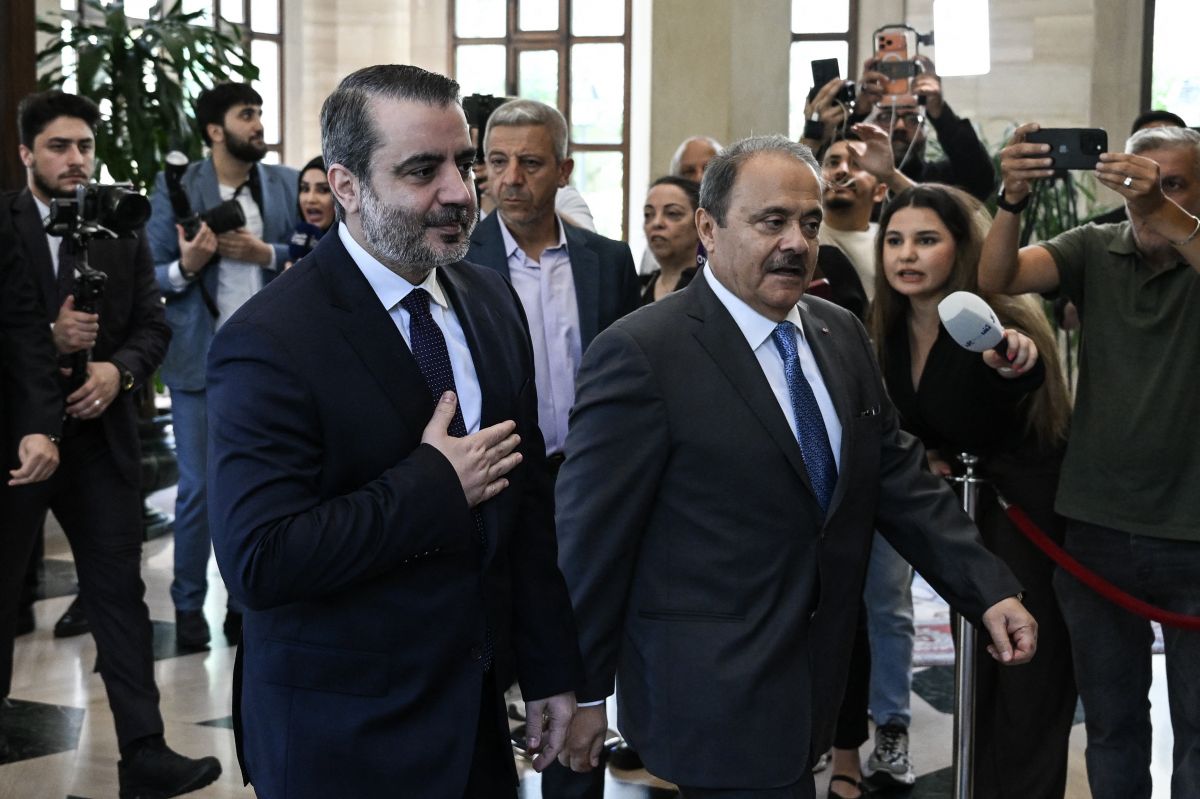
Syrian Foreign Minister Asaad al-Shaibani (L) arrives for a meeting with Lebanon's parliament speaker (unseen) at the speaker's residence in Beirut on July 2, 2026. (Credit: Joseph Eid/AFP)






BEIRUT — Visiting Beirut on Thursday, Syrian Foreign Minister Assaad al-Shaibani began a series of meetings with Lebanese leaders and ruled out any meeting with Hezbollah during the visit.
He also delivered an official invitation from Syrian President Ahmad al-Sharaa for President Joseph Aoun to visit Damascus.
Shaibani met Aoun at the Baabda Presidential Palace at around 9 a.m. According to the Lebanese presidency, Aoun said Lebanon was "committed to establishing brotherly relations between the two countries based on cooperation, coordination and non-interference in each other's internal affairs."
"We are as committed to Syria's stability as Syria is to Lebanon's stability. I am satisfied with the coordination between the two countries, particularly in border control and the fight against the smuggling of people, weapons and anything that threatens the security of both countries," Aoun added.
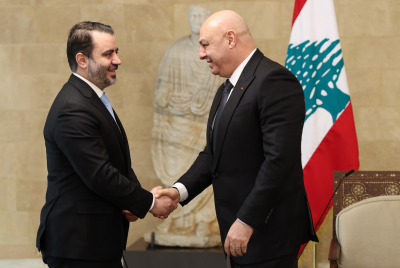
Aoun invited to visit Damascus
"The president, Ahmad al-Sharaa, has repeatedly assured me during our meetings and conversations that Syria's role will no longer be what it was in the past, that a new chapter has opened between our two countries, and that Syria will no longer stand with one Lebanese faction against another, but with all the Lebanese," Aoun said.
Aoun also welcomed the creation of a joint high commission between Lebanon and Syria to safeguard the interests of both countries.
For his part, Shaibani conveyed an official invitation from Sharaa for Aoun to visit Damascus, stressing that his visit to Beirut aims to strengthen bilateral ties and deepen coordination, particularly in the economic sphere, according to the presidency.
Creation of a Lebanese-Syrian joint commission
The Syrian foreign minister then met Parliament Speaker Nabih Berri and Prime Minister Nawaf Salam.
“We have signed an agreement to establish a Lebanese-Syrian joint commission aimed at strengthening cooperation between the two countries,” Salam announced, according to the Grand Serail. “We agreed to establish relations based on common interests. The purpose of the meeting is to cooperate in several areas, first and foremost electricity interconnection between Lebanon and Syria, as well as transport, trade exchanges, facilitation of movement at the borders, and the development of relations.”
For his part, Shaibani said his visit to Lebanon reflects Syria’s position of support for Lebanon, its government, and its people. “We signed the agreement to establish the High Commission for Cooperation and Partnership with Lebanon. This framework will serve as a platform for all ministries to develop partnerships, security understandings, and all areas of cooperation,” he added.
On the political level, he said Syria rejects Israeli attacks on Lebanon as well as the forced displacement affecting the Lebanese people. “The question of the framework agreement is an internal Lebanese matter. We hope a calm dialogue will take place on it and we support any political effort that serves Lebanon’s interest and stability,” he said.
Speaking from Ain al-Tineh after meeting with Berri, Shaibani said, "No meeting with Hezbollah is scheduled today, but if the interests of both countries require it in the future, we are open to it."
He added that his discussions with Berri focused solely on strengthening relations between Lebanon and Syria, stressing that Hezbollah was not discussed.
Shaibani then met with Grand Mufti Abdellatif Derian. According to Dar al-Fatwa, the Syrian minister conveyed to the mufti greetings from Syrian President Ahmad al-Sharaa and expressed the latter's affection for Lebanon and its people. Derian, in turn, praised "the efforts and initiatives of Syrian President Ahmad al-Sharaa, as well as his commitment to Lebanon's sovereignty, unity, Arab identity and the extension of state authority across the entire Lebanese territory."
Following his meeting with Shaibani, former Progressive Socialist Party leader Walid Joumblatt said, "The old regime belongs to the past and we must open a new page of political and strategic relations." "Between a balanced and objective relationship with Syria and an agreement that could be worse than the May 17, 1983, agreement, I prefer a balanced relationship with Syria."
Shaibani also met in Saifi with Kataeb leader Samy Gemayel, with whom he discussed "opening a new page" in relations between Syria and Lebanon. Gemayel said the meeting "has a lot of symbolism." "Our party, which offered thousands of martyrs against the Assad regime, welcomes today the representative of the new Syria, in the hope of creating a different stage in relations between the two countries."
The Syrian minister, who also visited Bkirki and where he met Maronite Patriarch Bechara Rai said that "The Christian presence in Syria and Lebanon has played a decisive role in the stability of both countries, and its historical legacy dates back several centuries."
Samir Geagea, Lebanese Forces leader, said after the meeting with Shaibani in Meerab that he was "glad the Syrian people have rid themselves of the ordeal of the former regime. Lebanon and Syria are neighboring countries, whether we like it or not, and we must respect that in order to promote the interests of both peoples."
"Had we implemented the May 17 Agreement [the 1983 accord between Lebanon and Israel], how many wars could Lebanon have avoided over the past 45 years?" the Lebanese Forces leader asked.
Lebanese Foreign Minister Joe Rajji, for his part, said Shaibani's visit "marks the beginning of a new era in Lebanese-Syrian relations, founded on equality and mutual respect, full recognition of each state's sovereignty, and joint action guided by the shared interests of both peoples."
"Shaibani reaffirmed Syria's full respect for Lebanon's sovereignty and independence, as well as its commitment to the principle of non-interference in its internal affairs. He emphasized the shared commitment to developing bilateral relations and strengthening cooperation across a range of areas, particularly in the economic and development sectors, as well as coordinating border control and combating smuggling. Lebanon is pursuing the establishment of a balanced relationship with the new Syria, based on full sovereignty, mutual respect and good neighborly relations, in a way that serves the interests of both peoples and contributes to security and stability in the region," Rajji added.
According to information obtained by L'Orient Today, the visit is intended to advance Lebanese-Syrian relations, support stability in both countries and promote broader Arab regional integration. It also aims to reassure Lebanese officials that Damascus has no intention of intervening militarily in Lebanon, amid concerns fueled by U.S. President Donald Trump's calls for Syria to do so.
On Thursday evening, Shaibani visited Dar al-Fatwa in Tripoli, where he met the city’s mufti, Mohammad Imam, in the presence of the mufti of Akkar and MPs from the region. Upon his arrival in the major city of northern Lebanon, he was welcomed by dozens of people gathered in the streets chanting “Allahu Akbar” (God is greatest), our correspondent Michel Hallak reported.
The talks are also expected to focus on strengthening security coordination along the Lebanese-Syrian border, enhancing efforts to combat smuggling, safeguarding the security of both countries, and eliminating any destabilizing elements operating along the frontier.

 8 p.m. recap: Israel again threatens Beirut’s south suburbs; 2 ships hit near Hormuz; Riyadh football matches canceled