






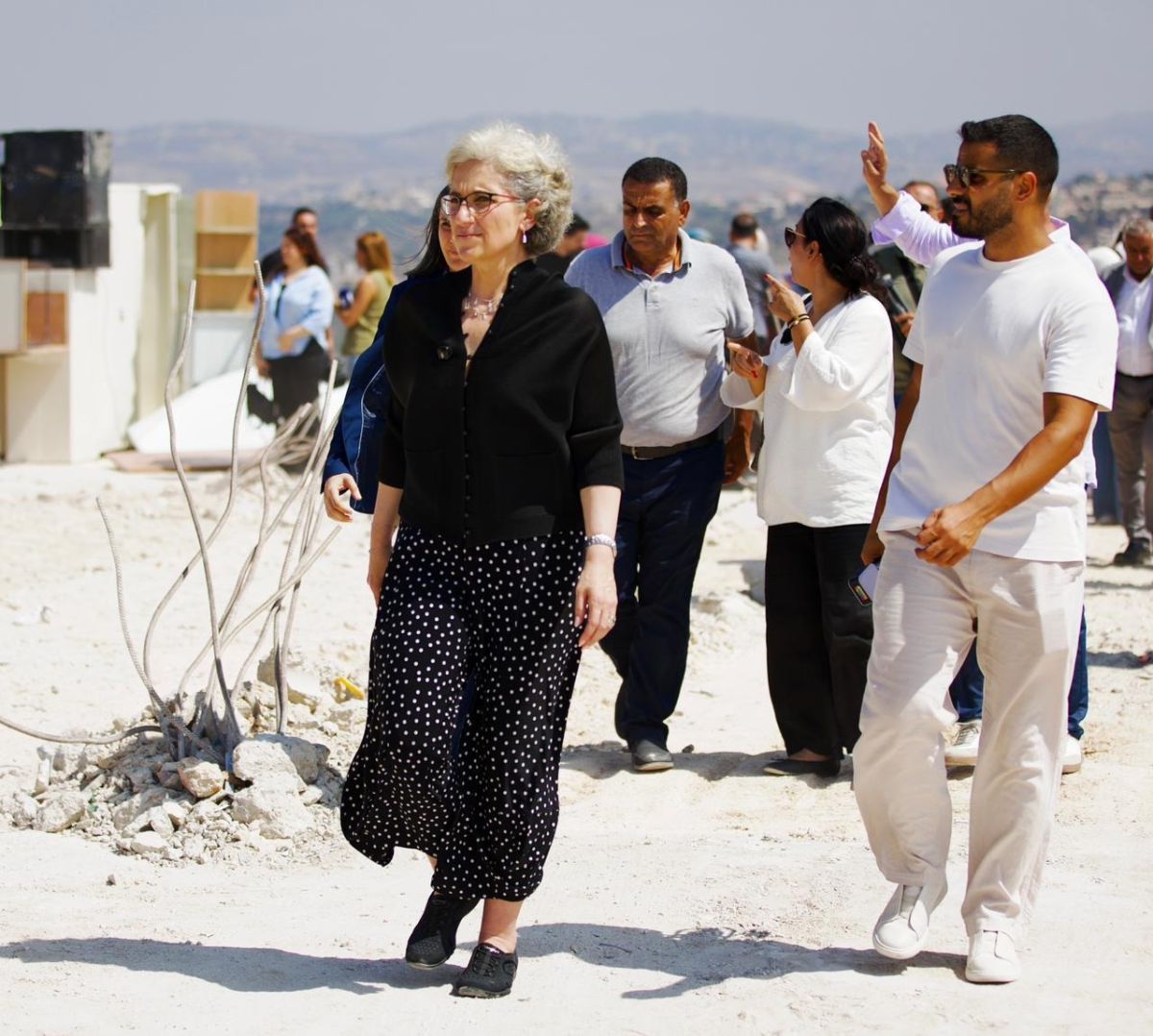
Minister of Education, Rima Karameh, on a tour of several schools in south Lebanon, ahead of the start of the 2026-2027 school year, on Sept. 2, 2026. (Credit: Matthieu Karam / L'Orient-Le Jour)






SOUTH LEBANON — Despite the scale of the challenge, Education Minister Rima Karameh sought to send a message of hope during a major tour of several schools in southern Lebanon on Wednesday: no student should be left without access to school for the 2026 academic year. For the minister, the priority is to maintain "in-person classes, wherever possible," while acknowledging that some schools will have to begin the year with remote learning.
“We must take into account the particular situation of each school in order to adapt our response, whether it’s full-time in-person classes, a partial presence, or remote learning,” Karameh told our reporter on the ground, Emmanuel Haddad.
“Continuing to invest in our children’s education is a response to Israel’s scorched earth policy,” she stressed, as Israeli attacks continue across this vast area of more than 600 square kilometers under occupation. Hundreds of thousands of people remain displaced in Lebanon. For residents unable to return to their region, the minister assured them that a “solution will be proposed.”
Prefabricated classrooms in Burj Qalaway, displaced people still in schools
The education minister, who was appointed by Prime Minister Nawaf Salam who has faced criticism during her recent visits to the South, told L’Orient-Le Jour that her commitment “also includes the Bint Jbeil region,” which lies largely within the vast area occupied and devastated by Israel.
She visited Froun and Burj Qalaway, two villages in the area. Following a meeting with the governor (mohafez) of southern Lebanon, Mansour Daou, the minister also visited two schools in Nabatieh before touring schools in the Sour district, in Srifa and the city of Sour. Froun and Srifa are two non-occupied villages that were among the three “pilot zones” announced by Washington.

Another issue raised during the minister’s visit was the presence of displaced people sheltering in schools. In Froun, for example, the school was rehabilitated with funding from the NRC, and the displaced people currently housed there will need to make way for students in the coming weeks.
“No one will be removed from a school without an alternative being offered,” Karameh promised during her tour.

The principal of the Srifa school, Naifa Fakiha, while emphasizing the importance of providing shelter to displaced people at her institution, also stressed that “education is a form of resistance in the face of Israeli destruction.” The school, rehabilitated by the Council for the South, opened registration on Wednesday, while the displaced people who had been sheltering there were relocated to a private school in the town.
The visit was welcomed by local officials. “Your visit gives us the feeling that we are not abandoned,” said the Burj Qalaway mayor.
In place of the village’s demolished school, 17 prefabricated classrooms will be installed in cooperation with the Council for the South to accommodate students for the new academic year. The minister encouraged students to return to their regions and schools, saying she was working to “provide prefabricated classrooms to guarantee continuity of education.”
Many principals from schools in villages still threatened by Israeli strikes also came to meet with the minister, expressing concern about the future of their institutions if enrollment declines. “All schools will remain open,” she assured them, suggesting that students from schools in high-risk areas could temporarily attend classes in nearby school buildings located in safer areas.
UNICEF, the United Nations Children’s Fund, warned two months ago that at least 100,000 Lebanese students could be unable to attend school next term if urgent action was not taken to rehabilitate schools damaged by the war before September.