






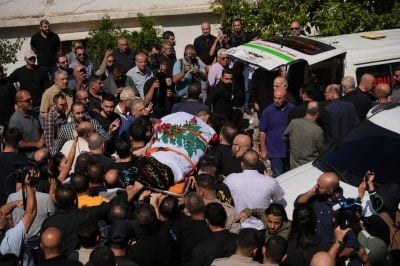
The funeral procession during the funeral of Reuters journalist Issam Abdallah, on Oct. 14, 2023, in Khiam. (Credit: Mohammad Yassine/L'Orient-Le Jour)






BEIRUT — The Committee to Protect Journalists (CPJ) on Tuesday called on the international community to pressure Israel to identify and punish the soldiers responsible for an attack on journalists in Lebanon three years ago.
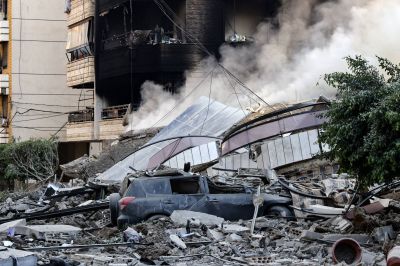
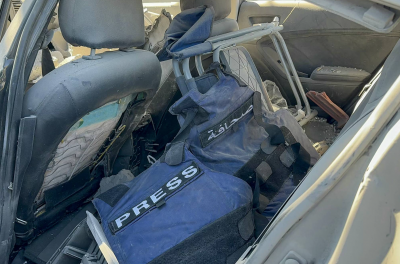
On Oct. 13, 2023, a double strike on a group of journalists in Alma al-Shaab killed Reuters videographer Issam Abdallah and wounded six other reporters, including two from Agence France-Presse (AFP), Dylan Collins and Christina Assi, the latter of which was left with an amputated leg.
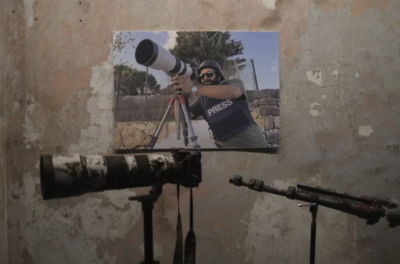
An independent investigation by AFP concluded that the incident involved two 120 mm Israeli tank shells fired from the Jordeikh area in northern Israel, near the southern Lebanese border. These findings were corroborated by other international investigations, including those by Reuters, CPJ, Human Rights Watch, Amnesty International, and Reporters Without Borders.
"Given Israel’s clear failure to account for its actions, we are calling on the international community to pressure Israeli authorities to conduct an investigation that identifies the units and individuals responsible for these deliberate attacks on journalists," said Sara Qudah, CPJ’s regional director for the Middle East. Failing to punish those responsible would perpetuate a form of "impunity," which "endangers other journalists," she continued in a statement, urging the European Union (EU) to consider sanctions. The suspension of the EU-Israel association agreement, which governs economic and political relations, "is one of the few remaining options that could apply meaningful pressure to break this cycle of impunity," said Qudah.
Questioned by AFP, the Israeli army said the attack on journalists was under "thorough review," but gave no details on how long the auto-investigation would take, three years after the facts. "The Israeli army does not target journalists. It does everything possible to minimize harm to uninvolved civilians while maintaining the safety of its troops," it insisted. The army "regrets any harm caused to journalists, respects press freedom and its essential role, and does not target journalists because of their profession," the army added.
'We need to know who did this to us'
The strike on the group of journalists in October 2023 has been widely condemned and has prompted repeated calls for accountability, so far without success.
Last June, Israel’s ambassador to France, Joshua Zarka, acknowledged that the Israeli army had made a "mistake" in striking the reporters, marking the first public admission by an Israeli official. The reporters "were not targeted because they were journalists," but because "the soldiers on the ground thought they were terrorists," Zarka said in an episode of the program "Complément d’enquête" on France Télévisions.
Asked by CPJ, Christina Assi also emphasized the importance of holding those responsible to account. "We need to know who did this to us," she said.
The Israeli attack on the journalists occurred just days after the Oct. 7, 2023, Hamas attacks on Israel and the opening of Hezbollah's "support front" for Gaza on Oct. 8, 2023. Since then, Israel has waged a genocidal war on Gaza, killing over 73,000 Palestinians, including over 21,000 children, and has waged two full-blown wars on Lebanon, killing over 9,000 people.
Since June 2026, Hezbollah has ceased to claim attacks under an agreement brokered between the U.S. and Iran, but Israel continues to occupy more than 600 square kilometers of Lebanese territory and to conduct daily attacks against southern Lebanon, including air and drone strikes, artillery fire, and home and infrastructure demolitions.
 1 p.m. recap: Hezbollah offers extensive aid package for the displaced; ICRC warns of 'disaster' in Middle East; explosive device found in the Bekaa