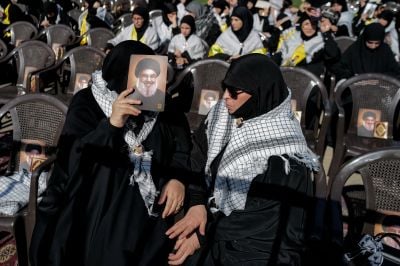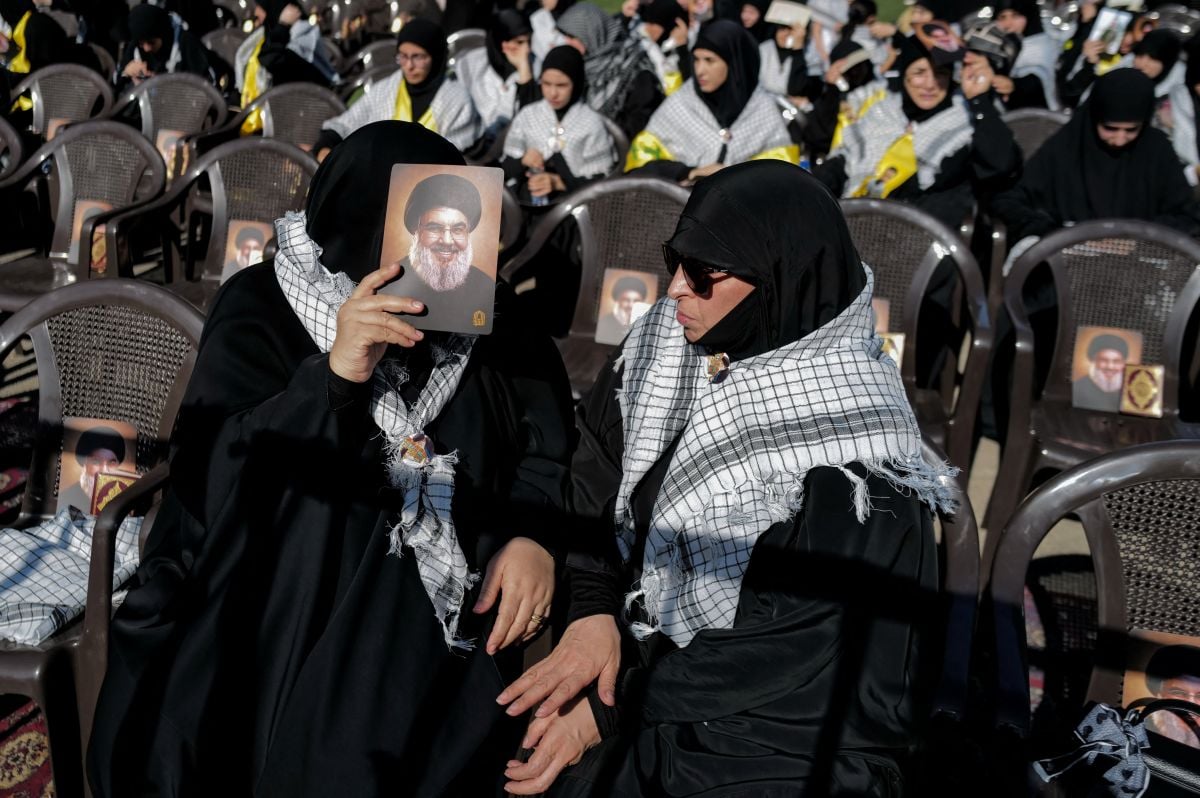
Hezbollah supporters hold a portrait of the party's slain leader, Hassan Nasrallah, during a commemoration of his assassination, in the southern suburbs of Beirut, Sept. 27, 2026. (Credit: Zohra Bensemra/Reuters)







Hezbollah has announced a new housing assistance program for displaced families and those whose homes were destroyed or rendered uninhabitable by Israeli bombardments. The plan provides aid of up to $14,000 in Beirut and its southern suburbs, and $12,000 in other regions, according to the party's executive council president, Sheikh Ali Daamouch. This announcement came a week after Reuters reported that Hezbollah had received $200 million from Iran to help the displaced. Sheikh Daamouch did not specify the total amount allocated for the new program. The funds will be distributed to beneficiaries over one year.
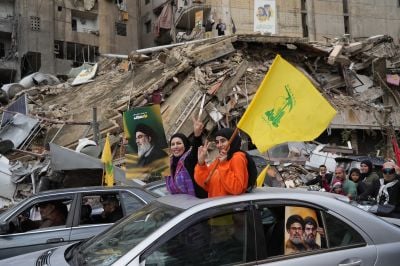
The program targets those affected by Israel's two successive wars, including residents of the occupied border villages, even if their homes have remained intact. Housing assistance is reserved for families deprived of their primary residence and with no alternative shelter. Hezbollah officials assured that payments will be made regardless of political or sectarian affiliation.
Why it matters
If these payments are actually made, they will mark another significant round of financial support by the party to its supporters since the start of the two devastating wars waged by Israel, after 2024 aid promises were only partially delivered before being suspended. The party lost much of its funding after cash flows from Iran were disrupted with the fall of the Assad regime in December 2024, which led to the closure of overland routes via Syria and the suspension of flights between Tehran and Beirut since February 2025. The main target of the aid is Hezbollah's popular base, which has borne the brunt of Israel's aggression; the regions where the party has a majority — southern Lebanon, the Bekaa, and Beirut’s southern suburbs — were the hardest hit by the Israeli offensive. Since 2023, Israel has killed more than 9,000 people in Lebanon, and Lebanese authorities estimate that reconstruction could cost about $27 billion.
Meanwhile, Washington disputes the possibility of $200 million being transferred from Iran to Hezbollah and accuses the group of trying to hide its financial woes. The United States is pressuring Beirut to move quickly on disarming Hezbollah, a U.S. state prerequisite for any reconstruction aid.

International Committee of the Red Cross (ICRC) President Mirjana Spoljaric called for urgent efforts to “de-escalate” the war in the Middle East, warning that intensified hostilities would be “disastrous” for tens of millions of people. “Civilians are paying an unacceptable price as a result of military operations in the Middle East,” she said in a statement. She especially lamented “the scale of the loss of human life” in Yemen, and the deaths, injuries and destruction in Saudi Arabia, as fighting has flared again between Riyadh and Yemeni Houthi rebels in recent weeks.
Elsewhere, Haaretz reported that Israel is attempting, through the United States, to obtain Saudi Arabia’s consent to join the military campaign against the Houthis. Israeli Prime Minister Benjamin Netanyahu initiated this request, which has so far been rejected by Saudi Crown Prince Mohammed bin Salman (MBS), the kingdom’s de facto ruler. The daily said Netanyahu wants to strengthen ties with Riyadh and “pave the way for a future normalization agreement” between the two countries. Saudi Arabia, for its part, has, so far unsuccessfully, sought U.S. backing for its strikes against the Yemeni rebels. Pro-Iranian fighters have warned Washington against any intervention.

- Three years since Issam Abdallah's death: The Committee to Protect Journalists (CPJ) has urged the international community to pressure Israel to identify and punish the soldiers responsible for an attack on journalists in Lebanon three years ago. On Oct. 13, 2023, a double strike on a group of journalists in Alma al-Shaab killed Reuters videographer Issam Abdallah and wounded six other reporters. Several independent investigations concluded that the two 120 mm tank shells were fired from the Jordeikh area in northern Israel, near the Lebanese border.
- Explosive device in the Bekaa: The Lebanese Army announced it had neutralized overnight an "old explosive device" that was camouflaged and ready for detonation in the Kfar Zabad area in the Zahle district. According to our correspondent in the Bekaa, the device was a box with an electrical wire protruding, discovered by security forces between Kfar Zabad and Ain Kfar Zabad, near the Lebanese–Syrian border.
- New anti-drone system for Israel: Israel Aerospace Industries (IAI) has unveiled HawkGuard, a new protection system against attack drones. The announcement followed multiple similar ones in recent months, as Hezbollah has inflicted significant damage on Israeli forces with its explosive drones. Since Saturday, the Israeli army has twice triggered alerts due to suspected aerial intrusions on its northern border, while attacks continue in southern Lebanon.
- Growth forecasts lowered: The International Monetary Fund (IMF) has sharply revised down its growth forecasts for the Middle East and Central Asia in 2026, with Gulf economies bearing the brunt of regional conflict. In its latest report, the institution now predicts a 0.3% contraction in the region in 2026, after projecting 1.9% growth just six months ago. This revision reflects “a longer-than-expected closure of the Strait of Hormuz,” the IMF said, adding it expects a strong rebound in 2027 as the crucial shipping route for the region’s oil and gas exporters progressively reopens.