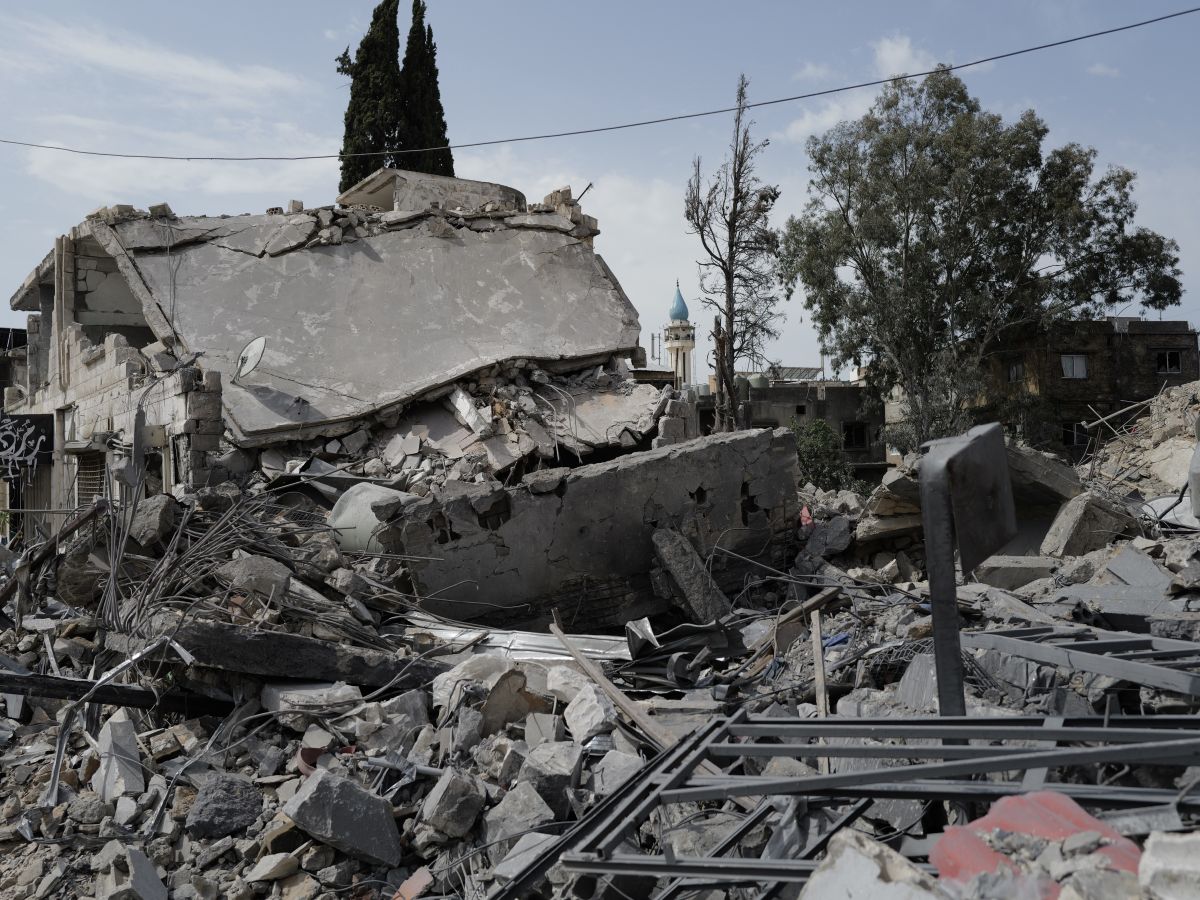
A building destroyed by Israel in Nabatieh, southern Lebanon, on April 17, 2026. (Credit: by Matthieu Karam/L'Orient Today)






SOUTH LEBANON — Israel escalated attacks on southern Lebanon on Wednesday. The Israeli army carried out no fewer than eight airstrikes — which have become less frequent since a theoretical cease-fire took effect in mid-June — as well as around a dozen demolition operations in villages it occupies, several of them highly intense, our correspondent in south Lebanon reported.
Israeli forces also killed a Hezbollah fighter, Mohammad Dayekh, in a drone strike on Nabatieh Fawqa. Hezbollah confirmed in the afternoon that he was one of its members. Originally from Jwayya, in the Sour district, he was killed in a strike that also wounded another person whose identity was not disclosed.
'Retaliation' for alleged Hezbollah attack and false alarm
For weeks now, violence has been concentrated in the Nabatieh area, where the Israeli army is reportedly preparing an offensive on the Ali Taher hills which overlooks the city. The Israeli army had also carried out several powerful strikes in the area at dawn.
In a rare development, it also bombed a small building at dawn in Arab Salim, a village in the Iqlim al-Tuffah area, in the northern part of the Nabatieh district. Israel has repeatedly targeted the area which lies outside the occupied “buffer zone.” No casualties were reported. It was the second bombardment targeting the village in less than a week.
According to the Israeli army, the strikes on “terrorist infrastructure in the Nabatieh area” were carried out in response to “the launch by Hezbollah overnight of two attack drones” targeting its troops in the Ali Taher ridge area. The drones reportedly caused no casualties, and Hezbollah has not claimed responsibility for any attacks.
This is the third time since Aug. 15 that the Israeli army has accused Hezbollah of launching drones toward its forces in Ali Taher. Each time, it has responded with bombardments outside the “buffer zone.” On Aug. 15, Israeli strikes on Deir Zahrani and Ansar killed 11 people. On Aug. 27, bombardments on Arab Salim killed a young woman.
It is worth noting that the Israeli army had initially said in a separate message, also in the morning, that it had launched interceptors over northern Israel after a drone had “likely crossed the Lebanese border,” before clarifying that it was a false alarm. A spokesperson said that “several interceptor missiles were launched toward a dummy target.”
Series of demolitions and strikes on Mansouri
The Israeli army continued its attacks throughout Wednesday across the southern Lebanon districts, carrying out at least 13 demolition operations. It also set fire to homes in Arnoun, in the Nabatieh district.
Israeli strikes heavily targeted Ali Taher and the surrounding area. At dawn, it carried out successive strikes using high-explosive missiles, the detonations of which were heard throughout the area, and fired artillery and white-phosphorus shells. The nearby Dabsheh hill and Zawtar Sharqieh were also bombarded by fighter jets, while artillery fire targeted Zawtar Sharqieh, Mayfadoun and Nabatieh Fawqa.
Beyond the Nabatieh area, Mansouri, in the Sour district, also remained under constant Israeli attack, with several airstrikes, artillery fire and a large demolition operation reported in the village since Tuesday evening. Houses were being demolished by bulldozers on Wednesday. A late-afternoon strike in an area not far from the coast was witnessed by beachgoers, according to a video.

In the Bint Jbeil district, Israeli military vehicle movements were observed in Beit Yahoun on Wednesday morning, alongside automatic weapons fire toward the village. A demolition operation took place in Haddatha, while automatic weapons fire from the village targeted neighboring Aita al-Jabal.
In the Marjayoun district, the Israeli army set fire to homes in Tallouseh, while artillery fire targeted Qantara. In the same area, the Israeli army also carried out several movements in Mais al-Jabal, to the north and west of the village, our south Lebanon correspondent reports.
Additional reporting by our correspondent in south Lebanon, Muntasser Abdallah.