


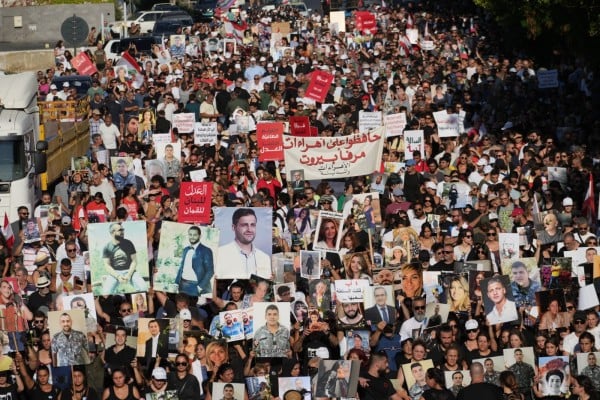
Thank you for following our live coverage of this third commemoration of the Beirut blast, marked by a march from the Karantina fire station to the port.
Check L'Orient Today's homepage for our full coverage of the commemoration, with profiles of survivors, an explainer on the causes of the suspension of Tarek Bitar's investigation into the blast, and an in-depth investigation into a series of assassinations connected to the Aug. 4, 2020 tragedy.
(Credit: Mohamad Yassin / L'Orient Today)
"There was a lot more sadness in this march than last year," says Monika Borgmann, a German-Lebanese filmmaker and the widow of activist Lokman Slim, who was assassinated in southern Lebanon in February 2021. "It's been three years, and nothing is moving. It's unbelievable," she continues. "Tarek Bitar is blocked. Our only hope is the international investigation. And for Lokman, if I don't find justice here, I'll seek it elsewhere."
Twenty days before being found shot dead in his car, Slim had described the Beirut blast of a "war crime," for which he blamed Russia, Syria and Hezbollah.
The speeches are over. Some demonstrators begin to leave the scene, others hand portraits of the victims to their relatives.
The voice of Fairouz singing "Li Beirut" (For Beirut) resounds in front of the port.
"What do I feel? Anger, disgust. As I've felt for the last three years," Alexandra Najjar's grandfather tells L'Orient-Le Jour at the end of the commemoration. Asked about the limited number of demonstrators, he replies: "I don't want to attack other Lebanese. But I'm not happy about it. I think people are in denial, they talk a lot, but when it comes to action, there's nobody left."
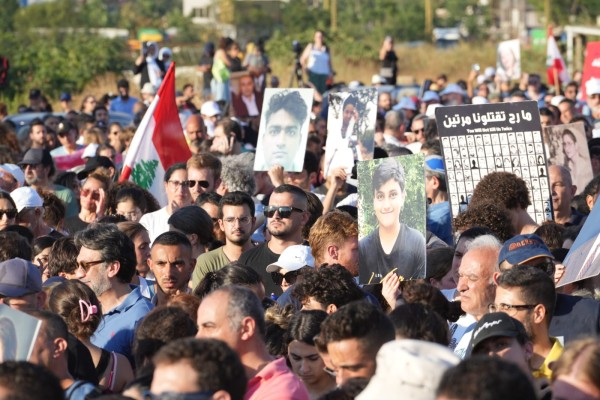
William Noun tells the crowd, "Hezbollah, along with judges, and security apparatuses in the country that are obstructing the investigation are all terrorists and accomplices in the crime that happened at the port."
"Everyone should be under the law, even terrorists should be under the law, and abide by the law. We are here to tell those in power you are hypocrites, and low lives," he shouts.
"We have two simple questions: who brought the ammonium nitrate and who blew it up," he continues. "We ask the European Union, the United States, and the international community to stand beside Lebanon and help us serve the victims justice. You have satellites that can show what happened," he insists.
"To Ali Hassan Khalil , Yousef Fenianos, and Ghassan Zeaiter, I tell you to look how people here are standing and cursing you in the middle of Beirut. The innocent go to court when they are called in for an investigation, and the guilty avoid going," Noun adds, addressing the former ministers who have been charged by the port probe's investigating judge, Tarek Bitar.
(Credit: Mohamad Yassin / L'Orient Today)
The collective of people who have disabilities as a result of the Aug. 4 explosion tells the crowd that they continue to call for the international community to stand by Lebanon and assist with the investigation to reach "the truth and know who the criminal that blew up the capital is."
Paul Najjar, father of Alexandra Najjar, the youngest Lebanese victim of the blast, tells the gathered demonstraters: "Our hearts are sad, they are forcing us to demand justice from abroad."
He continues, "They killed us in our homes three years ago; they are still killing us in our homes, and they are betting on us getting tired."
"We will continue demanding justice for our victims, we refuse to emigrate, if we don't have justice for the port explosion, we will never have justice for any crime that takes place in Lebanon. We don't want to stand one day and tell our children that we were robbed, we were starved, and we were oppressed, and we stood idly without doing anything," Najjar says.
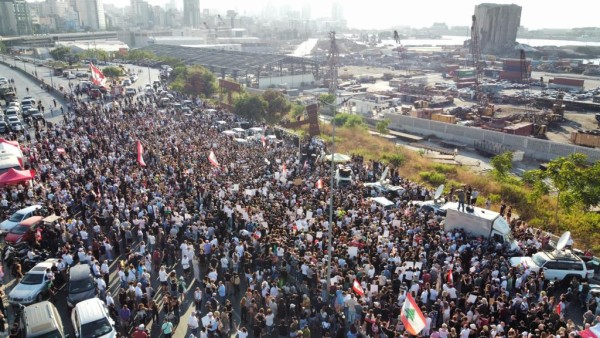
Hundreds gather at Beirut port, while members of families of the victims make speeches asking for justice.
(Credit: Mohamad Yassin/L'Orient Today)
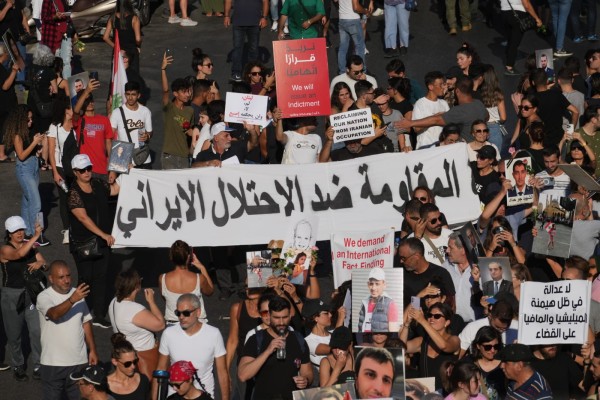
"Terrorist, Hezbollah is a terrorist [organization]!" some protesters chant. William Noun immediately reacts. He takes the stage and says, "Please, out of respect for the victims, let us continue the commemoration program and read out the names of the individuals charged."
(Credit: Mohamad Yassin / L'Orient Today)
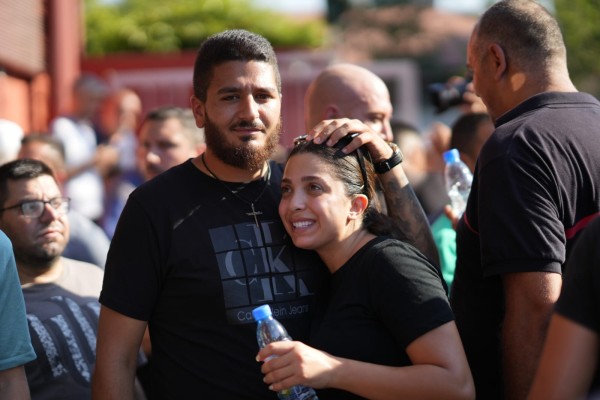
Protesters toss roses at the stage, as Maria Fares, sister of Sahar Fares, a firefighter killed in the explosion, begins crying while William Noun, who also lost his brother in the blast, tries to comfort her.
(Credit: Mohamad Yassin / L'Orient Today)
A brief fight breaks out among several individuals in the crowd after some people call on the politicians present at the scene, including MP Ghassan Hasbani from the Lebanese Forces and Cesar Abi Khalil from the Free Patriotic Movement, to leave.
William Noun says that the commemoration is "for the victims, not for making political statements."
The army quickly defuses the situation.
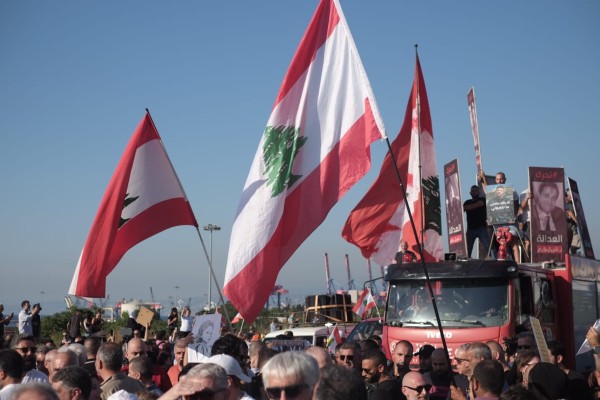
Protesters have arrived in front of the port and are holding a minute of silence in respect for the people killed by the blast. In the background, church bells and mosques' calls to prayer resound together.
At the demonstration, a man reads aloud the names of the victims.
(Credit: Joao Sousa / L'Orient Today)
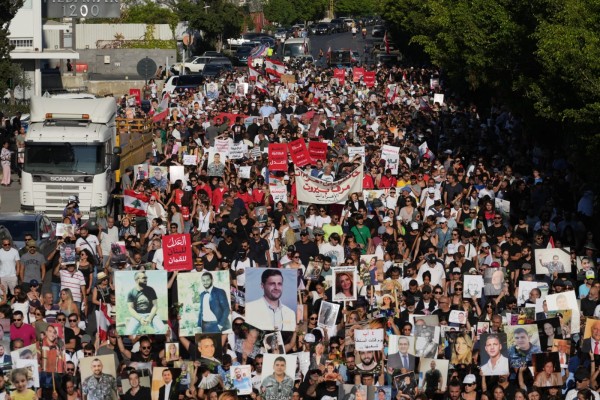
Hundreds of protesters head towards the Beirut port from the Karantina fire station.
(Credit: Mohamad Yassin/L'Orient Today)
"It's supposed to be a national cause!" exclaims Raissa, who has been living in London for six years. "We are not enough considering the catastrophe we have experienced," she adds. "What happened has affected all of us, directly or indirectly … People should have been motivated [to come to the protest]."
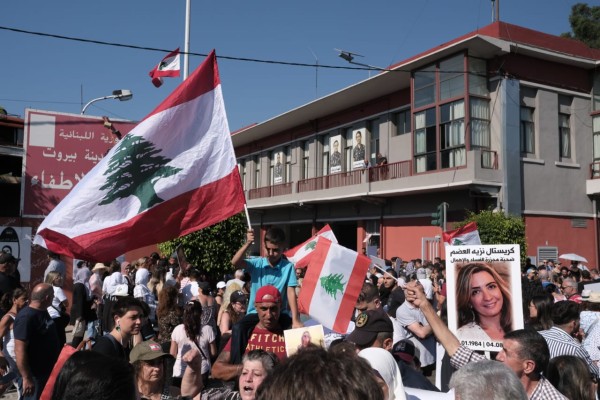
"We must come here for the families, to pay tribute to the victims, even if we are not as numerous as we would like," says a 22-year-old Lebanese woman, who has been living in Paris for four years but is presently in Lebanon on vacation. "I am shocked that some people do not want to come. Afterwards, they shouldn't complain if nothing changes," she adds.
(Credit: Joao Sousa / L'Orient Today)
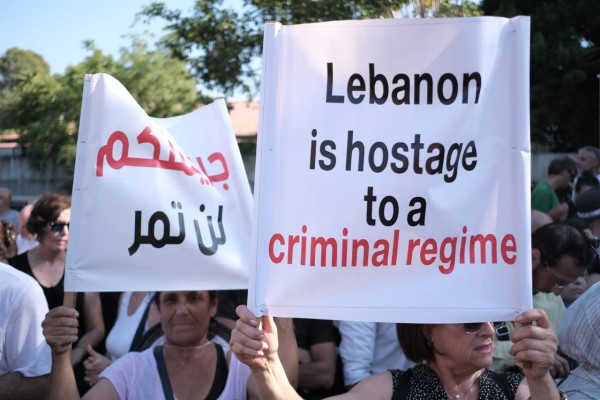
Protesters hold up signs stating "Your crime will not pass by [without justice being served] and "Lebanon is hostage to a criminal regime" at the Karantina fire station.
(Credit: Joao Sousa/L'Orient Today)
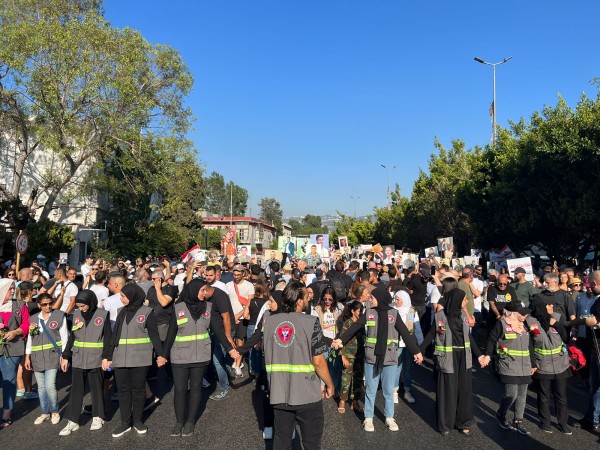
Protesters have begun marching from the Karantina fire station towards the Beirut port. They're walking behind a firetruck and an ambulance, all sirens blasting.
A marching band accompanies the protesters.
(Credit: Matthieu Karam / L'Orient-Le Jour)
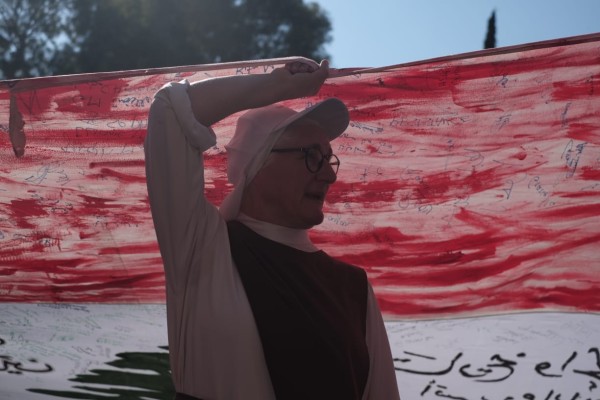
A nun helps protesters raise the Lebanese flag.
(Credit: Joao Sousa/L'Orient Today)
The US Department of State announces in a statement that "the lack of progress towards accountability is unacceptable and underscores the need for judicial reform and greater respect for the rule of law in Lebanon."
The US Department of State adds that "the US continues to stand with the people of Lebanon. The victims and their families deserve justice and accountability for those responsible for the disaster and the underlying causes."
(Credit: Mohamad Yassin / L'Orient Today)
Read one young man's journey through ridiculous resilience, three years after the blast.
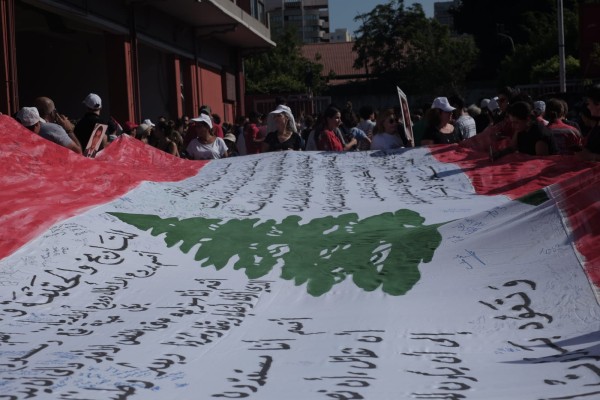
Patrick and Ali Nour Eddin tell L'Orient Today that they have been "regular protesters since the Oct. 17 protests" of 2019. However, they say they don't think there will be any justice for the Beirut port blast. "We're marching because of what we felt that day. Whether we were there or not," they say.
(Credit: Joao Sousa / L'Orient Today)
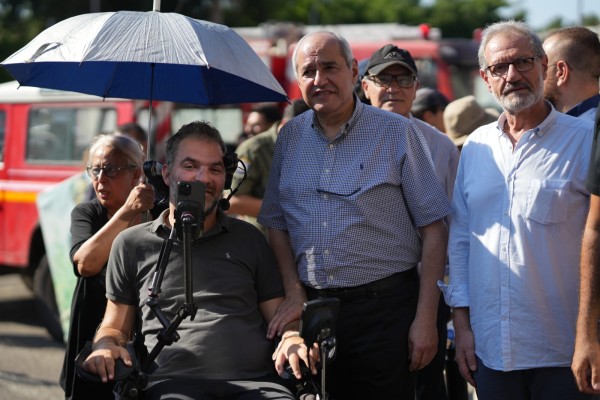
Several MPs are at the fire station, along with the protesters, most notably Chouf MP Marwan Hamadeh, Forces of Change MP Mehlhem Khalaf, Zgharta MP Michel Moawad, Kataeb MP Nadim Gemayel and independent MP Fouad Makhzoumi.
(Photo: Forces of Change MP Melhem Khalaf (right) along with Offre Joie NGO president Marc Torbey (left). Credit: Mohammed Yassin/L'Orient Today)
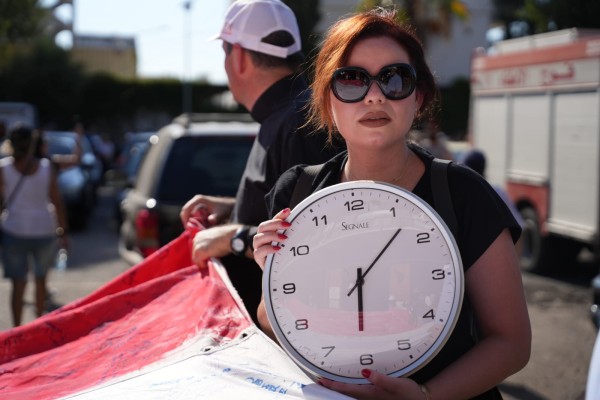
A protester at the Karantina fire station holds a clock showing 6.07 p.m., the exact time at which the 2020 explosion occurred.
(Credit: Mohamad Yassin/L'Orient Today)
How can the judge in charge of the investigation issue an indictment when his hands are tied? Read here.
Anne Merheb, a teacher who lives in Louaizeh, tells L'Orient Today that attending the protest is a way "to support the victims and demand justice."
"It's true, there are a few people, people are tired of fighting and seeing that nothing is happening, many have left. There is certainly despair, and we are still angry three years later," Merheb explains.
In this new explainer video, we shed light on the major mysteries of this tragedy, three years after the blast. Watch here:
Elie Andoun, brother of Joe Andoun, who was killed in the port explosion, tells L'Orient Today that they are demanding "justice here [in Lebanon] and internationally."
"I hope there will be more people [at the protest] and that they will stay close to us. We need to see more people. We hope for a significant presence," he says.
"There are people who stay close to us [in spirit], but I think due to the high cost of living, they don't come [to the protest]. Maybe it's intentional. If the people were aware, maybe they would stand with us. While there are people with disabilities, destroyed homes. It could have been anyone," he adds.
"But there are also politically motivated people who unfortunately don't join us," he concludes.
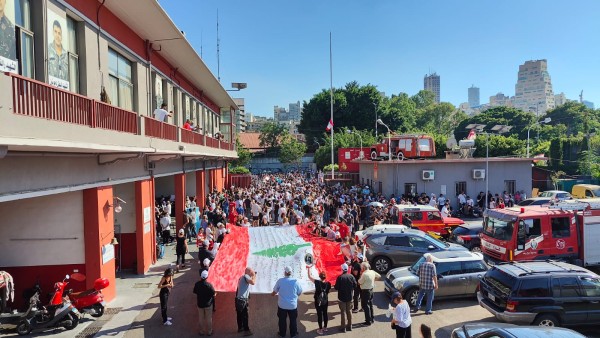
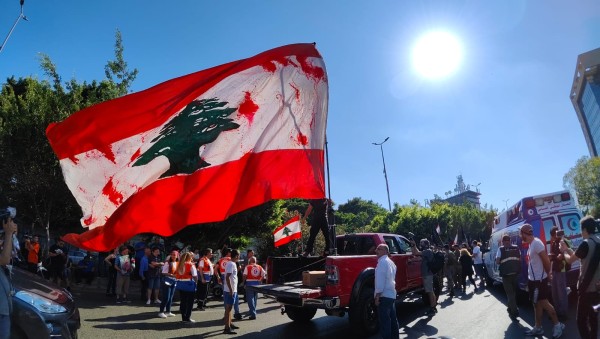
Hundreds of protesters have gathered at the Karantina fire station and more continue to arrive. Many of the demonstrators arrive carrying Lebanese flags, photos of the victims, or flowers. Music is being played, calling for justice for the victims and reaffirming that "Beirut will not die."
Protesters are chanting "justice for the victims," and "hang the guilty."
(Credit: Mohamad Yassin / L'Orient Today)
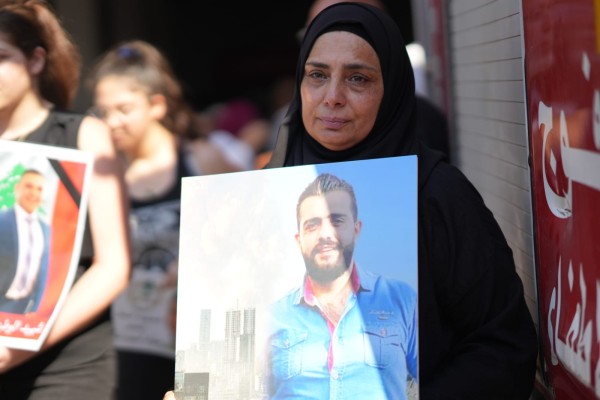
The mother of one of the victims of the explosion carries his photo at the Karantina fire station.
(Credit: Mohammed Yassin/L'Orient Today)
Despite financial burdens and a dire economic climate, Raif Lteif reopened Paul Gemmayzeh just 30 days after the blast, giving hope to the community. Read his story.
Immediately after the blast many Lebanese began rebuilding their businesses and destroyed streets. Read the story of one Lebanese restaurant owner here.
Rita Bdeir, 35, from Nabatieh is at the demonstration with her young daughter, who was sitting in a stroller with a Lebanese flag wrapped around her head.
“Today we came not to commemorate the memory but to say that three years later, with no justice, it means that we are still in danger of another explosion. It's been the same feeling for the past three years, the same fear. We are in danger. We, along with those who are accused, still have no justice," Bdeir says.
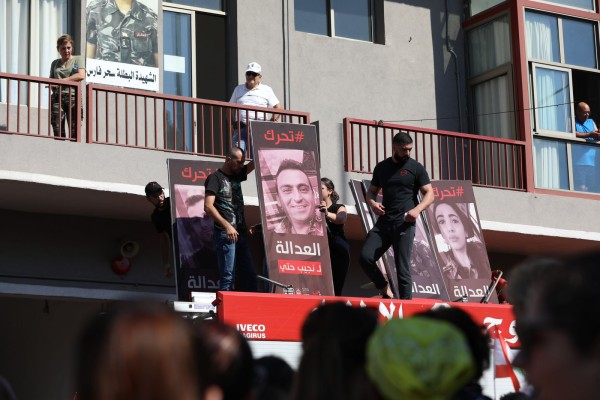
Posters of two members of the Beirut Fire Brigade are held up at the Karantina station on Aug. 4, 2023.
(Credit: Mohammed Yassin/L'Orient Today)
Salwa el Arab, who is 40 and lives in Beirut, is at today's protest because "we still have the same fear that we had at that moment." However, she adds, "People have stopped protesting due to our lives becoming too expensive. People are tired."
A 55-year-old dentist, Dr. Wissam Fouani, has joined the demonstration from the south. She tells L'Orient Today that "the feeling remains the same because we still don't have the truth. The martyrs who have left us did so because of this oppressive authority that [has also] stopped the investigation [into the blast]. The silence surrounding this crime and the prohibition of the inquiry demonstrate the criminality of this authority against the people. They should all be in prison."
"We cannot stay at home after all the consequences of this crime," Fouani adds.
Aline Salloum survived the blast. Along with her family, she decided to remain in Lebanon and rebuild. Read her story.
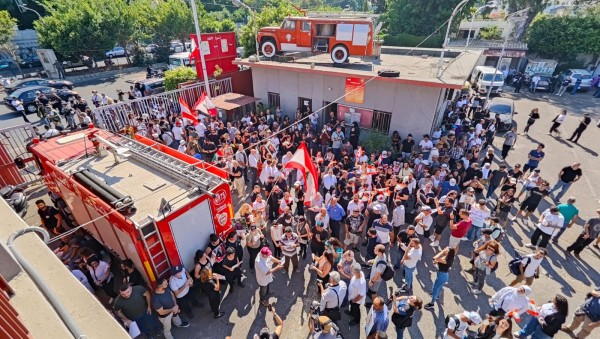
At the Karantina fire station, portraits of the port blast victims have been mounted on the walls, and others are being held up by people pouring into the station.
Peter bou Saab, whose brother was killed in the explosion says, "We hope that people will come, we have worked hard for this day, and we are here."
He stops, almost relieved. A crowd of people has just arrived.
"Yes, the case is on hold, but we will continue," he comments. "Even if they continue to pursue legal action against us, this barbarism [of the state] does not scare us; we will continue until the end."
(Photo credit: Mohammed Yassin/L'Orient Today)
Several judicial sources have told L’Orient Today in July that Judge Bitar plans to continue his investigation into the Beirut port explosion at all costs.
To this day, it is still unclear who imported the ammonium nitrate, which exploded on Aug. 4, 2020, to the port, and why. Read our investigation below as we tangle through the facts and lies to try and assemble the puzzle.
The Lebanese investigation into to the Beirut port explosion has been frozen since February due to interference by politicians and judges. Under the investigation, Judge Tarek Bitar prosecuted several high-ranking Lebanese officials but these individuals refused to appear in court.
The blast that ravaged Beirut on Aug. 4, 2020, killed over 220 people, wounded more than 6,500 and destroyed swaths of the capital.
Good afternoon, thanks for joining this Live Blog on the protests organized for the third annual commemoration of the Beirut blast.
Already have an account? Login here
You have reached your article limit
Add L'Orient Today to your syllabus.
Subscribe for $0.5/month for 3 months.
This article is only available to L’Orient Today subscribers.
Already have an account? Login here
