





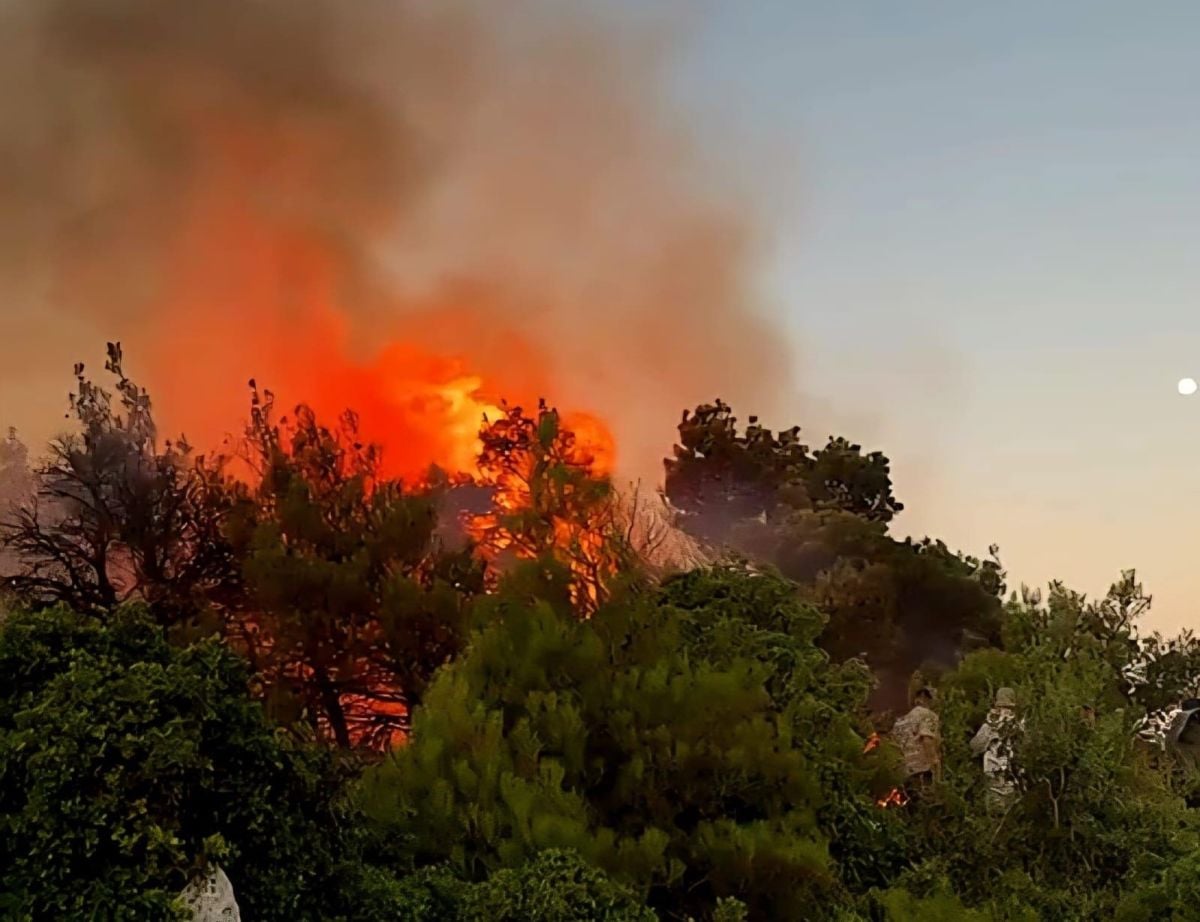
A forest in flames near the village of Akroum in Akkar, on July 31, 2026. (Credit: Photo shared by our correspondent Michel Hallak)






BEIRUT — The summer heat wave that has gripped Lebanon since the beginning of the week, mainly affecting the highlands and the Bekaa Valley, is significantly increasing the risk of wildfires spreading in wooded areas, according to Meteo Lebanon and Civil Defense, contacted by L’Orient-Le Jour.
Several countries in the Mediterranean basin and Europe — including France, Spain, Turkey, Italy and Greece — have recently been or are currently being ravaged by wildfires. Two firefighters died Thursday on the island of Crete while attempting to contain a blaze threatening seaside resorts and villages.
"In Lebanon, the risk of a fire starting spontaneously due to the heat remains low. However, the likelihood that a human-caused fire could escalate into a major wildfire rises considerably under the current weather conditions, with temperatures exceeding already-high seasonal norms by several degrees, particularly in the Bekaa," explained Jocelyne Abu Fares, head of the Meteo Lebanon division.
A spokesperson for Civil Defense’s communications office confirmed this assessment, noting that the heat, which dries out vegetation, combined with winds sweeping through some regions, creates particularly favorable conditions for fires to spread. He said firefighters had to respond to more than 140 fires on Tuesday alone.
“These were fires in wooded areas, largely caused by human activity, which we were able to contain before they spread,” the office said, assuring that Civil Defense remains fully mobilized to prevent uncontrollable blazes.
40 degrees in the Bekaa
The spokesperson added that the fire alert covered a vast zone including Akkar, Mount Lebanon, south Lebanon and western Bekaa.
According to statistics provided by the spokesperson, 2,097 wildfires and fires outside buildings have already been recorded in 2026, compared with 3,412 in 2025 — a year already marked by particularly low rainfall. “The majority of these incidents occur between June and November,” he noted.
In 2024, the number reached 6,412, an exceptionally high level. In 2023, 4,276 fires were recorded.
These statistics include fires detected in south Lebanon, including in areas occupied by Israel, where Civil Defense was unable to intervene, according to the spokesperson.
The vast majority of these fires are human-caused, whether intentional — typically involving people illegally clearing land in order to obtain building permits — or the result of negligence, he added.
According to our north Lebanon correspondent, Michel Hallak, army helicopters and Civil Defense teams managed to prevent the spread of a fire that broke out overnight from Thursday to Friday in the forests of Jabal al-Hosn, in the heights of Akroum near the Lebanon-Syria border. The steep mountainous terrain made the area inaccessible to fire trucks.
The current heat wave, mainly fueled by hot air masses coming from the Persian Gulf and Egypt, began on Monday, following an unusual and brief period of rainfall in part of the country. "It was less noticeable from Monday to Wednesday on the coast than in the highlands and the Bekaa, but the situation has since evened out," Abu Fares pointed out.
On the coast, temperatures are hovering between 32 and 34 degrees, from Beirut to Tripoli, remaining relatively close to seasonal averages. In contrast, temperatures have reached, and even exceeded, 40°C in the Bekaa and are expected to do so again by Sunday.
The air is drier in the highlands, while southeast to easterly winds carrying the hot air mass from Egypt are also blowing over the sea, increasing humidity along the coast and foothills, the same source added.
The heat wave is expected to begin subsiding at the start of next week, Abu Fares concluded, while also warning of the risk of heatstroke.

 Evening recap: Netanyahu announces West Bank offensive; 7 killed in Jordan church shooting; tents burned in south Lebanon
 US strike on Iran this weekend? ‘Absolutely,’ says Barrack; ‘I have no idea,’ says Trump