





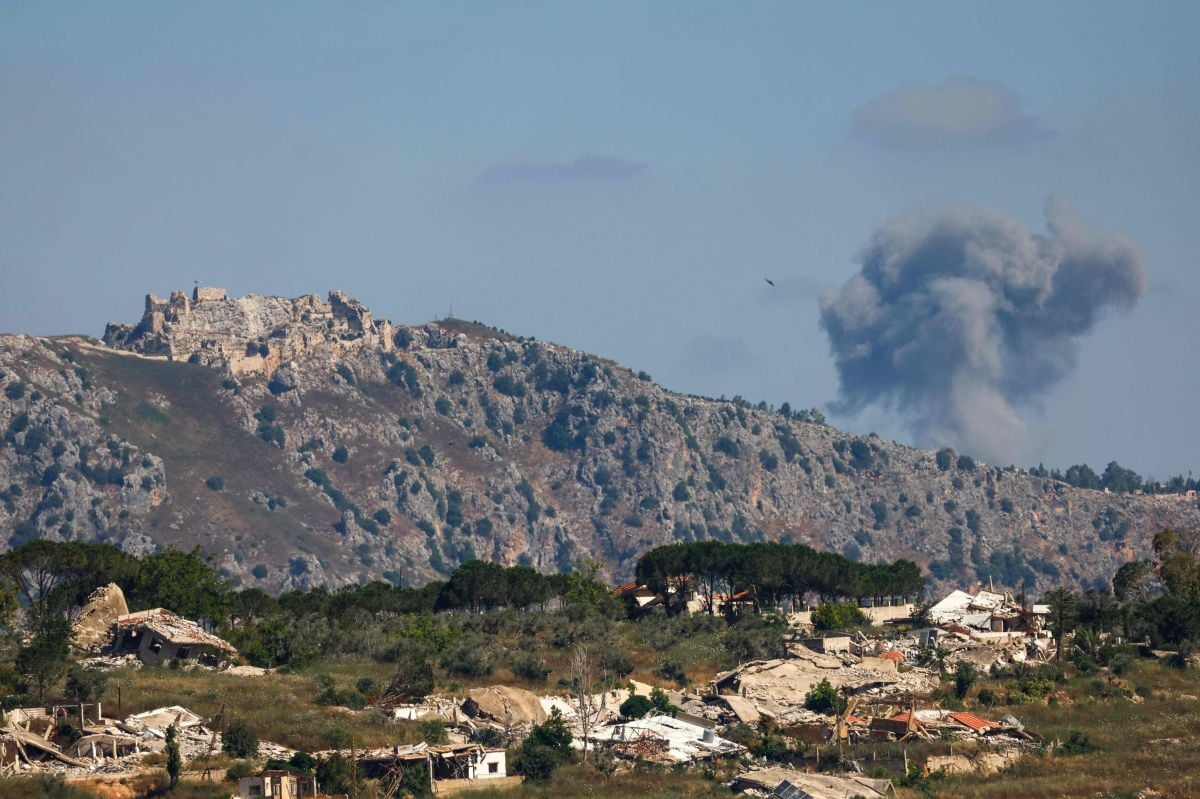
Smoke rises following Israeli bombardment in southern Lebanon close to the Beaufort Castle as seen from a position across the border in the Upper Galilee on June 19, 2026. (Credit: Jalaa Marey/AFP)






Late on Thursday night, almost at midnight, Israel dropped 700 tons of the explosive material TNT on Shaqif hill, also known as Shaqif Arnoun, in the Nabatieh region of southern Lebanon, within the perimeter of Beaufort Castle. It says it blew up a system of underground tunnels allegedly dug by Hezbollah. The explosion sent shockwaves that were felt as far as Saida.
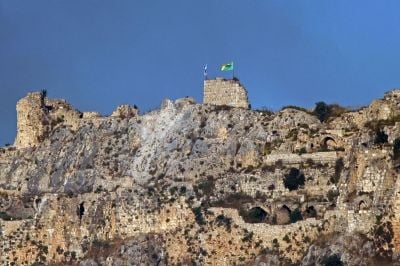
Beaufort castle, dating from the Crusader era and located in the part of southern Lebanon occupied by Israel, was added last week to UNESCO’s list of World Heritage in Danger. The damage appears to have affected the area around the site, but not the castle itself.
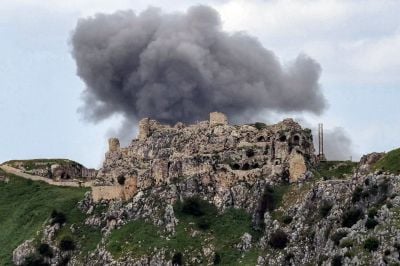
On Friday morning, the geophysics center at the National Center for Scientific Research (CNRS), located in Bhannes, issued a statement explaining that the huge explosion "caused seismic waves whose power can be compared to a 3.8-magnitude tremor on the Richter scale."
Pressure on the Roum fault?
It’s no surprise that explosions of this magnitude cause seismic waves, but, according to seismologist Tony Nemr, a professor at AUB, the danger is much more insidious and the risk extends beyond the event itself. "Shaqif hill, targeted last night, as well as Ali Taher hill, which the Israelis also regularly threaten to blow up, are located at a very sensitive point in southern Lebanon, near one of the country’s major seismic faults, the Roum fault," he told L'Orient-Le Jour.
The risk, according to the expert, is that such a large explosion could have altered the stresses (pressure) on the fault, possibly triggering movement that could result in later seismic activity induced by the event, beyond the tremor felt right after the blast itself. "We see this worldwide: human activities change the stress on faults, creating pressure that can cause artificially triggered seismic activity. Normally, this involves actions like large-scale water pumping or oil and gas extraction. An explosion of this magnitude near a major fault would be even more dangerous as the pressure it puts on the fault is sudden and extremely violent."
The Roum fault has caused major earthquakes in the past, the most recent in 1837 resulting in a 7.1-magnitude quake that killed 4,000 people.
Detecting recurrent microseisms
Asked by L'Orient-Le Jour, Marlene Brax, director of the CNRS Bhannes center, offered a more measured perspective. "It’s true the explosion causes a temporary change in the stress in the ground. The question is whether these increased stresses are large enough to accelerate a rupture of the fault. And to answer that, we’d need to know the current state of stress on the fault in question — in this case, the Roum fault — in other words, whether the fault is close to rupture (and thus to causing an earthquake), and whether an explosion of this size could be the trigger."
For the expert, since it’s not possible to know the current state of the fault, it’s crucial to closely monitor seismic activity at that specific spot in the hours following the explosion. She believes that detecting repeated microseisms in the blast zone would be a telling sign. However, she reported that since the Israeli explosion at midnight, "no microseism nor any activity has been detected on the fault," adding that all risk fades as time passes.
Nemr, for his part, calls for vigilance in the coming days, even though he believes "the most dangerous moment is the one directly after the explosion." He especially warns against another similar military action by Israel in the Ali Taher hill area, also in the Nabatieh region and just as close to the Roum fault.
The issue of artificially induced earthquake risks arises whenever a major explosion shakes the country. The giant double explosion at the Beirut Port on Aug. 4, 2020 (caused by the combustion of hundreds of tons of ammonium nitrate) caused a tremor equivalent to a magnitude of 3.6 on the Richter scale. The powerful bunker-busting bombs used by Israel in 2024 to assassinate Hezbollah leaders in underground sites in Beirut’s southern suburbs also shook distant regions. But, according to Nemr, they didn’t pose the same risk because those sites weren’t in geologically sensitive areas.
Brax asserts that military or industrial explosions, even those involving hundreds of tons of explosives, generally have a local influence incomparable to the tectonic pressures built up over decades or centuries. "On the other hand, repeated explosions of exceptional violence near a fault already on the verge of rupture could accelerate seismic activity," she warns.
Since the resumption of the war between Hezbollah and Israel on March 2, in the wake of the conflict in Iran and the region, the Israeli army, which occupies more than 600 km2 of territory in South Lebanon, has carried out massive destruction and repeated demolitions there.

 Evening recap: Netanyahu announces West Bank offensive; 7 killed in Jordan church shooting; tents burned in south Lebanon
 US strike on Iran this weekend? ‘Absolutely,’ says Barrack; ‘I have no idea,’ says Trump