


Smoke rises near the historic Beaufort Castle following Israeli bombings on the village of Yohmor, in southern Lebanon, as seen from Marjayoun, May 6, 2026. (credit: AFP)






BEIRUT — Israel carried out massive demolitions at the Israeli-occupied Beaufort Castle (Nabatieh) area on Thursday into Friday night, claiming to have destroyed several Hezbollah tunnels. This Crusader-era fortress was added to UNESCO's List of World Heritage in Danger last week. The damage appears to have affected the site's perimeter, but not the fort itself.
On Thursday, the Israeli army's Arabic-speaking spokesperson, Ella Waweya, said that the 36th division had "recently destroyed several key sections of the underground tunnel network in the Beaufort Heights region," where the historic castle, which was seized by the Israeli army in late May, is located. "A large section of the area's tunnel network has been destroyed," she said. "This network served as a central command complex from which combat and firing against Israeli soldiers and civilians were directed," Waweya added, specifying that this was a strategic infrastructure built over two decades, consisting of several levels that served as headquarters for Hezbollah's "Badr unit" and was allegedly financed and planned by the Iranian regime.
700 tons of explosives
Waweya also added that "this infrastructure was a threat to residents of northern Israel and its forces, as it is located about six kilometers from the overlook and the 'Galilee Panhandle,' from where dozens of drones, suicide drones and anti-tank missiles are believed to have been launched." According to the statement, Israeli troops have strengthened their control over the Beaufort Heights in recent weeks by taking control of the underground infrastructure.
In a joint statement, Israeli Prime Minister Benjamin Netanyahu and Defense Minister Israel Katz confirmed the destruction of "terrorist tunnels in the Beaufort region, using some 700 tons of explosives." They said these explosions occurred after "Hezbollah's blatant cease-fire violation on Wednesday."
Hezbollah has not claimed any attacks on Israel since June 20. The group opened a new front in the regional war on March 2 after it attacked Israel in support of Iran. Israel responded with a large-scale bombing campaign and ground offensive, as its army continues to occupy sectors of southern Lebanon stretching over more than 600 square kilometers.
A completely disfigured area
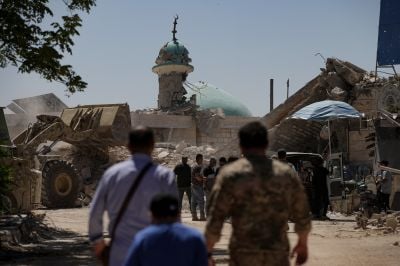
According to our correspondent in southern Lebanon, the Israeli demolitions on Thursday night in the Beaufort area were heard in most southern villages up to Saida and its surroundings. According to residents, the blasts shook homes and caused panic among locals, as thick clouds of smoke rose from the targeted areas.
The Ministry of Culture, through the Directorate General of Antiquities, confirmed that Israeli explosions did "not destroy" the historic Beaufort Castle area, but that the detonations may have caused damage near the fortress, according to the state-run National News Agency (NNA), which reported that the fort did "not appear to have been directly damaged."
The ministry explained that "the shocks caused by the explosions may have caused damage around the castle, but the extent of this damage can only be determined by a direct on-site inspection." It also said that "the area is under occupation, which prevents the presence of specialized technical teams and the necessary inspection." NNA, meanwhile, reported that a "1,200-meter area extending from the southern end of the castle toward Yohmor al-Shaqif has been completely disfigured."
Parliament Speaker Nabih Berri on Friday condemned Israeli explosions in recent days, particularly in the Beaufort area, saying that “the impact of the terrorist explosions caused by 700 tons of explosives, which registered a magnitude of 3.8 on seismographs and were felt by Lebanese from the South to Mount Lebanon and the outskirts of Beirut, should awaken national and human consciences to the crimes committed by Israel’s machine of destruction against people, heritage, culture and infrastructure. Otherwise, humanity itself and its future will be at risk.” “What happened is condemnable. We must neither remain silent, turn a blind eye, nor accept this reality,” he added.
MP Melhem Khalaf also condemned the Israeli demolitions."These repeated attacks constitute a dangerous escalation that undermines stabilization efforts and contradicts the principle of good faith on which the framework agreement" signed between Lebanon and Israel under Washington's patronage is based, he said. "Faced with this reality, any attempt to end the mission of the United Nations Interim Force in Lebanon (UNIFIL) or to weaken its role would create an extremely dangerous vacuum and expose the implementation of the framework agreement and resolution 1701 to the gravest risks," he warned.
Demolitions in several districts
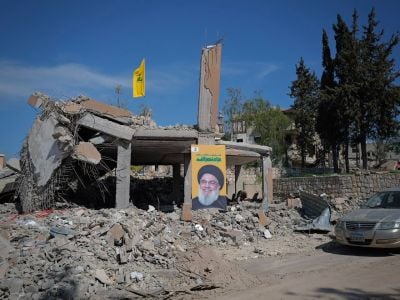
The Israeli army, which had intensified its attacks in southern Lebanon on Thursday, also said that its troops continue operations on the strategic heights of Ali Taher (Nabatieh), while maintaining a high level of readiness, both defensively and offensively. "Any aggression against our forces will receive an appropriate response," it warned.
On Friday, Israeli troops bombed the locality of Tallousa (Marjayoun), our correspondent reported. A Merkava tank positioned in the locality of Markaba also fired several shells toward this village. Israeli drones also dropped stun grenades on Mansouri (Sour) three times. In addition, Israeli military vehicles were seen moving on the road linking Deir Siryan to Adsheet al-Qsair (Marjayoun), according to local residents. The Israeli army also set fire to fields in Mais al-Jabal, in the district of Marjayoun.