






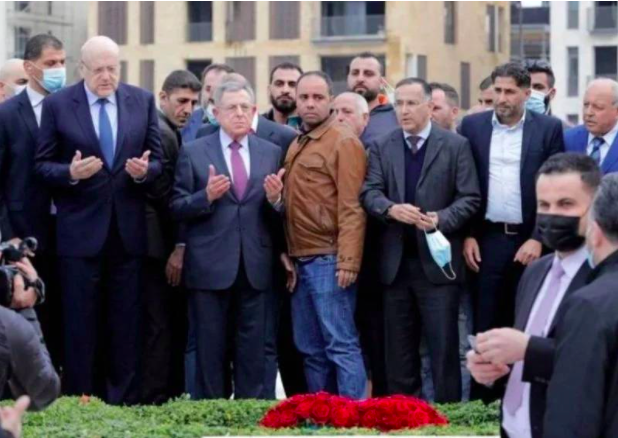
Fouad Siniora (center) accompanied by Prime Minister Najib Mikati, in front of Rafik Hariri's grave in Beirut on Feb. 14. (Credit: Anwar Amro/AFP)






Want to get the Morning Brief by email? Click here to sign up.
The deadline for candidates to declare their intention to run in the May 15 parliamentary election passed at midnight. Interior Minister Bassam Mawlawi, following the filing deadline, said that 1,043 candidates had registered, 77 more than in 2018, the National News Agency reported. Of those, 155 were women, representing less than 15 percent of the candidates. The candidate lists for each district will not be finalized until April 4, however. If a candidate is not included on an electoral list by that date, the candidacy will be disqualified.
Former Prime Minister Fouad Siniora announced yesterday that he will not run in the upcoming May 15 parliamentary elections. Although Siniora had called on all Lebanese people, “especially the Sunnis,” last month not to boycott the elections, he is now the latest in a line of established Sunni political figures to decide not to run, after former Prime Minister Saad Hariri withdrew from political life in January. However, Siniora emphasized that his decision did not amount to a boycott and that he would still be otherwise involved in the elections. Prime Minister Najib Mikati opted out of candidacy on Monday, while MPs Bahia Hariri, Roula Tabsh, Tarek Merhebi, Mohammad Hajjar and Assem Araji have also passed on the opportunity to represent their constituents in Parliament. Less than two months before people head to the polls for what many consider to be one of the most crucial elections the country holds due to the myriad of crises it has been weathering, the Sunni vote is proving to be one of the most unpredictable ones. Yesterday was the last day to officially register candidates for the elections.
Mikati called upon the UN for support in ensuring food security for Lebanon as it faces the financial repercussions of the war in Ukraine on food prices. Lebanon’s socio-economic crisis has gravely impacted the country's food security since late 2019. Food prices soared by 222 percent in the first half of 2021, as the poverty rate increased to 78 percent last year, according to a UN study. Concerns over food security increased in Lebanon following the Russian invasion of Ukraine, as the country imports most of its wheat from the Black Sea region. The prime minister, who announced Monday that he would not run in the upcoming parliamentary elections, also asked the Deputy Secretary-General of the United Nations Amina Mohammed to “help Lebanon meet the multiple challenges resulting from the presence of displaced Syrians in Lebanon.” Some 1.5 million Syrian refugees are now living in Lebanon as a result of the civil war that erupted in their country in 2011. In December, President Michel Aoun called on the UN envoy for Syria to “facilitate the repatriation of Syrian refugees.”
The Electricité du Liban workers’ and employees’ syndicate will continue striking until March 22. The ongoing strike, which came in response to the “indifference” shown by authorities to the syndicate’s demands, went into effect on March 9. The syndicate’s statement squarely blamed the “[energy] minister and the [EDL] management and board of directors” for the consequences of the strike, as a result of “their lack of response to the [syndicate’s] demands.” In addition to a reiterated list of demands, which included “guaranteeing full medical coverage and insurance” for workers and employees, a new list also includes paying salaries in cash in order to avoid “the humiliation workers and employees face at banks’ doors.” Lebanon’s state power provider has operated at a loss for decades and fails to provide the majority of the country with more than a meager two to three hours of electricity each day.
After enduring 11 days without state electricity, Akkar residents protested yesterday in front of EDL. Three hundred villages in the region have been shrouded in darkness as the state electricity provider only provides people with a few hours of electricity a day, due in part to a shortage of liquidity needed to purchase fuel. The demonstrators threatened to escalate and asked Energy Minister Walid Fayad to intervene quickly, adding that commercial and industrial activities are at a standstill and telephone calls are interrupted. Several localities in Akkar additionally suffer the consequences of electrical cable theft, a frequent occurrence due to the country’s economic crisis which has left many seeking any means possible to raise money.
Meanwhile, also in Akkar, environmental activists came to the rescue of three shepherds stuck in the snow with a herd of 200 goats near al-Qatr in Mishmish. Ahead of help’s arrival, around 60 goats had already died due to freezing temperatures and lack of food. The activists, led by Gilbert Moukheiber, head of 33 North, a sustainable and adventure tourism boutique operator, along with a group of shepherds from the town of Mishmish and volunteers from the Akkar Darb Association, made the trek to the shepherds’ location to deliver milk and medicine secured by the Agriculture Department in Akkar in cooperation with the Mada Association. Lebanon is dealing with an unusually harsh end of winter, with inland temperatures dropping to -2 degrees celsius yesterday and snowfall at altitudes above 600 meters, according to the Beirut airport-based meteorology department.
In case you missed it, here’s our must-read story from yesterday: “On the air, Jad Ghosn reaches across political lines, but can he convince voters to put him in Parliament?”
