






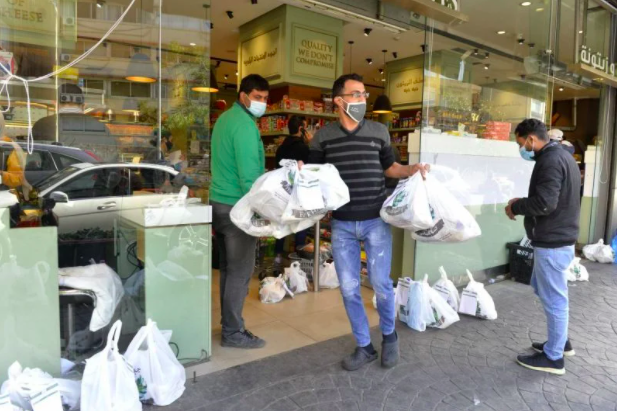
A delivery worker leaves a shop on a run. (Credit: Annahar)






Want to get the Morning Brief by email? Click here to sign up.
Lebanon is on the verge of experiencing a “great food crisis,” warned Nabil Fahed, the president of the union of supermarkets Saturday. With the country already reeling from an unprecedented economic crisis, the consequences of the Russian invasion of Ukraine could prove nothing short of disastrous. A note published by the World Bank vice president for the Middle East and North Africa Region, Farid Belhaj, indicated that Lebanon imports over 90 percent of its grain from Russia and Ukraine, in addition to only having about a month’s worth of grain reserves left. Additionally, to deal with the strict measures imposed by Banque du Liban and the “lack of liquidity in the market,” the union of supermarkets officially enforced a procedure that had been anticipated and denounced on social media in the days prior: from now on, customers will only be permitted to pay up to 50 percent of their bill by credit card. In statements to Lebanese TV channel Al Jadeed, Fahed warned against panic-buying, a trend that recently emerged, due to a perceived fear of oil and bread shortages among consumers.
Free Patriotic Movement head MP Gebran Bassil reiterated his candidacy in the upcoming parliamentary elections yesterday. He simultaneously slammed the cabinet’s decision not to establish megacenters in time for the elections. The FPM had been lobbying for the creation of massive voting centers that would enable members of the electorate to cast ballots without having to return to the town or village in which their vote is registered. However, many believe that the party’s strong support for these centers was merely a cynical tactic to ultimately postpone the elections, as it would have been impossible to get them ready in time for the polls, scheduled for May 15. In a speech, the former foreign minister and energy minister also heavily criticized his party’s political opponents, accusing the March 14 alliance of engaging in a “political assassination” of the FPM. Bassil has now named all FPM candidates bar one.
Six opposition groups and collectives announced a parliamentary alliance for the legislative elections Saturday. Just in time to meet the deadline for the filing of candidacies on March 15, The National Bloc, Minteshreen, Liqaa Tishreen, Taqaddom, the Plenary Assembly of October 17 and Khat Ahmar announced in a meeting that they are joining forces in order to demand “accountability and control.” Claiming to be a continuity of the Oct. 17, 2019, protest movements, opposition groups have recently been gearing up for the upcoming legislative elections, after months of what was seen by many as an inability to form coalitions. A few weeks ago, the National Bloc launched its campaign and presented its candidates while the secular and left-wing collective “Beirut Resists” promised to run candidates via a single list in the constituencies of Beirut I and II. Other regional coalitions, especially in the North and the Bekaa, have also emerged. The May 15 legislative elections are touted by many as an opportunity to create change but fears of a postponement of the polls and rampant clientelism by the ruling class still persist.
Meanwhile, members of Lebanon’s long-established political parties continue to launch their campaigns. Today at 12:30 p.m. Samir Geagea’s Lebanese Forces, which has since the Oct. 17, 2019, uprising sought — with limited success among much of the protest movement — to position itself in the opposition camp, launches its election campaign at its Maarab headquarters. The launch date coincides with the anniversary of March 14, the date the so-called Cedar Revolution erupted in 2005, which spawned the eponymous political alliance of which the LF was a main component. The March 14 alliance formed an integral part of the exact ruling class that the Oct. 17 protest movement seeks to overthrow. Later in the afternoon, at 3 p.m., Parliament Speaker and Amal Movement leader Nabih Berri is also expected to discuss the upcoming elections during a press conference at his Ain Tineh residence.
In case you missed it, here’s our must-read story from this weekend: “Lebanon's invisibility trap”
