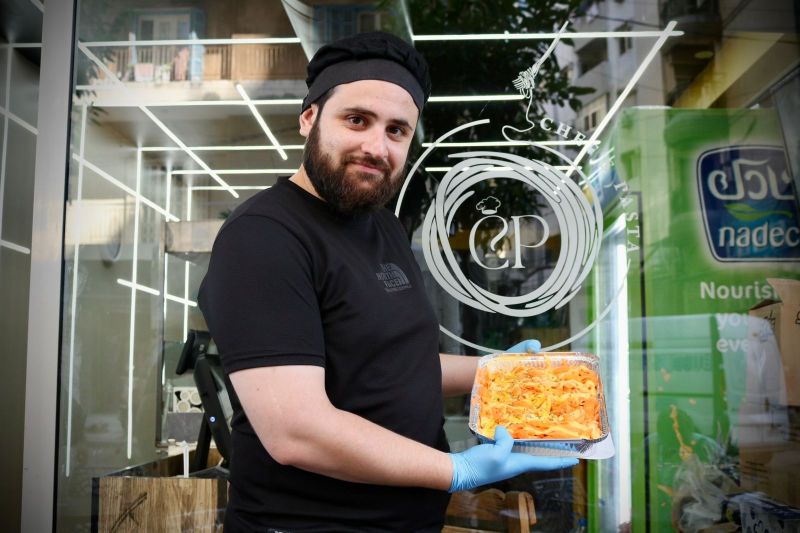
Monzir Habib displaying his pasta, which is achieving great success in Tripoli. (Credit: Rayanne Tawil)



Three years ago, a large crowd patiently waited for 40 minutes for their plate of pasta. Yet, here, in the shade of a century-old tree, there were no signs, no posted menu, just a modest cart and a calm crowd queuing, plastic bowls in hand.
Loyal customers watched with smiles as the same routine unfolded: a man hidden behind steam rising from his dishes, gradually mixing ingredients and sauces in a large steel pot, wiping his hands on a towel tossed over his shoulder, then calling out customers' names one by one.
Today, the cart is gone, but the aromas are the same. They now float out of a small restaurant on Maarad Street, across from the Sainte Famille school in Tripoli, not far from where it all began.
Article not found.
"I started my culinary journey with a simple cart where I sold corn, alone, without any help," explains the man now nicknamed "Chef's Pasta" to L’Orient-Le Jour.
"I was working for a company, but they fired me because of the crisis. I didn't want to stay home unemployed, so I borrowed money and bought this humble cart. I set up under my building in Kobbeh, Tripoli, and started selling corn."
There was no plan for this project or the type of pasta that would follow. In fact, it all started one evening when hunger drove him to get creative.
"I was really craving pasta. Everything nearby was closed. I thought to myself: Why not make it myself? I had a cart where I could boil water. I went to the supermarket, bought pasta and a big pot, and used what I had on hand: corn, cheese, pepper, salt and even barbecue sauce. That was my first attempt at pasta and my first signature sauce, which everyone knows today as 'Crazy Pasta.'"
Organized chaos of corn and pasta
When pasta first appeared on the menu, it was still pretty quiet among the corn. Habib didn't want to scare off his regulars. "I put a box of fresh pasta on the counter. When they saw it, they asked me: What's that? You make pasta? They tried it, liked it and told their friends about it."
Very quickly, some 40 to 50 people were hooked on the chef's pasta and kept coming back for more.
Article not found.
"I accepted the challenge. I had nothing but this cart, so why not make the most of it? I started experimenting with different sauces. My customers would try the new recipes with me and share their feedback. Little by little, I developed the perfect menu for them." One of these dishes, khabisa [chaos], soon became his bestseller.
"I called it khabisa because it reflects the humble cart and really represents the beginning of my adventure. I make it with cream, mushrooms, chicken, mozzarella, cheddar, various spices and our signature sauce with nine ingredients."
The whole thing, as the name suggests, might seem a little chaotic, but in reality, it's rich and addictive. It fits the story of a man who had nothing to lose.
Cooking and social media
"I used to post my new dishes on social media. At first, I didn't get any views. But that didn’t matter. I kept going on Facebook and Instagram. Then a friend told me about TikTok. That’s when people really started to notice me."
In 2019, after the uprising in Lebanon, things changed. Influencers started to shine a spotlight on him. A video showing his magical pasta even reached 15 million views… "From Corn Chef," he says, "I became Chef's Pasta."
But the success wasn't just online. On the ground, people were willing to wait for hours. "Sometimes customers waited between 40 minutes and 3 hours to be served. About 20 percent left, but 80 percent stayed. My question was for how long? I was convinced that at some point, even the 80 percent would leave."
That’s when he decided to take the plunge.
"I opened the restaurant, which bears my nickname, right next to where the cart used to be. The service is obviously better. People can sit down and enjoy their meal instead of standing by the roadside. Instead of waiting three hours, they wait 10 minutes."
A dream
In his new space, Habib expanded the menu, the portions — but not the prices, which deliberately remained low. "I started making big portions up to 2 kilos, family-size. On the cart, I couldn’t do that. It would have taken too long."
"I'm not here to make huge profits," he confides. "My prices are carefully considered. Dishes like this cost more than 900,000 LL in restaurants. My goal is to sell a large quantity and make a little profit in return."
The pasta chef uses exclusively Lebanese products and sets his prices based on customer comments he reads attentively. "When I get a bad review, I apologize and send another dish. When it's a good review, I take it to heart and keep evolving."
There’s a touching sincerity and coherence in his approach. The pasta is generous, and so is the philosophy.
‘We will definitely be back’
Nagham came from Akkar to try the chef's dishes. "I heard about him on TikTok and honestly, I was curious," she says. "The prices are amazing! I got the medium portion of khabisa and only ate a quarter of it; it’s so rich and filling," she says, taking her leftovers to go. "We will definitely be back."
Some people still show up looking for the cart, not knowing the dream has moved a few streets away. "I even had to hire a man whose only job was to sit under the tree and tell people my new address. I kept him there for two months," Habib admits with a laugh.
Even today, as he looks to expand further, invent new sauces, and reach Chekka and Batroun, he hasn’t changed — still available, still far from egotistical. "I love what I do, and I believe you can never please everyone. But I can say I've managed to satisfy 70 percent of my customers. I’m happy about that."
The Chef's Pasta story is something deeply reflective of Tripoli, not just in his humor, but in his ability to build something with his own two hands — quietly, without shortcuts, and against all odds.
This article was translated from L'Orient-Le Jour.