






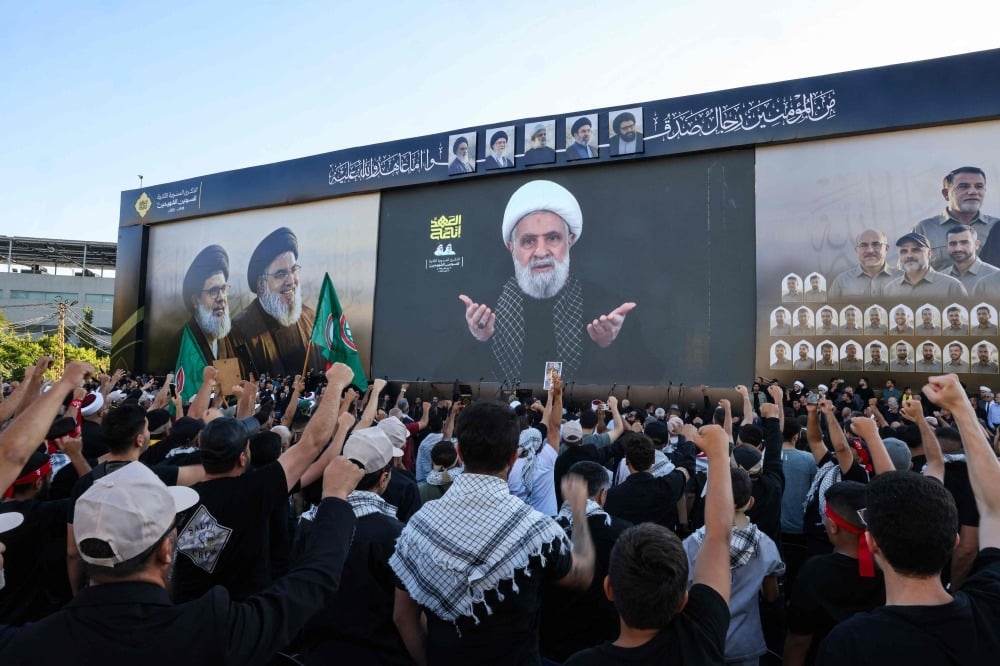
Hezbollah supporters chant slogans while watching a televised speech by Hezbollah leader Naim Qassem to mark the second anniversary of the assassination of former leader Hassan Nasrallah, in the southern suburbs of Beirut, on Sept. 27, 2026. (Credit: Anwar Amro/AFP)






Hezbollah Secretary-General Naim Qassem's speech on Sunday, to mark the assassination of his predecessor Hassan Nasrallah, sparked a series of reactions on Monday, notably from Lebanese Forces leader Samir Geagea, Kataeb Party leader Samy Gemayel and several MPs who identify as "sovereignists."
Throughout his speech, Qassem reaffirmed his refusal to disarm Hezbollah, defending armed resistance against Israel. He also criticized the Lebanese government, particularly President Joseph Aoun, over the authorities' decision to engage in direct negotiations with Israel.
"We have been resisters from the very beginning, but by appropriate means that yield appropriate results, not your way, which produced results that are the opposite of what you claim, since it led to Israeli occupation of the South," Geagea said in a statement. He said that "the blatant role played by Hezbollah in this new occupation explains the international community's silence" regarding Israeli actions in Lebanon.
Israel now occupies over 600 square kilometers in southern Lebanon and has destroyed dozens of villages. Its attacks have also killed over 9,000 people since October 2023, according to the Health Ministry.
Geagea added: "When you say the problem is Israel, not the resistance, you're actually saying you want to keep your weapons, which serve Iranian objectives, not to fight the enemy."
Qassem accused Aoun of "violating the Constitution, the Taif Agreement, the inaugural address and the ministerial declaration." The government, with the support of the president, declared Hezbollah's armed wing illegal as of March 2 and began direct negotiations with Israel under U.S. sponsorship in May. The two sides signed a framework agreement intended to lead to an Israeli withdrawal from the South on June 26. So far, however, Israeli forces have withdrawn from only one of the designated pilot zones.
'Are you serious?'
Following a meeting Monday in Baabda with Aoun, Gemayel said the issue of Hezbollah's weapons "is no longer a subject for debate." He said the matter "was settled by the president's inaugural address" in January 2025 and "by Cabinet decisions" supporting the state monopoly on arms adopted since August 2025.
Addressing Qassem, Gemayel claimed: "Are you serious, Sheikh Naim, when you say the resistance protected Lebanon? There wasn't a single Israeli soldier before the two wars, and it is you who brought Israel to occupy southern Lebanon." Gemayel said he "supports the president and is standing up to a militia that is holding Lebanon hostage for Iran's benefit."
MP Ibrahim Kanaan, an independent and former member of the Free Patriotic Movement's parliamentary bloc, expressed a similar position. On X, he defended the president's decision to engage in direct talks with Israel, describing it as "patriotic, constitutional and responsible."
"This is the only way for Lebanon to regain its stability, its territories, its institutions and its sovereignty," he wrote. He added: "Let anyone with a viable alternative come forward; otherwise, let them rally behind the president and support his choices."
Beirut MP Fouad Makhzoumi also denounced what he described as Hezbollah's seizure of the state's decision-making, accusing the party of placing Lebanon "under Iran's control." In his view, "those who led Lebanon into the wars" cannot "judge the president in the name of the Constitution" or hold the government accountable.
"What have these weapons brought to the people of southern Lebanon? How can victories be measured by the number of destroyed villages and displaced families?" he said.
Tripoli MP Ashraf Rifi, for his part, said that "Lebanon must not serve as a stage for any project; it is not a card in Iran's hands nor the property of any given party, and its national decision-making must remain in Beirut."
"We believe in coexistence, but will never be party to an Iranian project, or any project aimed at subjecting Lebanon to a foreign entity," he added in a statement.
Finally, independent MP Simon Abi Ramia, a former member of the FPM parliamentary bloc, defended the negotiations after meeting with Aoun in Baabda. Without naming Qassem, he said "negotiations are the only way to extend the state's sovereignty" through "an Israeli withdrawal from occupied land, cessation of hostilities and a monopoly on arms in the hands of official institutions."