






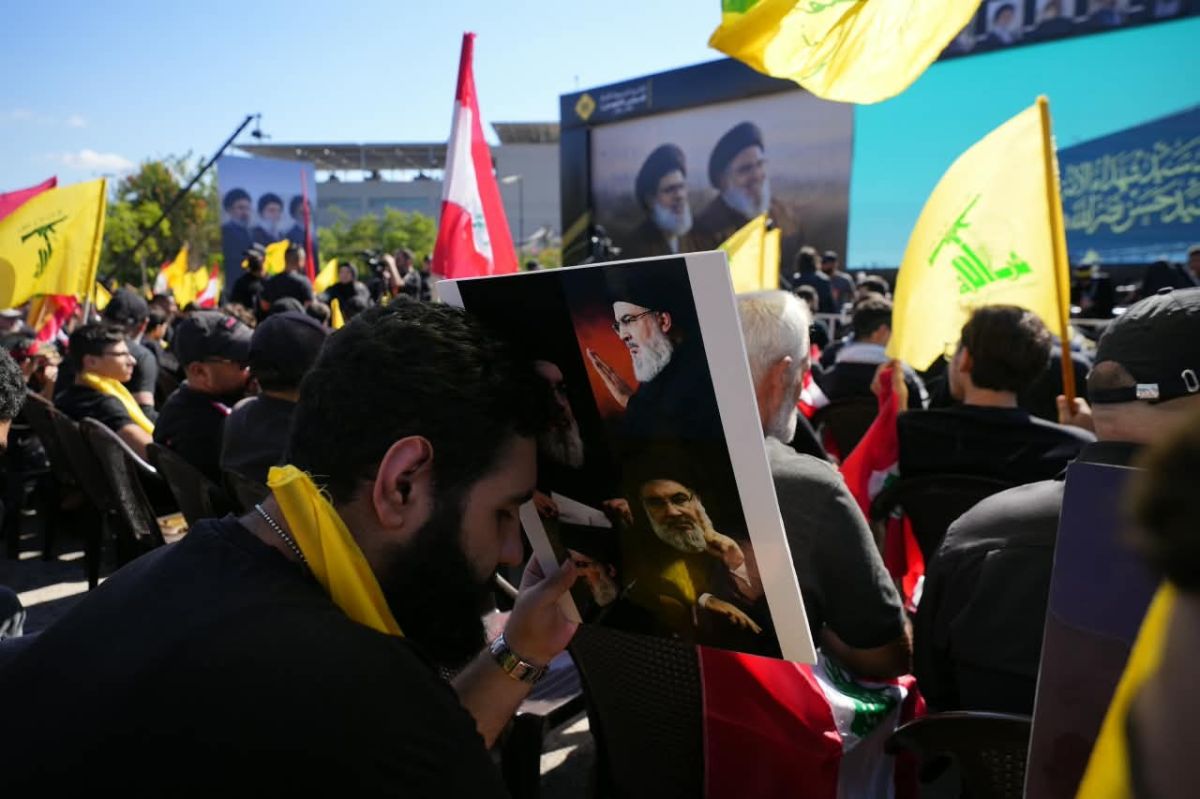
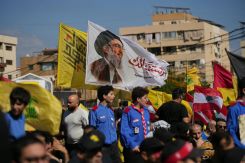
In the crowd, a man holds a portrait of former Hezbollah leader Hassan Nasrallah, killed in Israeli strikes on the southern suburbs of Beirut in Sept. 2024, during the commemoration of his assassination, on Sept. 27, 2026, near the airport road in the suburbs of Beirut. (Credit: Mohammad Yassine/L'Orient-Le Jour)






BEIRUT — On the occasion of the commemoration of the killings of Hassan Nasrallah, former secretary-general of Hezbollah, and his successor, Hashem Safieddine, Hezbollah leader Naim Qassem delivered a fiery televised address Sunday, calling on the Lebanese authorities to “freeze direct negotiations with Israel” and return to indirect talks. He accused the authorities of “contributing to the Israeli project instead of opposing it.”
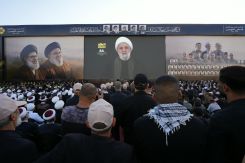
Thousands of supporters gathered to watch the speech at the mausoleum of the former Hezbollah leader near the airport road in Beirut’s southern suburbs. Qassem directly criticized President Joseph Aoun, saying he wanted a head of state who was “an arbiter and a unifying figure, not a party to the conflict,” before condemning a government “without a Foreign Ministry.” He reiterated that his party would continue “on the path of resistance,” with the “liberation” of Lebanese territory as its priority.
'Ready for dialogue, but...'
Turning to negotiations with Israel, Qassem said that the seven rounds of direct talks had produced no results. “What have they achieved? Less than zero, not zero,” he said, before calling for an end to “concessions” and for the negotiation process to be “corrected.”
He then directly addressed the president. “It is true that the president of the Republic has the right to negotiate, but he does not have the right to violate the Constitution, the Taif Agreement, his inaugural address or the ministerial statement,” he said. He also argued that Aoun could not “give up Lebanon, its people and its army’s right to defend the national territory.”
“We want the president to be an arbiter and a unifying figure, not a party to the conflict,” Qassem said. While saying he was “ready for dialogue,” he nevertheless asked: “How can we engage in dialogue with someone who has declared that the resistance and its people are outlawed?”
The Hezbollah leader also sharply criticized the framework agreement reached between Lebanon and Israel in June under U.S. auspices. He accused the authorities of having “given up all their leverage at once” and of having “met all the enemy’s demands.” According to Qassem, the reduction in the level of escalation across Lebanon was due to the agreement reached between Iran and the United States in June, rather than to the negotiation process Beirut initiated with Israel.
Weapons and the continuation of the 'resistance'
On the issue of Hezbollah’s weapons, Qassem said the pressure being exerted on Lebanon was aimed at pushing the Lebanese army to accomplish what Israel had, in his view, failed to achieve militarily. He again said he was ready for dialogue over the group’s weapons, “but first start by liberating the South, allow its residents to return, drive out the enemy, and then we will reach an understanding among ourselves,” he said.
In this context, the Hezbollah leader rejected any capitulation to Israel, which he said would mean “the end of Lebanon and coexistence, in favor of Israeli settlements.” “We will not give up an inch of Lebanon’s 10,452 square kilometers,” he added, reiterating his intention to continue the armed struggle: “We support the continuation of resistance against the enemy until it leaves our territory and we achieve the complete liberation of the occupied lands.”
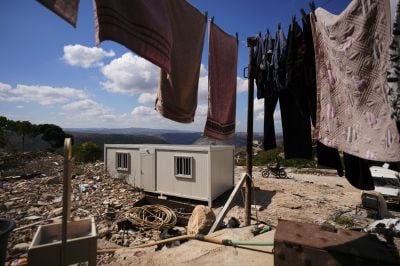
After notably remaining silent about Israel’s destruction of Hezbollah tunnels beneath the Ali Taher ridge more than two weeks ago, the Hezbollah leader said his fighters had held the strategic hill for three months.
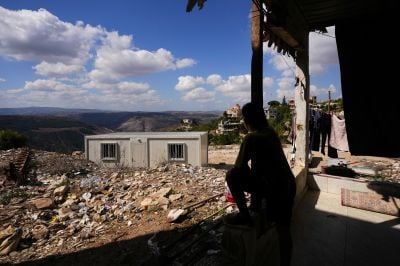
According to Qassem, the party’s method of warfare is based on “harassment operations and withdrawal rather than maintaining permanent positions,” as Israeli attacks continue against villages in the South, dozens of which have been razed, while Israeli troops continue to occupy more than 600 square kilometers.
He also said Hezbollah had prevented Israel from achieving its objectives, including the destruction of Hezbollah, consolidation of the occupation and the establishment of settlements in Lebanon.
Turning to the domestic situation, Qassem lashed out at the government. “Where is the reconstruction? Where is the electricity? We now have a ministry that is switched off, not a Ministry of Energy,” he said.
“We have a government without a Foreign Ministry,” he continued, directly criticizing Joe Rajji, who is close to the Lebanese Forces and supports disarming Hezbollah. He also questioned the fate of depositors’ money.
“If only you put as much effort into talking about depositors’ money as you do attacking the resistance and satisfying the Israeli enemy and the American enemy,” he said.
With the war between Israel and Hezbollah having displaced more than one million people, only 40 % of whom had returned to the South, the Hezbollah leader said his party was “committed to providing housing, repairs and reconstruction” using its own resources and donations, while calling on the state to assume its share of responsibility.
He announced that Hezbollah would “very soon” unveil its contribution to a housing project, despite what he described as “the blockade and restrictions” imposed by the authorities on the arrival of certain donations.
The conflict could cost Lebanon around $20 billion, according to an estimate given in May by Finance Minister Yassine Jaber.
Hassan Nasrallah and Hashem Safieddine were successively killed in massive Israeli strikes on Beirut’s southern suburbs during the war between Hezbollah and Israel, on Sept. 27, 2024, and Oct. 4, 2024, respectively. The conflict severely weakened the group and destroyed part of its arsenal.
After a cease-fire in November 2024, the Lebanese government drew up a plan to disarm Hezbollah. But the group, which refuses to surrender its weapons, once again drew Lebanon into war by launching attacks on Israel in early March in support of Iran. The war has killed more than 4,300 people, according to the Health Ministry, while the Israeli army continues to occupy more than 600 square kilometers in southern Lebanon.
Among the crowd, a banner reading “We miss you” alongside the face of the former Hezbollah leader was displayed, according to photos taken by our photojournalist Mohammad Yassine, who was on site. Some participants waved the party’s yellow flags and the Lebanese flag, while others held portraits of Hassan Nasrallah and Hachem Safieddine.
Before Qassem’s speech, Jaafari Mufti Ahmad Kabalan, who is close to Hezbollah, said that “nothing was more important” to Hassan Nasrallah than strengthening national defense and preventing the sectarianization of security. He added that Nasrallah had repeatedly warned against “foreign tutelage” and “internal fragmentation,” as well as turning Lebanon into a “farm state” subject to political bargaining.
Last year, the commemoration was held on Beirut’s waterfront, sparking a heated controversy. Portraits of the two men were projected onto Pigeon Rock despite a ban issued by Beirut Governor Marwan Abboud, who had authorized the gathering but prohibited any lights at the iconic site.
The incident led to a standoff between Hezbollah and Prime Minister Nawaf Salam. Salam then asked the relevant ministries — Interior, Justice and Defense — to “take appropriate measures” and “detain those responsible.”