






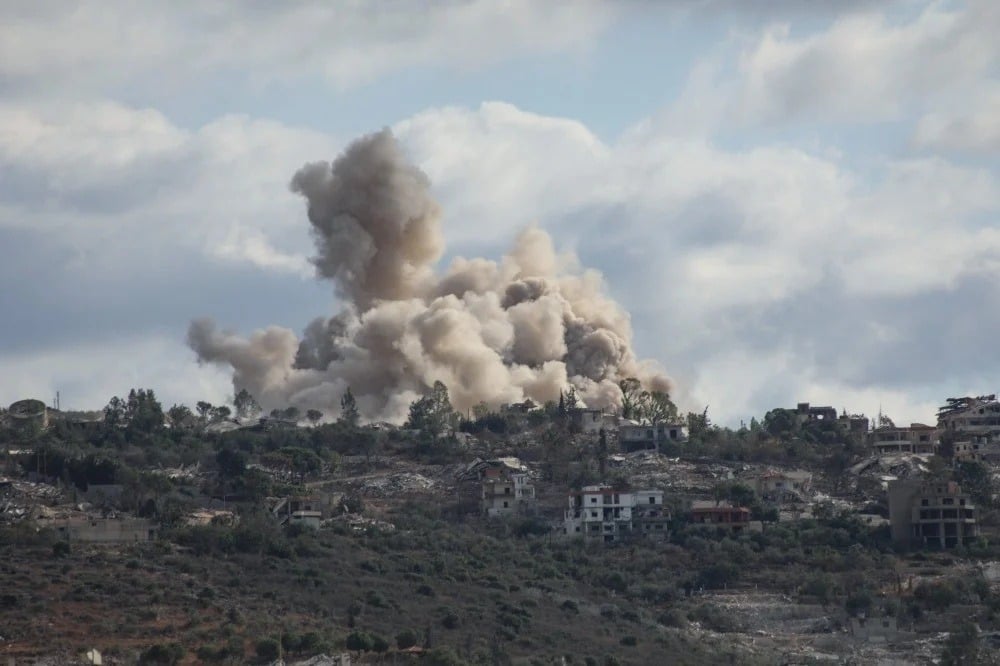
Smoke rises from the site of an Israeli explosion in the village of Majdal Zoun, seen from the neighboring village of Haniyeh, in Southern Lebanon, on Sept. 26, 2026. (Credit: Kawnat/Haju/AFP)






SOUTH LEBANON — Israeli artillery shelling and demolitions targeted several areas of southern Lebanon overnight from Saturday into Sunday and continued into Sunday morning, while Israeli forces expelled olive farmers from the outskirts of Kfar Shuba after they refused Israeli conditions for harvesting.
On Sunday, artillery shelling targeted Wadi Zibqine and Mansouri (Sour), Wadi Slouqi (Marjayoun) and the outskirts of Mayfadoun (Nabatieh). Israeli forces also carried out demolitions in Qantara (Nabatieh), where two explosions were reported. Machine-gun fire targeted Beit al-Sayyad (Sour), while Israeli military vehicles were spotted moving in Zawtar Sharqieh (Nabatieh).
At 8:20 a.m., an explosion was reported in Beit al-Sayyad (Sour). In Tabbnine (Bint Jbeil), an unidentified object exploded as a fire was being lit, injuring two Syrian nationals. No security incident was reported in connection with the explosion.
Overnight, after 8 p.m., Israeli forces fired medium machine guns from Majdal Zoun toward Wadi Zibqine (Sour), while artillery struck Mansouri (Sour) and southeastern Khiam (Marjayoun). The shelling in Khiam was accompanied by extensive machine-gun fire. Israeli military vehicles were also spotted around Beaufort Castle (Nabatieh).
After 9 p.m., Israeli forces carried out a major demolition targeting homes in Beit Yahoun (Bint Jbeil). Machine-gun fire targeted the outskirts of Braasheet (Bint Jbeil), alongside movements by Israeli military vehicles, while Wadi Zibqine (Sour) was also swept with machine-gun fire.
After 10 p.m., artillery struck the outskirts of Braasheet and Beit Yahoun (Bint Jbeil), Kfar Tibnit and Zawtar Sharqieh (Nabatieh), and Mansouri (Sour). Israeli forces also carried out a major demolition on the outskirts of Zawtar Sharqieh (Nabatieh).
After 11 p.m., artillery fire resumed on the outskirts of Braasheet (Bint Jbeil) and targeted the area between Zawtar Sharqieh and Mayfadoun (Nabatieh). Israeli forces also carried out demolitions targeting homes in Khiam (Marjayoun), while Mansouri (Sour) came under further artillery fire.
Around midnight, artillery targeted the outskirts of Hariss and Haddatha (Bint Jbeil).
The previous day's tally recorded Israeli warplanes striking homes in one southern village, artillery shelling hitting 14 villages and demolitions carried out by the Israeli army in eight villages, after a decline in such operations in recent days, according to our correspondent in the south.
Olive farmers refuse Israeli conditions in Kfar Shuba
Residents of the Arqoub villages refused to head to their olive groves on the outskirts of Kfar Shuba (Hasbaya), despite being told they could harvest for one day in the Sabia, Jall al-Hanbal, Azariel Road and Wadi Khansa areas.
Residents rejected Israeli conditions that included handing over their phones and identity cards, limiting participation to 100 people and 25 vehicles, and prohibiting the Lebanese Army and UNIFIL from accompanying them.
Separately, an Israeli patrol expelled olive farmers from the outskirts of Kfar Shuba and prevented them from continuing to harvest. Kfar Shuba's head of municipality Qassem al-Qadri told L’Orient Today that the patrol arrived unexpectedly and ordered the farmers to leave the area and not return.
Movements by Israeli troops and military vehicles were also reported south of Kfar Shuba, in the Qate’ area toward al-Dawwara.
On Sunday morning, the Israeli Army radio said that "the Israeli military is permitting the harvesting of olives within the security zone in southern Lebanon—stretching from Shebaa in the east to Alma al-Shaab in the west—conducted in coordination with and under the supervision of its forces, with the participation of Lebanese individuals and Syrian workers."
Sunday's dispute follows an incident on Thursday, when Israeli forces intercepted farmers heading to olive groves near Kfar Shuba (Hasbaya) and told them to wait until Sunday for authorization from the “Mechanism,” which coordinates between the Lebanese and Israeli armies, according to witnesses. The Union of Municipalities of Arqoub had called on farmers to head to their land together with the Lebanese Army and the United Nations Interim Force in Lebanon (UNIFIL), but neither force accompanied them, according to the union.
On Friday, an Israeli force including a D9 bulldozer, two tanks and several military vehicles advanced toward the southern side of Kfar Shuba and uprooted olive trees in the Azariel area. Israel had previously told residents and farmers they would be allowed to return the following week to harvest their olives.
Fadlallah defends Hezbollah’s weapons transfers
Hezbollah MP Hassan Fadlallah said Sunday that the group was not seeking confrontation with the Lebanese state but defended its right to transport weapons, arguing that it needed to prepare its capabilities to fight Israel.
“It is natural for the resistance to transport weapons and for them to reach the front. Otherwise, how will the resistance prepare itself and equip its capabilities? How will it fight this enemy? Are we supposed to fight with bags of potatoes?” he said.
Speaking in Tibnin (Bint Jbeil), Fadlallah accused "some Lebanese officials of acting under U.S. pressure" and warned that the country’s political balance would change. He also called on the "government to assume responsibility for repairing damaged homes, reconstruction and supporting displaced residents," saying Hezbollah’s assistance did not absolve the state of its obligations.
On Thursday, Hezbollah claimed ownership over hundreds of kilograms of explosives that were seized by the authorities between the Bekaa and Beirut, during a press conference held by Fadlallah. Separately, the party announced Tuesday a new housing aid program for displaced people and families whose homes have been destroyed or rendered uninhabitable by Israel's bombardments since October 2023. The initiative offers aid of up to $14,000 for those in Beirut and its southern suburbs, and up to $12,000 in other regions.
Reporting contributed by our correspondent in the south Muntasser Abdallah
