






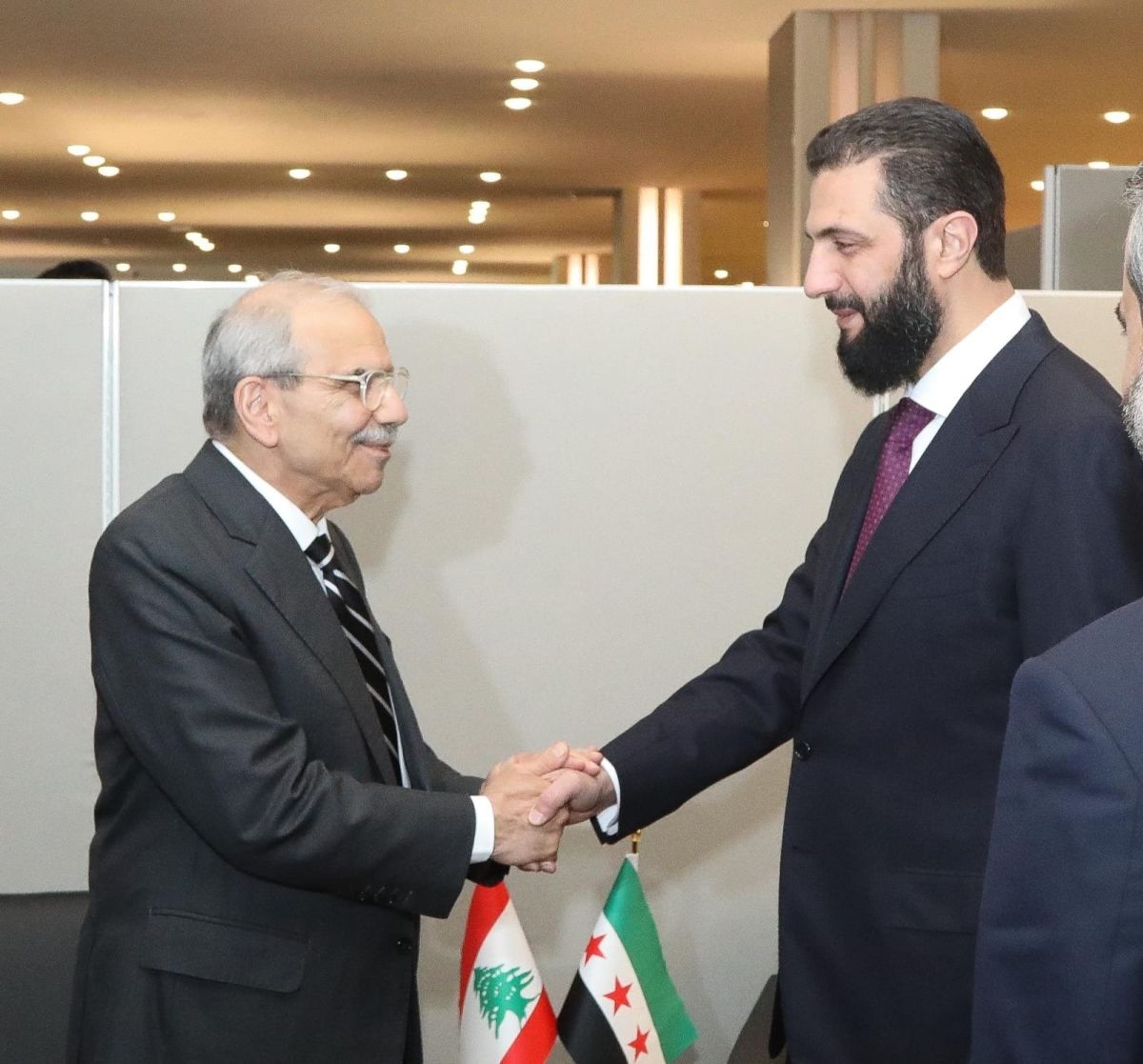
Handshake in New York, on the sidelines of the UN General Assembly, between Lebanese Prime Minister Nawaf Salam and Syrian President Ahmad al-Sharaa, on Sept. 23, 2026. (Credit: Photo published on X by the Lebanese Prime Minister’s Office)






BEIRUT — From Damascus to Tehran, Lebanon seeks "healthy" relations. On the sidelines of the U.N. General Assembly, Prime Minister Nawaf Salam held a series of diplomatic meetings Wednesday and Thursday. His two most important meetings were with Syrian President Ahmad al-Sharaa, then with Iranian President Masoud Pezeshkian, in the presence of Iranian Foreign Minister Abbas Araghchi.
The latter meeting was all the more symbolic because Salam was accompanied by his foreign minister, Joe Rajji. Known for his opposition to Hezbollah and Tehran’s axis, Rajji sparked a political and diplomatic outcry earlier this year when he declared Iran’s designated ambassador, Mohammad Reza Shibani, persona non grata, accusing him of interference.
The decision caused tensions at the highest levels of government, particularly with President Joseph Aoun, who was not informed of its contents in advance. The decision ultimately was not implemented, and Lebanese authorities granted Shibani a courtesy residence permit, but without diplomatic status.
On this subject, the prime minister suggested that Iranian officials appoint a new ambassador to Beirut. While Iran has not yet responded to the Lebanese “suggestion,” its president told MTV ahead of the meeting that he “hopes it will go well.”
'The monopoly on arms' is a priority
In a statement released by the Grand Serail after his meeting with Pezeshkian, Salam said he had “explained [to the Iranian president] that the relationship between Lebanon and Iran was historic, between the two countries as well as between the two peoples, and that Lebanon wished to open a new page and build a healthy, state-to-state relationship based on respect for each other’s sovereignty and independence, non-interference in each other’s affairs, and common interests.”
His comments come as Lebanon is trying to distance itself from the Iranian axis and disarm Hezbollah, Tehran’s local proxy.
“Nawaf Salam stressed that Lebanon had paid a heavy price in terms of security, stability and the economy, and did not want to be a theater for regional conflicts or an exchange of messages,” the statement added, specifying that the prime minister saw “the total withdrawal of the Israelis” and “the monopoly on arms” as his priorities.
“We wish Iran and its people all the best, safety, stability, prosperity and development,” the prime minister said. He also invited Iran to appoint a new ambassador to Lebanon, the statement concluded.
For his part, the Lebanese foreign minister said after the meeting that he “had no problem meeting with anyone.”
“Negotiation is done with the party with whom there is an issue,” he added. “We said what needed to be said during the meeting, starting from Lebanon’s sovereign position.”
Salam then met with his Pakistani counterpart, Muhammad Shehbaz Sharif, again in Rajji's presence. According to the Grand Serail, the Lebanese prime minister commended Pakistan’s efforts to promote regional de-escalation.
Again, he stressed that Lebanon did not want to be “a stage for regional conflicts or the exchange of messages,” emphasizing that “nobody negotiates on behalf of Lebanon except the Lebanese state.”
He also emphasized the importance of maintaining pressure for Israel’s complete withdrawal from Lebanese territory and the cessation of its attacks, as well as continuing the process of extending state authority throughout the country by its own means.
For his part, the Pakistani prime minister said Lebanon and de-escalation there were priorities for Pakistan, which ensured that the country was included in any related process.
Sharaa: Beware 'exaggerated promises' in talks with Israel
The previous day, Salam had met with Syrian President Ahmad al-Sharaa. Cooperation between Lebanon and Syria was at the center of the discussions. During the meeting, Salam stressed the importance of “reviewing” the agreements between the two countries to move forward with organizing the first meeting of the joint Lebanese-Syrian Higher Commission, established in July.
“For some time, we have been working to open a new page with our Syrian brothers, and to build relations between our two countries based on trust, non-interference in internal affairs, and common interests,” Salam said in a statement.
The issue of noninterference has been central to all exchanges between Beirut and Damascus since the fall of the Assad regime, which placed Lebanon under tutelage between 1976 and 2005, and since Hezbollah fought alongside the former regime during the Syrian civil war starting in 2013.
“We discussed the need to finalize the review of agreements between the two countries, so they can serve as the basis for the first meeting of the joint Lebanese-Syrian Higher Commission we established in Beirut. This step must not remain a dead letter. If the meeting does not take place at the start of next month, it will be held the month after,” Salam stressed.
The creation of this commission was approved in July by the Lebanese Parliament.
Sharaa, for his part, acknowledged that between Syria and Lebanon “the legacy is difficult,” affirming that “Syria is trying to establish new relations based on the economy and good political relations, which will in the future influence the security situation.”
In a statement to MTV, Sharaa stressed that concerns are the same in Lebanon and Syria and that “they must always bring [the two sides] closer together and foster the best relations.”
Despite both countries’ authorities wishing to “turn the page” on decades of tense bilateral relations, some scars and issues remain, including Syrian detainees in Lebanon, the demarcation of the land border and the fate of refugees.
Asked about Lebanese-Israeli negotiations and the advice he would offer Lebanon, the Syrian president called for “complete transparency,” warning against “exaggerated promises.” The eighth round of negotiations between Lebanon and Israel has been postponed to October, with no specific date yet set.
In addition to these meetings, Salam met with Russian Foreign Minister Sergey Lavrov and Spanish Prime Minister Pedro Sánchez. He also conferred with Abdallah al-Alimi, vice president of the Yemeni Presidential Council; European Commissioner for Mediterranean Affairs Dubravka Šuica; Kuwait’s crown prince, Sheikh Sabah Khaled al-Hamad al-Sabah; Egyptian Prime Minister Mostafa Madbouly; and UAE Minister of State for International Cooperation Reem al-Hashemy.
The discussions focused on Israeli attacks in the south and the need to “lower tensions” in Lebanon and the region, issues of regional cooperation and the end of the mandate of the United Nations Interim Force in Lebanon (UNIFIL).
On this point, Salam advocated for “a formula guaranteeing the maintenance of an international presence responsible for observation, reporting and liaison missions, under the aegis of a U.N. Security Council resolution.”

 8 p.m. recap: Israel again threatens Beirut’s south suburbs; 2 ships hit near Hormuz; Riyadh football matches canceled