






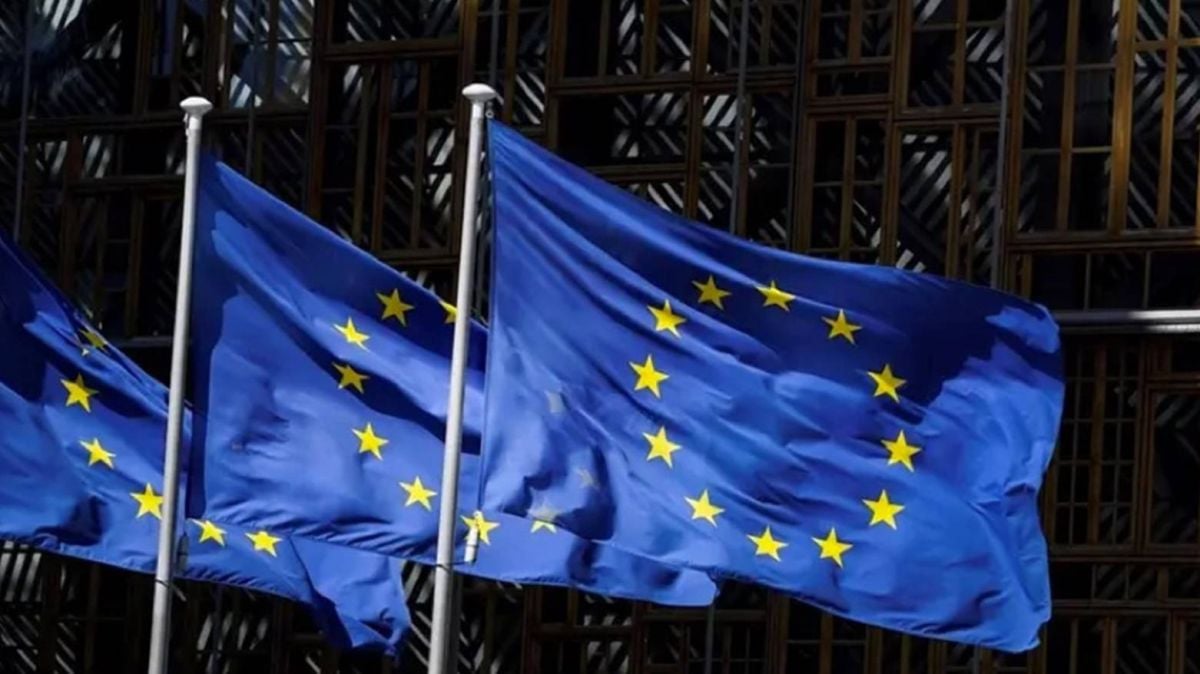
Flags of the European Union. (Credit: AFP)






Lamia Moubayed Bisat, president of the Institut des Finances Basil Fuleihan, writes about the first meeting of the EU-Lebanon Partnership Joint Monitoring Committee, held in Beirut on Sept. 3 and 4.
What if the question is no longer how much more Europe can do for Lebanon, but what Lebanon and Europe can now build together? That may be the best way to understand the significance of the first meeting of the EU-Lebanon Partnership Joint Monitoring Committee, held in Beirut on Sept. 3 and 4.
Since 2011, the European Union and its member states have provided Lebanon with more than €3.5 billion to respond to successive crises, support refugees and host communities, maintain essential services and strengthen institutions. This support has been indispensable, but it has also often made up for the state’s shortcomings.
A new phase is now possible
The ninth EU-Lebanon Association Council, held in Brussels in December 2025 after an eight-year hiatus, gave the relationship fresh momentum. The EU’s nearly €500 million package for 2026-2027 offers an opportunity to rethink the framework for cooperation: continuing to protect vulnerable populations and refugees, while putting greater emphasis on economic recovery, reforms and strengthening the state.
The question is no longer simply how much support will Europe provide Lebanon, but what kind of Lebanon will that support help build?
From assistance to capacity-building
For years, international partners have funded services, supported communities, responded to emergencies and, when necessary, set up parallel systems to deliver essential services. This assistance has saved lives and helped preserve social stability.
But what begins as a necessity can become a model — and that model can become a trap. When international aid substitutes for state capacity for too long, it can inadvertently delay efforts to rebuild it. The next phase must therefore move away from substituting for state institutions and toward strengthening them.
The Lebanese state must once again take its place at the heart of development, not simply as a recipient of technical assistance, but as the institution responsible for public policy, regulation, service delivery and accountability.
European support can help by strengthening public administration, public financial management, public procurement, revenue collection, public investment, the judiciary, regulatory authorities, digital government and the governance of state-owned enterprises.
Capacity-building itself must also change. Lebanon needs to rebuild institutions that can attract and retain skilled professionals while holding them accountable, through merit-based recruitment, clear career paths and responsibilities, and a culture of performance.
The same principle applies to essential services. In energy, water, transport and health care, the goal cannot be to indefinitely finance the operating deficits of systems that are financially and institutionally unsustainable. External support should help reform these systems, improve their governance and create the conditions for sustainable investment.
From grants to investment
The second shift is from grants to investment. Lebanon’s private sector has shown remarkable resilience, but it cannot continue to make up for failing infrastructure, electricity shortages, regulatory uncertainty, inefficient customs procedures or shortcomings in the commercial justice system.
The next generation of European support should therefore focus increasingly on mobilizing investment rather than substituting for it.
The Global Gateway initiative offers an opportunity to operate on a much larger scale. Since 2021, Team Europe has mobilized more than €306 billion to attract greater private investment in sustainable infrastructure and connectivity, particularly in the digital, energy and transport sectors.
The European Fund for Sustainable Development Plus (EFSD+) alone can provide up to €40 billion in risk-sharing instruments, with the aim of mobilizing as much as €135 billion in public and private financing. In Lebanon, this could allow renewable energy, digital infrastructure, water or transport projects to combine grants, guarantees, loans and private capital.
But access to these instruments is not automatic. They require bankable projects, credible institutions, sound regulation, transparent procedures and a predictable business environment. That is precisely why reform and investment must go hand in hand.
The challenge is not simply for Lebanon to gain access to new European financing tools, but to develop the capacity to make effective use of them.
The government must identify its priorities, build a pipeline of projects, fund feasibility studies, put the necessary regulatory frameworks in place, improve public procurement and track results. A Lebanon better equipped to attract investment would also be a stronger partner for European businesses.
From parallel systems to national ownership
The third shift is from parallel systems to national ownership. Social protection must remain at the heart of the partnership. Humanitarian assistance will remain essential as long as crises and displacement continue, but it cannot serve as a permanent development model.
The goal must be to gradually build Lebanese systems capable of financing, administering, and delivering social protection, while pursuing lasting solutions for the most vulnerable and protecting host communities.
The shift in European support for the Social Development Ministry reflects this approach. In April 2026, the European Union announced 45 million euros in funding to be channeled directly through a Lebanese government institution, notably to support the AMAN program and institutional reforms within the ministry.
Cooperation should therefore move toward stronger Lebanese institutions rather than permanent parallel mechanisms.
A transformation that must also come from Lebanon
This shift cannot be expected from Europe alone. The Lebanese government must help shape it by setting clear priorities and translating them into credible reforms and investment-ready projects that can draw on European and international financing.
It must also improve aid coordination so that funding from the EU, its member states, international financial institutions and the private sector is aligned around the same priorities. Initiatives to that effect are already underway in public financial management, led by the Finance Ministry.
Finally, the government must create the conditions for investment: regulatory stability, transparency, fair competition, banking reform, an effective justice system and tax predictability.
The strongest signal Lebanon can send to its European partners, then, is not another funding request. It is the ability to put forward credible reforms, projects ready for financing and institutions capable of delivering them.
Turning the Joint Monitoring Committee into a strategic tool
This is precisely where the Joint Monitoring Committee can play its most valuable role. It should be more than a mechanism for reviewing programs. It should be the forum where Lebanese priorities are aligned with European resources, initiatives are coordinated, and progress is measured against concrete results.
In this way, it can help shift the relationship from managing individual programs to building a common strategy.
Why this transformation matters
Lebanon is trying to rebuild its economy and institutions while the south remains plagued by insecurity. The framework agreement has yet to deliver the stability the country needs, and the conditions for lasting peace remain fragile.
For Lebanon, security, sovereignty and development are inseparable. No country can achieve lasting recovery while its people remain exposed to violence and displacement, or while the state is unable to exercise its authority fully.
At the crossroads of the Mediterranean, the Middle East and Europe’s neighborhood, a stable, sovereign and prosperous Lebanon is also in Europe’s strategic interest, from regional security and trade to connectivity, migration and resilience.
A stronger Lebanon, then, is not only in Lebanon’s interest. It is also in Europe’s.
Ultimately, a new approach to the partnership should be measured neither by the amount of funding mobilized nor by the number of programs, but by a more demanding question: Have we made Lebanon better able to plan, make decisions, finance its priorities, implement them and be held accountable?
Lebanon must do its part: pursue reforms, set priorities, strengthen its institutions and develop credible projects in an environment conducive to investment. Europe, for its part, can invest more in institutions, infrastructure and the private sector.
That reciprocity can give the partnership new momentum: less substitution, more capacity; less fragmentation, more strategy; less crisis management, more investment in the future.
The first Joint Monitoring Committee meeting could therefore mark more than just a new stage in EU-Lebanon dialogue. It could be the starting point for a relationship in which Europe no longer simply helps Lebanon weather its crises, but works with it to build stability, sovereignty and prosperity.
And one in which Lebanon is no longer defined simply by the needs its partners help meet, but by the capacity it rebuilds, the reforms it delivers and the opportunities it creates.
This article was originally published in French in L'Orient-Le Jour and was translated by Sahar Ghossoub.

 8 p.m. recap: Israel again threatens Beirut’s south suburbs; 2 ships hit near Hormuz; Riyadh football matches canceled