





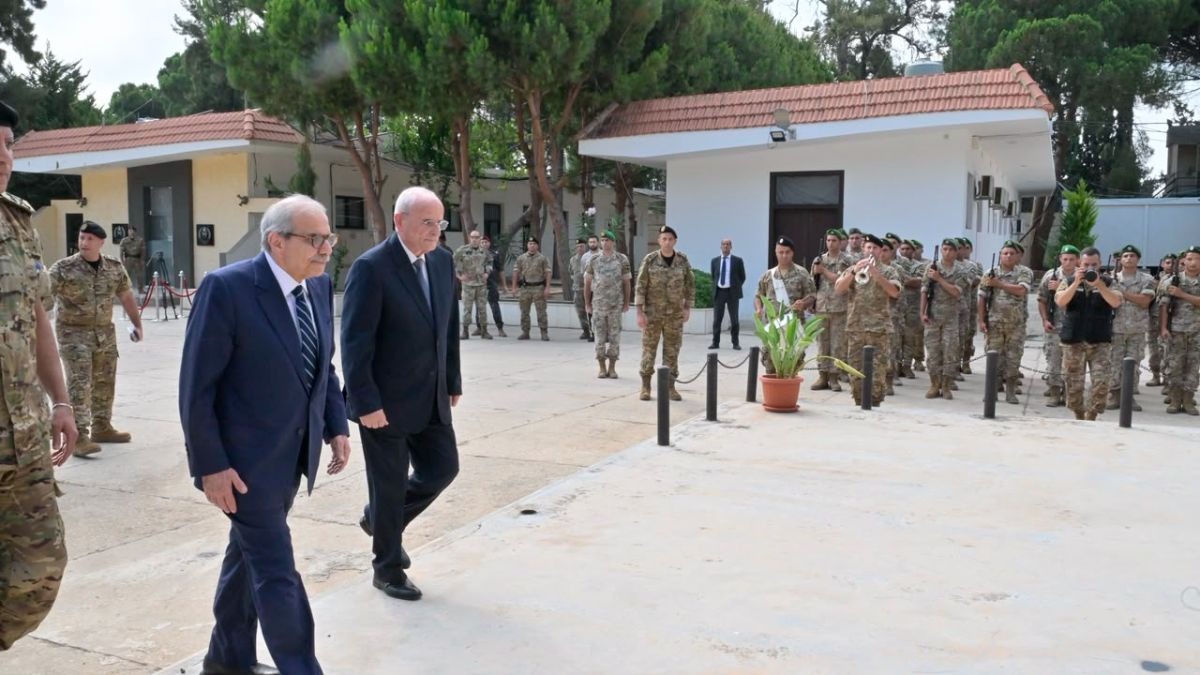
Prime Minister Nawaf Salam (left) and Defense Minister Michel Menassah at the Lebanese Army Benoit Barakat barracks in Sour on Aug. 21, 2026. (Credit: National News Agency)






BEIRUT — Lebanese Prime Minister Nawaf Salam and Defense Minister Michel Menassah chose southern Lebanon, where Israeli attacks continue, to project a united front 10 days after their dispute in Parliament. The two officials stood side by side during a visit and military briefing at a barracks in Sour, where Salam, emphasizing his government's “solidarity,” stressed the importance of strengthening the army and preserving its unity as part of efforts to restore the state and reestablish its sovereignty over the entire country.
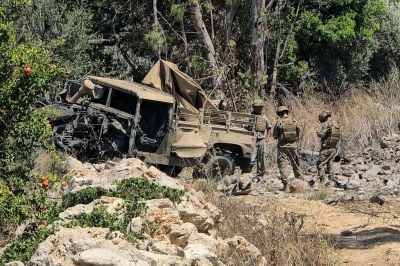
Ten days ago, a parliamentary session on a general amnesty law turned into a bitter dispute between the two men. Menassa, who is close to President Joseph Aoun, had planned to address Parliament to denounce the release of Islamists accused of killing members of the Lebanese Army. Salam opposed this, arguing that only he should speak on behalf of the government. The exchange became heated, with voices raised between the two officials.
On Aug. 13, the day after Parliament adopted the legislation, Menassah criticized the fact that “the army had been prevented from speaking.” Salam defended his decision, citing the need for government cohesion and his constitutional prerogatives. A source at the Grand Serail later told L’Orient-Le Jour that no tensions remained between the two officials.
Upon their arrival at the barracks, reporters asked Salam about the dispute. He responded with a smile: “Do we look like we're at odds?”

Strengthening and unity of the army
The joint visit not only sought to dispel the impression of divisions within the executive branch, but also any suggestion of a rift between the prime minister and the army.
Salam affirmed that his government remains “united as required by the Constitution” and “continues to mobilize all possible Arab and international support to develop the army's human and technological capacity, as well as improve the financial and social conditions of its members.”
For the prime minister, “the development of the army's capacity is not a secondary matter for the government, nor a purely technical issue, but a strategic choice at the heart of our plan to restore the state.”
The Lebanese Army is expected to play a crucial role in implementing the framework agreement signed by Lebanon and Israel in June, including deploying in areas vacated by Israeli forces and disarming Hezbollah there.
"I realize the magnitude of the challenges you face in the South due to Israeli aggressions, but I also know sovereignty can only be restored by the sons of the state, and the state can only achieve this through a strong and united army," Salam said.
He also asserted that “the presence of the army in the South is not just a military deployment: it is the presence of the state.” “Every position where the army is deployed is a position where the state recovers its sovereignty, its authority and its prestige. And every Lebanese flag raised above an army position is a symbol of the legitimacy of the state,” he said. Salam stressed that the state wants to return to the South with “schools, hospitals, roads, electricity and water, administrations, justice, job opportunities and reconstruction.”
Stating that “the restoration of sovereignty can only happen through the building of a capable state, and a capable state cannot exist without a single, strong army,” he called on the military to remain united and “not allow political considerations to divide you.”
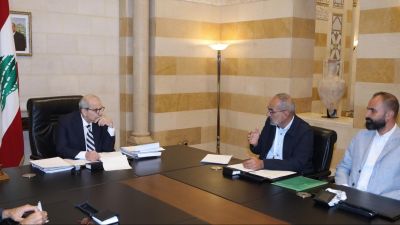
Following the meeting, Salam met with residents of several border villages in Sour. He assured them that the government was closely monitoring their situation and "stands by their side" in order to "meet their needs and address their demands within the limits of the capabilities of the State and its institutions." Following the army’s deployment to an initial "pilot zone" in Zawtar Gharbieh last July, Salam sparked controversy by visiting the site before residents were allowed to enter the village, and without giving prior notice of his visit.
Menassah: Negotiations are the best solution
Meanwhile, Menassah reaffirmed the government's “clear determination to recover the sovereignty of the state over the entirety of the territory” and to reclaim “every last square centimeter of the South,” more than 600 square kilometers of which are occupied by Israel.
“The complete withdrawal of the Israeli occupation army is the first objective of the negotiations” between Lebanon and Israel, Menassah said, emphasizing that the talks are “the best available path to get out of the tunnel and this devastating war.”
For his part, General Nicolas Tabet, commander of the south Litani sector, stressed that the army places “the safety of citizens, the protection of the territory and the preservation of state sovereignty at the forefront of its priorities, despite the difficulty of the situation on the ground.”
He welcomed the visit by Salam and Menassah as a “message of support and confidence in the military institution and proof of the attention that the state pays to the people of the South and their sacrifices.”
Israeli forces continue to blow up and demolish homes, infrastructure and entire neighborhoods in villages across south Lebanon.
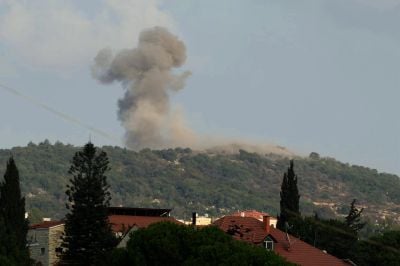
During the Lebanese officials’ visit to Sour, powerful explosions were heard following blasts set off by Israeli forces in Mansouri and Majdal Zoun in the area. Israeli warplanes also bombed a house in Braasheet, in the Bint Jbeil district, after artillery fire had targeted the Wadi Slouqi valley between Mais al-Jabal and Houla in the Marjayoun district, the outskirts of Mayfadoun in Nabatieh, Wadi al-Jamal between Mais al-Jabal and Houla, and Shebaa in the Hasbaya district.
Overnight, the strategic Ali Taher hill, a site where Israel accuses Hezbollah of maintaining strategic military installations, was again targeted by artillery fire and airstrikes.

 7 p.m. recap: Iran warns Egypt, Israeli soldiers vote in south Lebanon, Haret Hreik responds to Kataeb