











The Ali Taher hill remains in the spotlight. Could this strategic high ground, coveted by Israel, become the spark that sets off a new regional war? Within Hezbollah, the signals are mixed.
While Hezbollah’s more prominent public figures refuse to address the issue openly, two views are currently emerging in more closed circles.
The first points to a recent statement by Iran’s chief negotiator with the United States, Parliament Speaker Mohammad Ghalibaf, who said he was in direct and constant contact with the fighters at Ali Taher. Supporters of this view see the statement as unequivocal evidence of the hill’s importance to the Iranians themselves.
Ghalibaf, they argue, was signaling that the site falls under Iran’s responsibility, and that any decisive attack aimed at taking control of it would inevitably draw Iran directly into the fight over this hill. That, in turn, could trigger a new full-scale regional war, with the United States becoming involved.
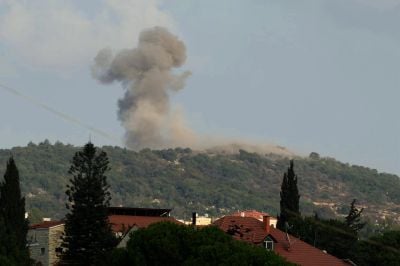
The second appears, at first glance, to be the opposite of the first. It plays down the hill’s importance, arguing that it is the Israelis who are exaggerating its significance by claiming that a strategic Hezbollah command center is located there.
According to these circles, Israel is seeking a symbolic victory that would help Benjamin Netanyahu and his camp win the next parliamentary elections, scheduled for Oct. 27. The Ali Taher hill does overlook the Nabatieh district and commands access to Iqlim al-Tuffah. But, they argue, it is no more important than the hill on which Beaufort Castle stands or the heights overlooking Wadi al-Houjeir.
Against this backdrop, a question is increasingly being raised: could Hezbollah’s sudden efforts to downplay the importance of the Ali Taher hill actually reflect a belief that the site is destined to fall into Israel’s hands?
Those who subscribe to this view argue that this is why the party has begun circulating information suggesting that Ali Taher is not, in fact, a decisive factor in the course of the battle.
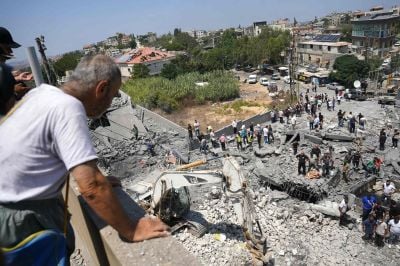
Asked about the issue, Hezbollah gives an indirect answer. It maintains that every inch of Lebanese territory is important, but some locations carry greater symbolic weight than others and attract more media attention. The Ali Taher hill is one of these sites, and the two views within Hezbollah agree on the same conclusion that the Israelis want to seize it, but without triggering a major war.
Israel therefore wants Ali Taher for several reasons, including the fact that the hill lies outside the yellow line that Israel drew south of the Litani River to mark the Lebanese territory it occupies. Seizing the hill would thus be an indirect way for Israel to have freedom of action beyond that zone.
Similarly, from Hezbollah’s perspective, beyond the south of the Litani River, the issue of its disarmament becomes an internal Lebanese matter linked to a national defence strategy. However, by stepping up their attacks on Ali Taher Hill, the Israelis are seeking to make it clear that, as far as they are concerned, Hezbollah must be disarmed across the whole of the country.
According to Hezbollah, the Israelis are attempting to take control of this site in two ways. First, gradually, by tightening the noose around it and even pumping gas into the exposed tunnel openings to suffocate those inside, paving the way for a ground advance without having to fight a major battle.
Secondly, the Israelis are seeking to take control of this zone through negotiations in Rome. According to the group, the U.S. proposed that the army take control of Ali Taher, which would thus gradually become more accessible to the Israelis. The army expressed reservations precisely so as not to give the Israelis an advantage, and the negotiations came to a standstill.
However, according to Hezbollah, Iran’s threats have had the desired effect, and the U.S. is unwilling to risk a return to full-scale confrontation in the region. Moreover, an Israeli takeover of Ali Taher would mean that the security of residents in northern Israel would once again be at risk, which could have a decisive impact on the outcome of the vote.
There is, however, Hezbollah does not mention the idea of postponing Israeli elections. For now, no one is openly discussing it, but the idea is beginning to circulate quietly.
This article was translated from L'Orient-Le Jour and translated by Joelle El Khoury.

 7 p.m. recap: Iran warns Egypt, Israeli soldiers vote in south Lebanon, Haret Hreik responds to Kataeb