





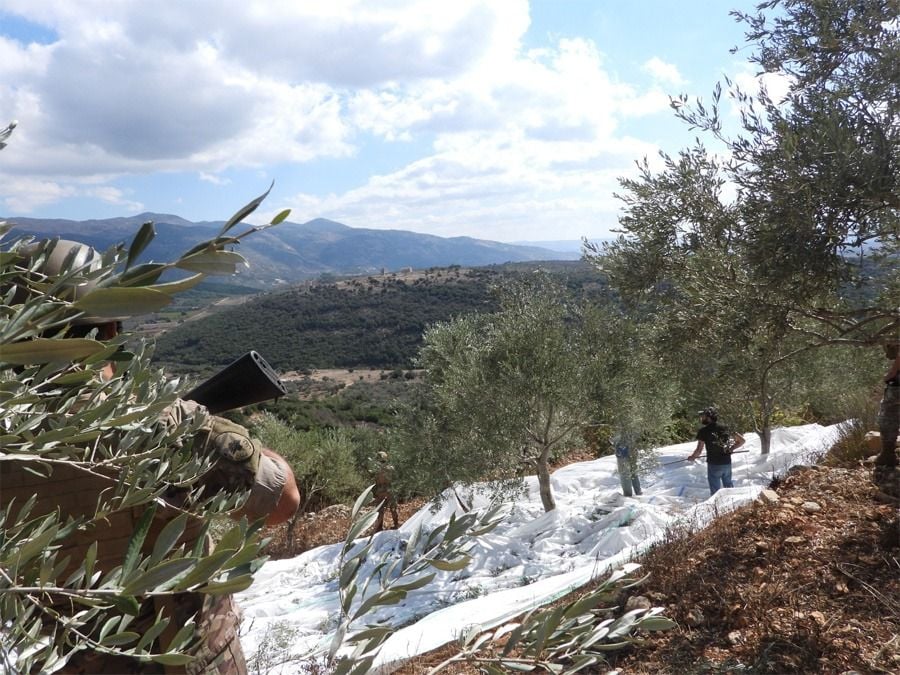
A Lebanese soldier supervising the olive harvest in Rashaya al-Foukhar, southern Lebanon. (Credit: Photo published on Oct, 20 on the Lebanese Army's website)






SOUTH LEBANON — As Israeli attacks continued Tuesday in southern Lebanon, a resident of Braasheet, a village in the Bint Jbeil district north of the Israel-occupied zone, was ordered during a suspicious call to evacuate his home under threat of bombardment, according to our correspondent in southern Lebanon.
The authenticity of the call could not, however, be confirmed. Municipal President Abbas Farhat told L’Orient-Le Jour that the building also houses a dispensary affiliated with the Social Development Ministry that is currently damaged and out of service.
As a precaution, the home and neighboring residences were evacuated, and the road leading to the area was closed. A
lerted by the municipality, the Lebanese Army contacted the cease-fire monitoring committee, known as the “mechanism,” to check the origin of the call and assess whether the threat was credible.
The municipality said it was waiting for an official response from the committee and would continue to follow up with the relevant authorities.
Braasheet and the neighboring locality of Beit Yahoun are regularly targeted by the Israeli army, as was the case Tuesday when about 10 shells landed in the area.
Elsewhere in the South, heavy artillery shelling hit Mansouri (Sour district). The Israeli army also set houses on fire in Zawtar Sharqieh and continued work to build a new road connecting the banks of the Litani to Yohmor, in the Nabatieh district.
Around 3 p.m., the Israeli air force carried out two strikes on the outskirts of Kfar Tibnit (Nabatieh) before striking Qantara (Marjayoun).
In the morning, fire also targeted Kfar Shuba, in the Hasbaya district, where the Lebanese Army announced it had escorted farmers from Rashaya al-Foukhar to secure the olive harvest.
Tensions with the Israeli army had marked attempts by local growers to enter their olive groves in the neighboring locality of Kfar Shuba last week.
Two robotic tanks north of Mansouri
The night was marked by several attacks. Before midnight, two Israeli army robotic tanks were reported leaving Mansouri and heading north toward Aamrieh, just south of a checkpoint established by the Lebanese Army.
Mansouri is the northernmost point under Israeli occupation along the coast. These remote-controlled vehicles subsequently withdrew to Bayyada, in the occupied “buffer zone.” Artillery shells were also fired at Mansouri and the neighboring Zibqine valley farther east.
In addition to this advance, our correspondent reported artillery fire hitting the outskirts of Mayfadoun and Kfar Tibnit (Nabatieh), Beit Yahoun and Haddatha (Bint Jbeil), and Wadi Slouqi (Marjayoun), a strategic valley targeted multiple times.
In Khiam (Marjayoun), several houses were blown up while the Israeli army fired on the locality with medium-caliber automatic weapons.
Fahmy promises Arab support for the Lebanese Army
On the diplomatic front, Arab League Secretary-General Nabil Fahmy traveled Tuesday morning to Zawtar Gharbieh, a “pilot zone” a few 100 meters from the Israeli-occupied zone.
Fahmy said, “What is happening in southern Lebanon is unacceptable.”
“Arab efforts are underway to put pressure on Israel, which continues its illegal practices,” he added. He also committed to working to strengthen the capabilities of the Lebanese Army, saying he would make the issue a priority in his contacts with Arab countries. He also promised to work to mobilize material, security and economic support for Lebanon, based on the organization’s latest ministerial resolution.
“We are by your side,” he told southern residents. However, the visit prompted dissatisfaction among Municipal President Abed Ezzeddine and residents who were waiting to meet Fahmy in the village square. According to the state-run National News Agency, his convoy continued toward Sour without stopping to meet them.
In a brief statement, the United Nations Interim Force in Lebanon, whose mandate ends in December, also said it remains “committed to supporting peace and stability in the region,” in line with its mandate established by Security Council Resolution 1701.
“As the Security Council considers options for the post-UNIFIL period, our work continues on the ground,” the force added.
Washington opposes any renewal of its mandate, while the Security Council is set to consider several alternatives proposed by Secretary-General Antonio Guterres.
Earlier in the day, the Israeli army announced that it had “evidence” that Hezbollah continues to operate freely at military sites that were supposed to have been neutralized by the Lebanese Army since the 2024 cease-fire.
The Israeli army’s Arabic-speaking spokesperson accused the Lebanese Army of “failing” in its mission to disarm the party.
The accusations come as Tel Aviv and Washington are pushing for the Lebanese and Israeli armies to coordinate directly on the ground, a prerequisite for resuming negotiations, ahead of discussions scheduled later in the day in Tampa, Florida.
Reporting contributed by our southern Lebanon correspondent, Muntasser Abdallah

 2 p.m. recap: Israel accuses Lebanese Army, Israel-Lebanon negotiations in Tampa, Palestinians fleeing Lebanon shipwreck near Greece