





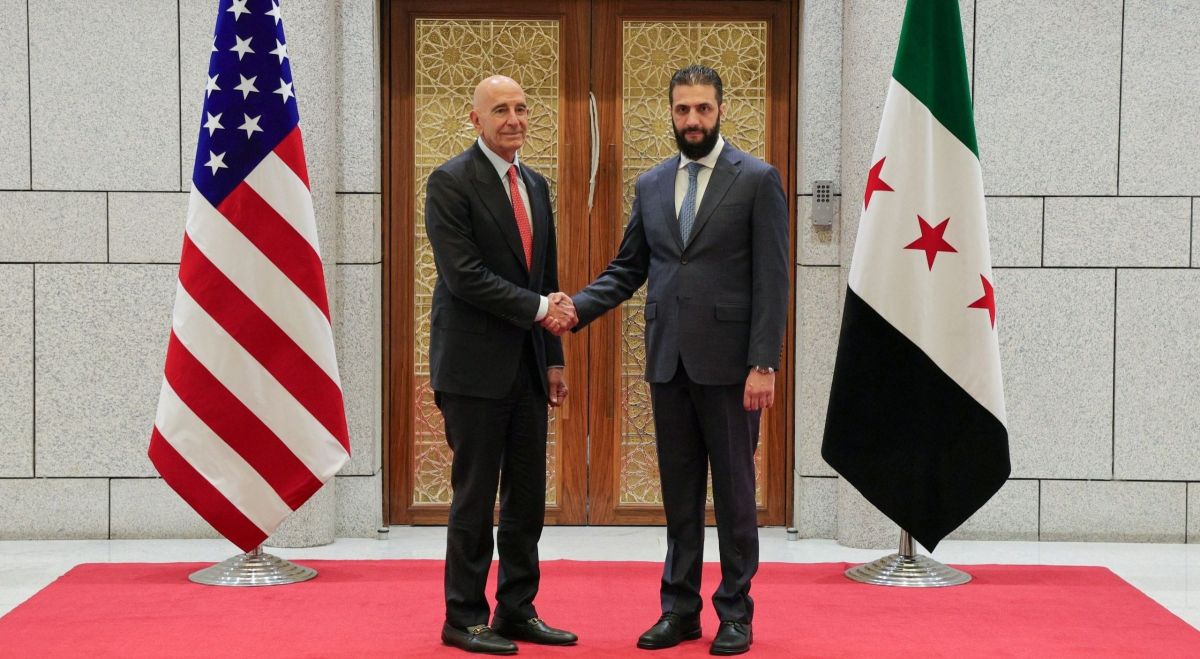
Syrian interim President Ahmad al-Sharaa, right, receives the American special envoy for Syria, Thomas Barrack, in Damascus, on May 29, 2025. (Credit: AFP/SANA)






U.S. Ambassador to Turkey and Special Envoy for Syria Tom Barrack said Tuesday that Syrian President Ahmad al-Sharaa wants to normalize relations with Israel, while calling for an end to Israeli military operations in Syria and questioning whether Washington should intervene to stop them.
Speaking at the Global Security Forum in Doha, Qatar, Barrack said Sharaa had handled difficult circumstances well and sought to reassure Israel that his government did not pose a threat.
"President Sharaa, in my view, has done a very good job under very difficult circumstances," Barrack said, describing the message he believed the Syrian leader was sending to Israel. "I’m not predatory, I have no problem with Israel, I want normalization with Israel," he quoted Sharaa as saying.
Barrack also urged Israel to halt its operations in Syria, while expressing uncertainty over whether the United States should intervene to bring them to an end. "It’s time to stop this [Israeli actions in Syria]. I don’t know if it’s time for the U.S. to intervene to stop it," he said.
Israel intensified its military operations in Syria following Assad’s ouster on Dec. 8, 2024. Israeli forces entered the demilitarized "buffer zone" along the Golan Heights and took positions on the Syrian side of Mount Hermon, with Israel describing the deployment as a temporary security measure. Israeli strikes have also targeted military sites and weapons depots across the country.
Syria’s political transition
Barrack cited Syria’s political transition as an example of how groups once regarded as adversaries could be incorporated into new political and security structures.
“You could take al-Nusra, at one point a foreign terrorist organization, and on Dec. 8 see a transition to something that many people look at today and say: That’s a model,” he said.
Al-Nusra Front, a jihadist group that emerged during Syria’s civil war and pledged allegiance to al-Qaeda before breaking away from the network. Its leader, Ahmad al-Sharaa, later headed Hay’at Tahrir al-Sham (HTS), the Islamist group that led the offensive that toppled Assad.
He also cited the integration of the Kurdish-led Syrian Democratic Forces (SDF) into Syria’s national military as an outcome that many had previously considered unlikely. “Nobody ever thought you could reintegrate the SDF, this Kurdish entity, into a national military, and it happened,” Barrack said.
Damascus and the Kurdish-led forces signed an agreement on March 10, 2025, to integrate the SDF’s military and civilian institutions into the Syrian state. However, implementation faced delays amid disagreements over the terms of integration and the future of Kurdish self-administration.
Barrack questions past US interventions
Separately, Barrack expressed doubts about the effectiveness of previous U.S. interventions in the Middle East, citing Washington’s involvement in what he described as 23 regime changes across the wider region. "Every time we try and intervene, change the person or the regime, it seems to have been a mistake," he said. He also questioned the value of U.S. intervention in Yemen, describing it as apparently "pointless."
Barrack’s comments come as Washington faces continued tensions with Iran and weighs the prospect of a diplomatic settlement. He said President Donald Trump remained open to negotiations with Tehran and that the United States favored a diplomatic solution over further military escalation.

 2 p.m. recap: Israel accuses Lebanese Army, Israel-Lebanon negotiations in Tampa, Palestinians fleeing Lebanon shipwreck near Greece