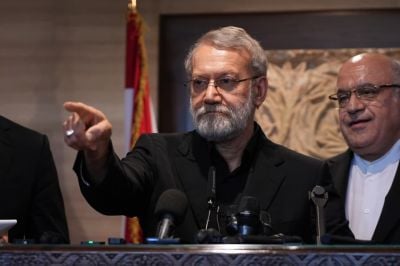
The Iranian envoy Ali Larijani in Ain al-Tineh, on Aug. 13, 2025. (Credit: Mohammad Yassin/L'Orient-Le Jour)






Ali Larijani made it clear. During his visit to Beirut, the secretary of Iran's Supreme National Security Council clearly conveyed Tehran's order to Hezbollah: Lebanon's rule that only the state can have weapons must be ignored.
Speaking from Ain al-Tineh after a meeting with Parliament Speaker Nabih Berri, the Iranian envoy stated that his country “does not support certain decisions setting a precise timeline” to disarm Hezbollah, instead calling for a “friendly, comprehensive and serious dialogue in Lebanon.”
“We respect any decision taken by the government in coordination with all factions,” he added.
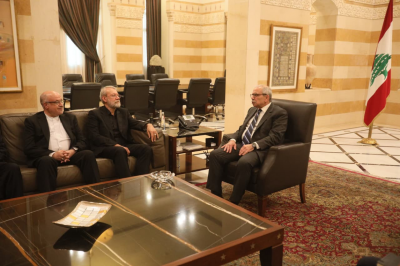
While Berri remained silent, President Joseph Aoun and Prime Minister Nawaf Salam stood their ground. During the meeting at the presidential palace, the head of state set the tone: “We reject any interference in our internal affairs, regardless of the source, and we want the Lebanese scene to remain safe and stable in the interest of all Lebanese, without discrimination.”
The president recalled that his country “never interferes in the affairs of other countries, nor does it accept any interference in its own.” He emphasized, “No group can be allowed to bear arms and rely on foreign parties,” adding that it is the duty of the legitimate armed forces to defend and protect all Lebanese.
According to the president's X account, Aoun also condemned “the language recently used by some Iranian officials regarding Lebanon, which is not helpful,” noting that the country “wishes to cooperate with Iran but only within the limits of sovereignty and friendship, based on mutual respect.”
Salam went even further. While giving his guest a calm reception at the Grand Serail, the prime minister said that “the Lebanese government's decisions must not be discussed in another country, as the center of decision-making is the Parliament, and Lebanon’s decisions are made solely by the Lebanese, who accept neither guardianship nor diktat,” saying he expected Tehran to “respect these rules.”
He insisted that “all relations with Lebanon must be conducted exclusively through its constitutional institutions, not by any political party or parallel channel,” adding, “Any external assistance is welcome, provided it passes through official channels.”
'It is time to turn this page'
Salam further stated that “the recent statements of certain Iranian officials, including Foreign Minister Abbas Araghchi, Ali Akbar Velayati and Brigadier General Iraj Masjedi, deputy commander of the al-Quds Force of the Revolutionary Guards, are rejected in both form and substance.”
According to him, “these positions, which directly criticize Lebanese decisions taken by the country's constitutional authorities and include a clear threat, are a flagrant violation of diplomatic norms and an affront to the principle of mutual respect for sovereignty — the basis of any healthy bilateral relationship and an essential foundation of international relations and international law.”
Speaking to the press after the meeting, the prime minister recalled that “Lebanon is a small country that has long suffered from external interference,” asserting that “it is time to turn this page.”
“Lebanon will not accept being used as a platform to settle scores or as a messenger box. Our sovereign decisions are based on our national interest, including any planning or timeline for the state monopoly on arms," he concluded.
'The official position of the Islamic Republic'
Larijani's visit occurs as Iran has repeatedly expressed opposition to the Lebanese government’s decision to disarm Hezbollah. In this context, the senior Iranian official said his country “does not interfere in Lebanon’s internal affairs,” and that the statements he made upon arriving in Beirut “reflect the official position of the Islamic Republic of Iran.”
At Beirut airport, the Iranian official stated that his country plans to always “defend Lebanon's higher interests.”
In his meeting with President Aoun, Larijani reiterated his invitation for the head of state to visit Tehran and expressed Iran's willingness “to help Lebanon with reconstruction” if the government requests it.
He then met with Berri, whom he called a “friend” and “an influential man in Lebanon.” Speaking to the press from Ain al-Tineh, he said Tehran has not prepared any “document, as the Americans have done,” in reference to the roadmap by U.S. envoy Tom Barrack, and emphasized that Iran “does not interfere in Lebanon’s internal affairs.”
The Iranian official told MTV that no meeting was scheduled with Foreign Minister Joe Rajji due to “lack of time.” In response, the Lebanese foreign minister stated that even if Larijani “had had the time, I wouldn’t have met with him.”
The Iranian official’s convoy was greeted outside the airport by dozens of Hezbollah supporters. Billboards displayed photos of Larijani and Iran's Supreme Leader Ali Khamenei, with the words “Khoch Amadid, Ahla w sahla,” meaning “Welcome” in Persian and Arabic.
As the paper was going to press, Larijani’s meeting — after he paid his respects at the grave of Hassan Nasrallah, former Hezbollah leader — with the party’s secretary-general, Naim Qassem, had not yet been announced.
Still, the group clearly seemed to have received the Iranian message. Speaking to Al Jadeed TV, Wafik Safa, head of Hezbollah’s liaison and coordination unit (considered to lead the party’s formidable security apparatus), declared: “The surrender of our arsenal will not happen.”
This article was translated from L'Orient-Le Jour.