






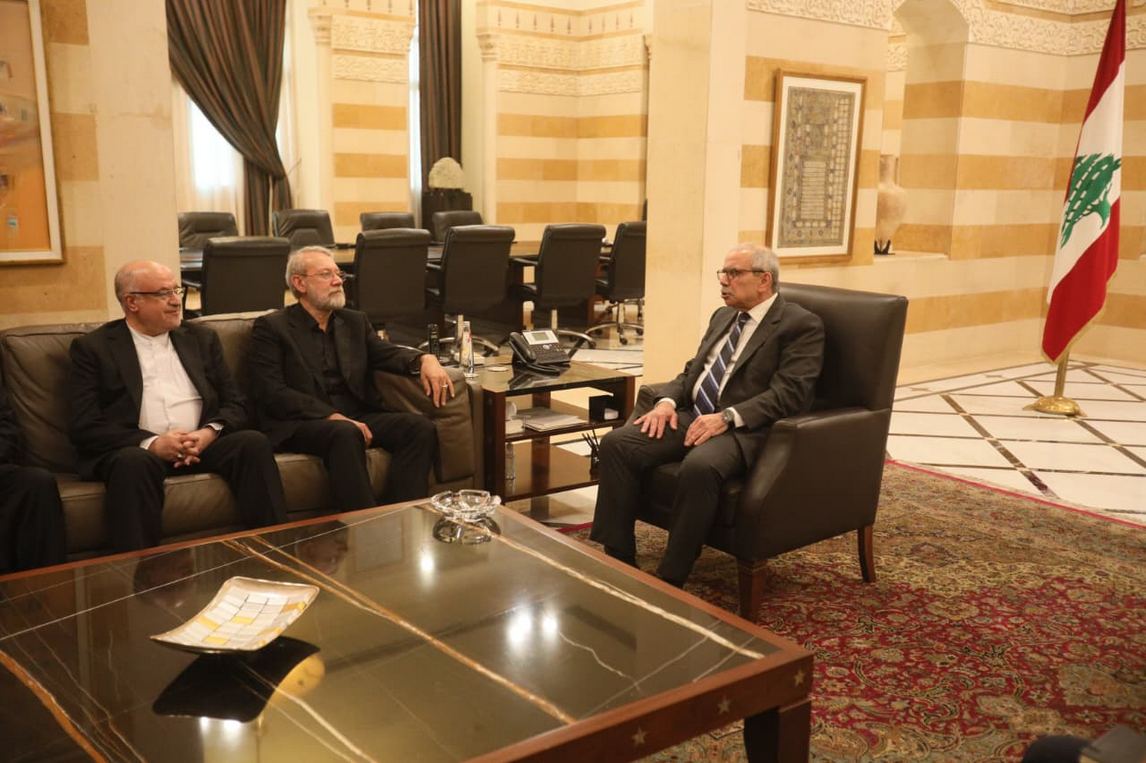
Iranian envoy Ali Larijani received by Prime Minister Nawaf Salam on Aug. 13, 2025. (Credit: Mohammad Yassine/L'Orient Today)






BEIRUT — Prime Minister Nawaf Salam and President Joseph Aoun, in their respective meetings on Wednesday with visiting Iranian official Ali Larijani, pushed back against Iranian interference on the issue of Lebanon's ongoing attempts to establish a state monopoly on arms, which centers specifically around Hezbollah's disarmament.
Since Cabinet's decision to adopt an American plan for the party's demilitarization last week, Hezbollah and Iran have made clear their objections. The Lebanese Army has been tasked with submitting a draft framework for the process by the end of the month.
During the meeting at Baabda Presidential Palace — the first stop on the Iranian envoy’s tour of Lebanon — Aoun told Larijani that Lebanon rejected "any interference in our internal affairs, whatever its source, and we want the Lebanese scene to remain safe and stable in the interest of all Lebanese, without discrimination,” according to a statement released by the presidency.
Larijani, secretary of Iran’s Supreme National Security Council, insisted in turn that his country “does not interfere in Lebanon’s internal affairs” and that his statements upon arriving in Beirut “reflect the official position of the Islamic Republic of Iran.”
Lebanon “wants to cooperate with Iran," Aoun said, "but within the limits of respect for sovereignty and friendship, based on mutual respect.”
“It cannot be permitted for any party, without exception, to carry weapons and rely on foreign parties," the president stated, criticizing "recent statements" from Iranian officials. "The Lebanese state and its armed forces are responsible for the security of all Lebanese, without exception.”
In his meeting with Aoun, Larijani renewed his invitation for the president to visit Tehran and expressed Iran’s willingness “to help Lebanon in the field of reconstruction” if the government requests it.
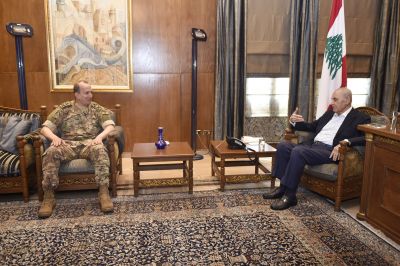
Around noon, Larijani was received at Ain al-Tineh by Parliament Speaker Nabih Berri, Hezbollah’s main ally, to whom he said Iran “does not support certain decisions setting a precise timetable” for the party’s disarmament, in line with the roadmap delivered by U.S. envoy Tom Barrack.
Calling for “friendly, comprehensive and serious dialogue in Lebanon,” Larijani said Iran “respects any decision made by the government in coordination with the factions.”
Speaking to reporters after the meeting, Larijani referred to Berri as a “friend” and “an influential man in Lebanon,” and said that Tehran had not prepared “a document like the Americans did” — a reference to Barrack’s memorandum — and reiterated that Iran “does not interfere in Lebanon’s internal affairs.”
“Who attacked your country?" he posed. "Was it not Israel?”
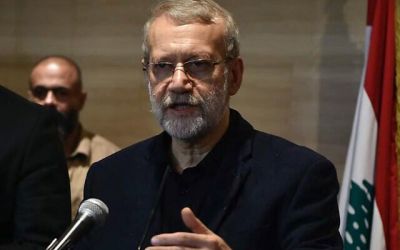
In an interview with MTV, Larijani confirmed that he did not have a meeting planned with Foreign Minister Joe Rajji, citing a “lack of time.” Asked for his response to these comments, Rajji said that even if Larijani had had the time, "I would not have met with him.”
Salam doubles down on rejection of interference
Following his own meeting with Larijani, Salam reiterated his rejection "in both form and substance" of recent statements from Iran objecting to Salam's government's attempts to bring Hezbollah's disarmament into fruition, naming specifically, comments from Foreign Minister Abbas Araghchi, Ali Akbar Velayati, and the deputy commander of the Revolutionary Guard's al-Quds Force, Brigadier General Iraj Masjedi.
“These positions, in that they contain direct criticism of Lebanese decisions taken by the country's constitutional authorities, particularly those that concealed an explicit threat, constitute a flagrant violation of diplomatic practice and an attack on the principle of mutual respect for sovereignty, which is the basis of any healthy bilateral relationship and an essential foundation of international relations and international law,” Salam, the former head of the International Court of Justice, declared during a press conference.
"Neither I nor any Lebanese official would allow ourselves to interfere in Iran's internal affairs, such as supporting one side over another, or opposing Iran's sovereign decisions," Salam insisted. "Consequently, Lebanon will not accept any interference in its internal affairs in any form, and it expects a clear and explicit commitment from the Iranian side to respect these rules."
Salam defended his government's decision to adopt an American proposal for Hezbollah's disarmament, saying it "should not be subject to debate in another country," and insisting that Iran conduct its diplomatic activities with Lebanon through "constitutional institutions" rather than through individual parties or "parallel channels."
“Lebanon is a small country that has long suffered from the interference of others,” Salam told reporters. “It is time to turn the page.”
“Lebanon will not accept being used as a platform for settling scores or as a mailbox," he said. "Our sovereign decisions are based on our national interest, including any planning or timetable” for the state's monopoly on weapons.
Warm welcome from Hezbollah supporters
Larijani arrived in Beirut earlier in the day, telling reporters at Beirut's international airport that Iran intends to always “defend Lebanon’s supreme interests” and “support the Lebanese people under any circumstances.”
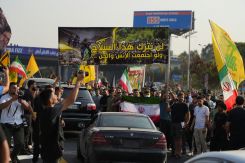
His convoy was greeted outside the airport by dozens of Hezbollah supporters. Banners bearing portraits of Larijani and Iran’s Supreme Leader Ali Khamenei read “Khosh Amadid, Ahla w sahla” (“Welcome” in Persian and Arabic). One banner read that Hezbollah would not give up its weapons “even if humans and jinn unite,” a phrase from the Quran, according to images by L’Orient Today's photojournalist on the scene.
Larijani’s visit coincides with multiple diplomatic deadlines and tours by other envoys, including U.S. envoy Tom Barrack, accompanied by his predecessor Morgan Ortagus. France is also preparing for a visit by its envoy, Jean-Yves Le Drian, ahead of an international conference in support of Lebanon’s reconstruction. Reports also mention a possible visit by Saudi envoy Yazid bin Farhan.
