






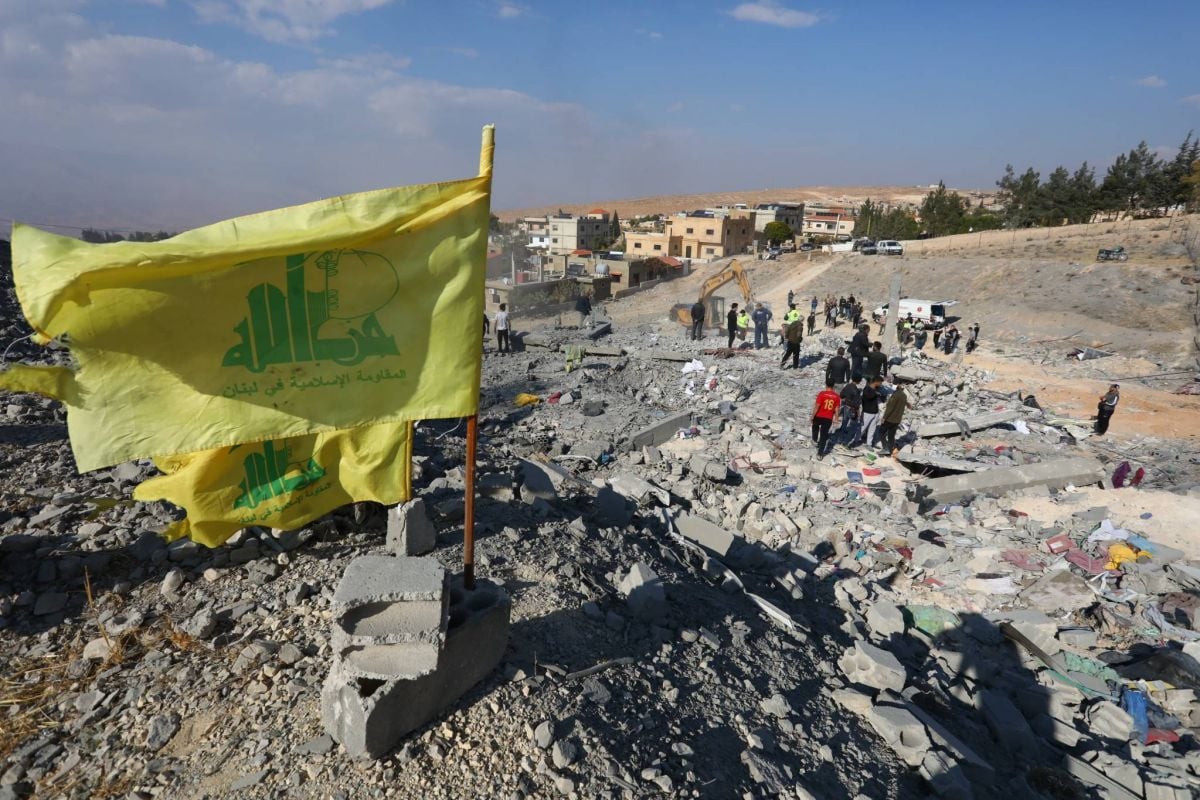
A Hezbollah flag planted on a hand in the ruins of a building bombed by Israel, in Hermel, November 2024. (Credit: Mohammad Yassin/L'Orient Today)






BEIRUT — Hezbollah said it would disregard Cabinet's decision to set the end of 2025 as a deadline for the party's disarmament, a plan that was the result of a five hour debate among Prime Minister Nawaf Salam's ministers on Tuesday.
The government committed “a grave sin by taking a decision that strips Lebanon of the weapon of resistance against the Israeli enemy,” Hezbollah said in a statement released Wednesday, adding that it will therefore act as if the decision "doesn't exist."
Cabinet's highly anticipated meeting on Hezbollah's disarmament ended with an announcement from Salam that the ministers had tasked the Lebanese Army with drawing up an arms monopoly plan and would meet again on the topic on Thursday.
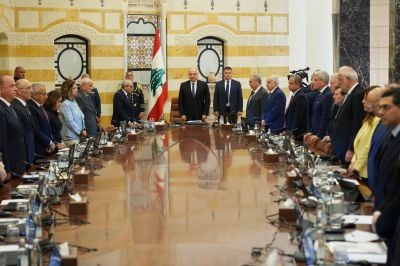
“We have decided to continue discussions on the document presented by the U.S. on Thursday and to task the Lebanese Army with drawing up a plan for the monopoly of weapons before the end of the year and submitting it to the Cabinet before the end of this month,” Salam said.
Shortly before the Cabinet was adjourned, Environment Minister Tamara al-Zein and Health Minister Rakan Nassereddine — affiliated with Hezbollah — left the chamber, while Administrative Development Minister Fadi Makki remained, a political source told L'Orient Today. The first two, however, remained on the Baabda Presidential Palace grounds.
According to Hezbollah, “this decision is a clear violation of the national charter and contradicts the government's ministerial statement, which stated in Paragraph Five the following: ‘The government commits, in accordance with the National Accord Document agreed upon in Taif, to take all necessary measures to liberate all Lebanese territories from Israeli occupation and to extend the sovereignty of the state over all its territory exclusively through its own means, and to deploy the Lebanese army in the internationally recognized Lebanese border area,'" the party said in its statement.
'Dictates by American envoy'
“This decision came as a result of dictates by the American envoy [Tom] Barrak, as was mentioned in the justifications for presenting it to the Cabinet and in the reasons for its adoption — with Prime Minister Salam announcing that the Cabinet ‘decided to continue discussions on the American paper next Thursday, and tasked the Lebanese Army with developing an implementation plan to restrict arms before the end of the current year.’ This decision serves Israeli interests entirely and leaves Lebanon exposed to the Israeli enemy without any deterrent,” Hezbollah said.

“The government has completely disregarded the commitment made by President of the Republic General Joseph Aoun in his oath of office speech, in which he stated:'My pledge is to call for a discussion of a comprehensive defense policy as part of a national security strategy at the diplomatic, economic, and military levels, enabling the Lebanese state — I repeat, the Lebanese state — to remove the Israeli occupation and repel its aggression from all Lebanese territories.’”
“What the government has decided is part of a strategy of surrender and a clear abandonment of Lebanon’s sovereignty,” according to Hezbollah.
"At the same time, we remain open to dialogue, to ending the Israeli aggression on Lebanon, to liberating its land and releasing the prisoners, and to working toward building the state and rebuilding what was destroyed by the brutal aggression. We are ready to discuss a national security strategy, but not under the shadow of aggression," the party said.
Hezbollah noted that the agreement must be implemented by the Israeli side first, and the government must prioritize taking all necessary measures to liberate all Lebanese territories from Israeli occupation, as stated in its ministerial declaration.
The international community continues to press the Lebanese authorities to disarm Hezbollah and draft a clear execution plan with precise deadlines. Israel believes Hezbollah is weakened after the latest conflict and refuses to accept any conditions prior to disarmament.
Government should put effort to end 'Israeli killing machine,'
Tuesday’s Cabinet meeting garnered mixed reactions from Lebanese politicians.
Hezbollah's ally, the Amal Movement, said Wednesday in a statement that since the cease-fire, Israel "has repeatedly failed to abide by the agreement and continues its aggression, launching airstrikes and carrying out assassinations using drones, violating Lebanese airspace, and maintaining its occupation of vast areas of Lebanese land."
"Additionally, it prevents the residents of the border villages from returning to their homes after they were completely destroyed."
"It would have been more appropriate for the Lebanese government — which is rushing to offer further free concessions to the Israeli enemy through new agreements — to instead dedicate its efforts to first consolidating the ceasefire and putting an end to the Israeli killing machine, which has so far claimed the lives of hundreds of Lebanese citizens, leaving many dead and wounded," the statement said.
Fadi Makki, the only Shiite minister not affiliated with the Amal-Hezbollah alliance, said he had “expressed his reservation within the institutional framework, at the Cabinet table, specifically regarding the aspect related to setting a deadline” for Hezbollah’s disarmament, in a message posted on X on Tuesday.
“My position stems from a deep conviction that these discussions must continue calmly and responsibly, in a way that ensures the interest of all Lebanese and addresses their legitimate concerns,” he explained.
'Weapons incompatible with the principle of state-building'
Justice Minister Adel Nassar stated in an interview with Sky News Arabia that: “Hezbollah must understand that weapons are incompatible with the principle of state-building,” and that it therefore “cannot remain an obstacle to that process.”
Foreign Minister Joe Rajji, affiliated with the Lebanese Forces (LF), also described the decision as “historic,” saying it “meets the expectations of the Lebanese people.”
“We say to the people and the international and Arab communities in a clear way: this decision is decisive and final, and we will not go back on it,” he said.
In a statement, the LF press office said the decision should have been made long ago, noting it is provided for in texts such as the Taif Agreement, U.N. Security Council Resolutions 1559 and 1701, and the cease-fire agreement reached last November.
It criticized Hezbollah’s camp for “pouring out its anger against the president, who only remained faithful to his inauguration speech, and against the prime minister, who only remained faithful to the ministerial declaration.”
“The Cabinet on Aug. 5 put Lebanon on the path to a return to a real and normal state,” the LF said.
Agriculture Minister Nizar Hani said “there is nothing new or surprising” in the Cabinet session held yesterday, which will continue tomorrow, as “everything that is being discussed is part of a national debate that has been going on for several months.”
“The discussion in yesterday’s session was calm and constructive, without any confrontation,” he added.
Denying that the government had “turned against the Taif Agreement,” Hani said his “mission is to implement the ministerial decision, to which all parties have committed themselves to the Lebanese people.”
He also stressed the need for Lebanon to “move towards a phase of recovery and development, rather than remain in a stalemate that has contributed to the economic collapse.”
Mufti Sheikh Abdellatif Derian, the highest Sunni authority in the country, called Salam, praising the government’s recent decision as being: “in the interest of Lebanon and the Lebanese,” according to NNA.
The Political Bureau of the Kataeb Party, chaired by party leader MP Sami Gemayel, held a meeting on Wednesday dedicated to commemorating the fifth anniversary of the Beirut Port explosion.
The bureau praised the “government's vote on the item related to illegal weapons, accompanied by tasking the army with developing a plan for implementation and setting deadlines,” in a statement.
It called the decision “historic,” stating that it “puts Lebanon on the path toward restoring sovereignty and places the state on the road to reclaiming its free decision-making power.” Kataeb renewed its confidence in the government to continue discussions on the issue of restricting weapons until a final resolution is reached.
The bureau warned against any attempt to approach this decision negatively or to continue using intimidation and coercion, arguing that “those times are over and will not be allowed to return under any pretext.”
It rejected the statements made by Hezbollah’s Secretary-General Naim Qassem, describing them as “immersed in denial and an attempt to drag the country into a confrontation that the Lebanese people reject.” It also commended the efforts of the security forces in containing unlawful field movements “used to pressure or threaten the sovereign decision.”
The Council of Maronite Bishops, in a statement following their monthly meeting at the patriarchal summer residence in Diman, chaired by Maronite Patriarch Bechara al-Rai, Wednesday, said that they “received with great interest the decisions of the Lebanese government, especially the decision to make the possession of arms exclusive to the state.” They viewed this as a step toward building a “strong and orderly state that extends its sovereignty over all Lebanese territory, free from any group imposing its will over another.”