






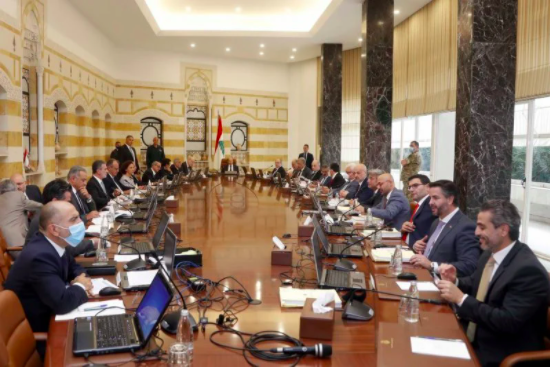
Cabinet, picture here in September 2021, will reportedly finalize the 2022 draft budget law today before sending it to Parliament. (Credit: Dalati & Nohra)






Want to get the Morning Brief by email? Click here to sign up.
The cabinet will convene at 2 p.m. today in Baabda amid expectations it will finalize the 2022 draft budget, which will then be sent to Parliament. The treasury advance to help fund fuel purchases by Electricité du Liban was nixed from the draft, however, as Prime Minister Najib Mikati’s cabinet decided last week to separate it from the rest of the budget. The government is expected to hold discussions in the near future on a reform plan for the electricity sector, needed to unlock potential World Bank financing for natural gas and electricity transfers to Lebanon, as well as Lebanese state money for EDL. Other issues, including potential taxes and at what rate to set the “customs dollar” — or the lira exchange rate to assess customs duties — have also been issues of contention in the past two weeks of discussions. On Feb. 3, the cabinet set the “customs dollar” at the Sayrafa rate, exempting food and medicine imports from the fees, a move that has raised concerns that it would fuel further inflation. The government has been discussing the draft budget, a prerequisite for any potential International Monetary Fund support, since Jan. 25.
A ceremony will be held today at 11 a.m. to re-inaugurate Lebanon’s National Library, located near the Sanayeh Gardens in Beirut, following decades of closure. Culture Minister Mohammad Mortada tweeted that “the pulse of life will return to the heart of the National Library.” An old Ottoman building in the neighborhood, near Downtown Beirut, was set aside in 1999 as the home of the National Library, which had been closed since 1979 during Lebanon’s civil war. New 20 years of restoration work later, the National Library saw a false start in December 2018, when President Michel Aoun inaugurated the building, only for it to close for further maintenance. The building suffered further damage from the Aug. 4, 2020 Beirut port explosion.
President Michel Aoun, Speaker Nabih Berri and Prime Minister Najib Mikati separately met yesterday with US energy envoy Amos Hochstein. The officials discussed the long-stalled indirect maritime border negotiations with the Israeli government as well as US-backed plans to import electricity and gas from Jordan and Egypt via Syria. Israel-born Hochstein is the top US energy diplomat and Washington’s mediator for the negotiations on Lebanon’s border with occupied Palestine. He arrived in Beirut on Tuesday with proposals to move the negotiations forward, according to local media reports. In a statement, Aoun’s office said the President told Hochstein that Lebanon was ready to “study the points” raised in the diplomat’s proposals. Hochstein also met with Lebanese Army chief Joseph Aoun, a sit-down described by the US Embassy in Lebanon as “fruitful.” The indirect talks between Lebanon and Israel have been on hiatus since May 2021.
Lebanon received a letter from Germany asking for information on Banque du Liban Gov. Riad Salameh’s finances, Reuters reported on Tuesday. Germany is now the fourth European country to reportedly ask Lebanon for assistance investigating the governor’s wealth. Reuters reported last week that France and Luxembourg had requested information about Salameh’s bank accounts and assets, and the Swiss attorney general’s office said last year it had requested assistance from Beirut in a probe of “aggravated money laundering.” Amid the growing probes into his financial activity, Salameh has repeatedly denied any wrongdoing. In an interview with L’Orient-Le Jour on Jan. 19, Mikati said that he argued to President Aoun against removing Salameh at the central bank because it might upset the “international community.” The US has long defended the central bank governor. In May 2020, the US ambassador to Lebanon, Dorothy Shea, said that Salameh — the architect of Lebanon’s disastrous financial engineering policies — “enjoys great confidence in the international financial community.”
A Lebanese judge ordered airlines and ground service operators at the airport to pay the Health Ministry and the Lebanese University “in fresh dollars” a portion of the revenues from PCR tests done there. The matter was referred to the Court of Auditors after allegations surfaced that tens of millions of dollars in PCR test fees were not paid to the two institutions, in violation of the agreement between parties. In a statement late last month, the Lebanese University claimed it was owed $50 million. On Jan. 10 the government began requiring travelers to pay for PCR tests conducted at the airport, which initially cost $50 before being revised to $30.
In case you missed it, here’s our must-read story from yesterday: “What’s to become of Beirut’s forgotten castle?”