






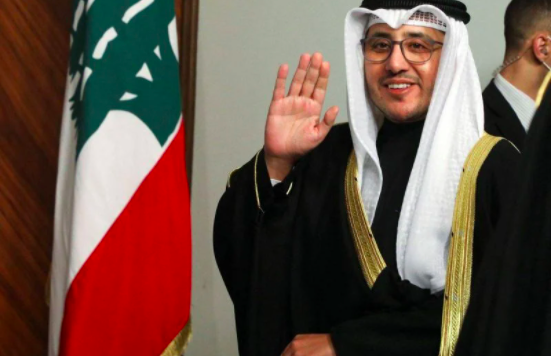
Kuwait's Foreign Minister Sheikh Ahmad Nasser Al-Mohammad Al-Sabah, who last weekend delivered a list of 12 demands that the Gulf monarchies will require Lebanon to fulfill in order to end the diplomatic rift between the two parties. (Credit: Mohamed Azakir/Reuters)






Want to get the Morning Brief by email? Click here to sign up.
Lebanon’s response to a Kuwaiti proposal to resolve a diplomatic crisis with the Gulf Arab monarchies is “under consideration,” the head of Kuwaiti diplomacy announced yesterday. Sheikh Ahmad Nasser al-Mohammad Al-Sabah, whose remarks followed a meeting of Arab foreign ministers, added that decisions would be taken during the follow-up to this initiative. On Saturday, before a meeting with Gulf Arab counterparts, Lebanon’s Foreign Minister Abdallah Bou Habib had told Al Jazeera he was not going to “hand over” Hezbollah’s weapons nor “end Hezbollah’s existence.” “It is out of the question in Lebanon,” he said, “We are going for dialogue.” Bou Habib also insisted that implementing UN Security Council Resolution 1559, one of the terms set by the Kuwaiti foreign minister and which calls for Hezbollah’s disarmament, “will take time.” The Gulf diplomatic crisis, ongoing since October, has added to the difficulties facing Lebanon as it struggles with a more than 2-year-old financial crisis that the World Bank has described as one of the worst recorded in modern history.
Over the weekend, two “new” names threw their hats in the ring as candidates in parliamentary elections scheduled for May 15. Following a meeting Saturday with the Tashnag party, Elias Murr announced the candidacy of his son Michel to represent the Metn area, following in the footsteps of Elias Murr’s father, also Michel, who served in Parliament from 1968 to 1972 and then from 1991 until his death in 2021. Elias Murr — who served as interior minister from 2000 to 2005 and then as defense minister until 2011 under six different cabinets — said that his son “aspires for change and wants to live in Lebanon.” The National Liberal Party announced Sunday the candidacy of its secretary-general, Dory Chamoun, who will run for one of three Maronite seats in the Baabda constituency. The National Liberal Party also announced an alliance with the Lebanese Forces, led by Samir Geagea, in this constituency and unspecified “others.” In the electoral district of Baabda, there are six seats waiting to be filled: three Maronite, two Shiite and one Druze.
At least six of the nine Daesh fighters killed by the Iraqi army on Saturday were of Lebanese origin. According to information confirmed by L’Orient Today’s correspondent in Tripoli, four of the Lebanese militants killed were from Wadi al-Nahleh-Beddawi, while the other two were from Akkar. The Iraqi strikes against Daesh came in retaliation for a nighttime attack carried out on Jan. 21 and claimed by Daesh. According to informed local political sources, scores of young people have disappeared in recent weeks to illegally join Daesh in Iraq, taking a route that passes through Akkar and into Syria. Sources at the Interior Ministry have for their part minimized this phenomenon, however they have not denied it.
The Litani River Authority, which operates hydroelectric facilities, sounded the alarm on Saturday, blaming energy-intensive cryptomining for straining its resources and draining the electricity it generates. In a statement, the public utility called for “strict measures to remove the infringements from the public [electricity] network, especially from mining devices for cryptocurrencies,” the state-run National News Agency reported. The Litani River Authority said cryptomining is increasing demand on its power provision by 20 percent, an amount equivalent to 8 megawatts of its production capacity. In 2020, the Litani River Authority generated a little under 7 percent of Lebanon’s public electricity, according to Electricité du Liban statistics. Cryptomining, or the use of energy intensive set-ups of hardware to conduct complex computations to produce new cryptocoins, has come under increased international attention and criticism for its growing use of electricity. Given the already extremely dire shortcoming in state power provision, Lebanon can ill afford such an additional drain.
The United States aims to redirect $67 million in military assistance intended for Lebanon's armed forces to support members of the military, Reuters reported Saturday. According to a notification sent to Congress, the State Department plans to change the content of previously appropriated foreign military funding for Lebanon to include “livelihood support” for members of the Lebanese military, citing “economic turmoil as well as social unrest. “Livelihood support for [armed forces] members will strengthen their operational readiness, mitigate absenteeism, and thus enable LAF members to continue fulfilling key security functions needed to stave off a further decline in stability,” said the notification to Congress, seen by Reuters. According to the United Nations, more than three-quarters of Lebanon’s 6 million inhabitants have been pushed into poverty, with the national currency’s value taking a dive of more than 90 percent since 2019. Discontent has been brewing within the security forces as inflation has eroded the value of soldiers’ wages. With the average soldier's monthly paycheck now worth around $55 at the parallel market exchange rate, many in the military have been forced to take on side jobs, and some have even quit altogether.
The cabinet reconvenes for 2022 budget discussions this morning with EDL funding a potential sticking point. “The electricity file is stormy,” acting Information Minister Abbas Halabi said Friday. “Energy Minister Walid Fayad has been asked to justify” the LL5.25 trillion treasury advance allocated to EDL to spend on fuel, according to Halabi. The government is also still debating the so-called “customs dollar,” or the specifically designated Lebanese lira to US dollar rate that would be used to calculate customs duties on imports, which is currently set at LL1,500. The cabinet has been meeting since last Tuesday to discuss the long-awaited 2022 draft budget, which was published by the Finance Ministry on Jan. 21. The budget, already deemed controversial by many financial experts, is seen as critical for any effort to unlock an International Monetary Fund financial rescue package. The document forecasts a deficit of LL10.26 trillion — 20.77 percent of expenditures — excluding the allocation for EDL.
In case you missed it, here’s our must-read story from over the weekend: “Lebanon’s economic crisis is reshaping career planning for university students”

 8 p.m. recap: Israel again threatens Beirut’s south suburbs; 2 ships hit near Hormuz; Riyadh football matches canceled