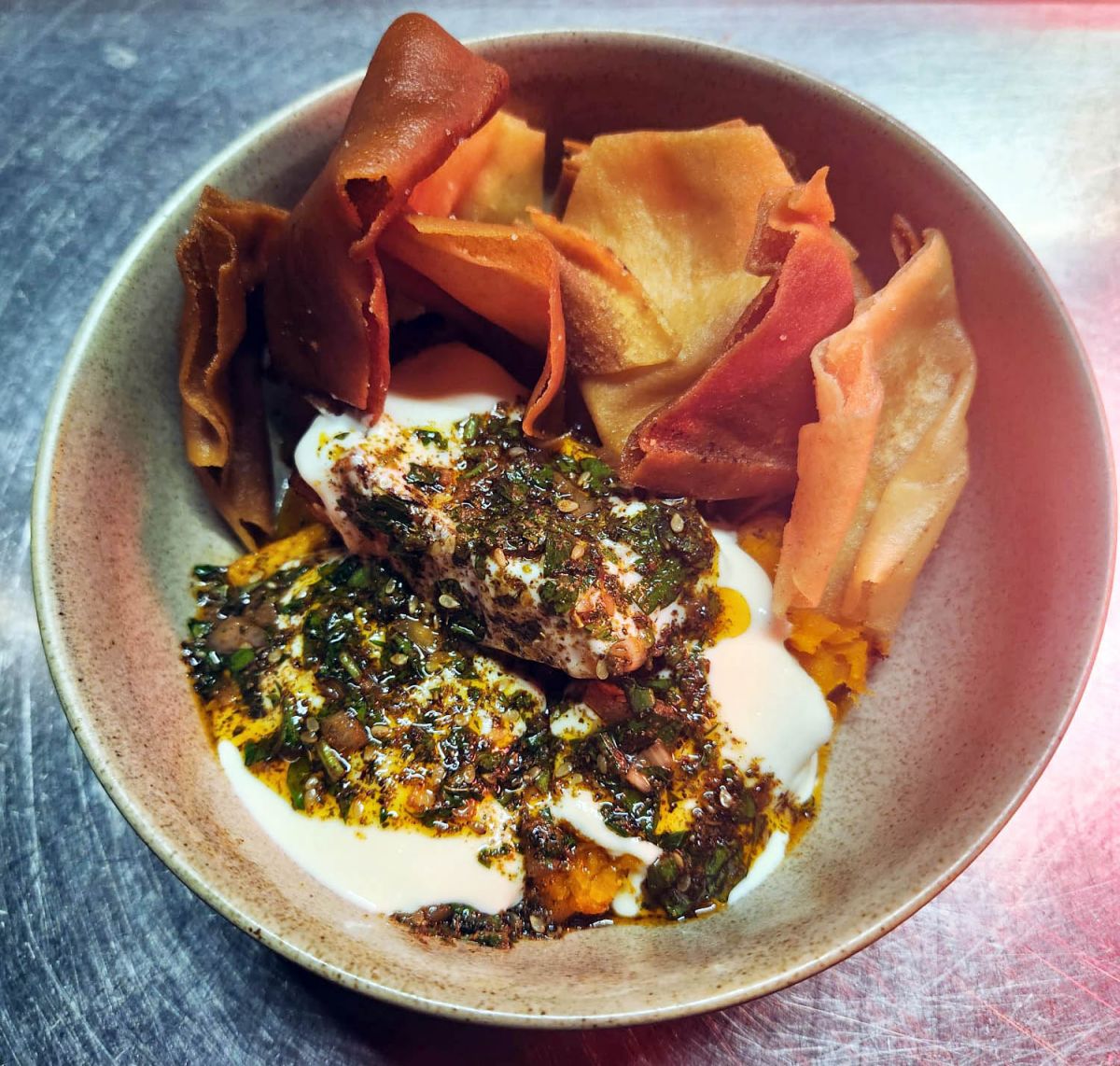
Fatteh revisited with red kabocha squash. An ideal recipe for autumn.


-

Preparation 25 min
Cooking time 20 min
-

Portions
4 people
-

Difficulty
Easy
Ingredients All ingredients
- For the kabocha squash marinade:
- 1 whole kabocha squash
- 5 grams sweet paprika
- 4 grams zaatar
- 80 grams olive oil
- For the chimichurri:
- 20 grams scallion
- 20 grams parsley
- 5 grams smoked paprika
- 5 grams cayenne pepper
- 10 grams zaatar
- 1 shallot
- 100 milliliters olive oil
- For the fatteh cream:
- 160 grams soy yogurt
- 2 grams garlic powder
- 20 grams tahini
- 10 grams lemon juice
- Salt
- For the chips:
- Lebanese pita bread (One whole bag)
- 500 milliliter neutral oil (sunflower)
- Salt
Preparation Vegan kabocha squash fatteh
For the chimichurri:
- Finely chop the herbs (parsley and scallion) and the shallot.
- Mix them together in a bowl with the spices and zaatar.
- Add room-temperature olive oil (do not heat).
- Mix well and let rest.
For the kabocha squash:
- Peel and seed the kabocha squash, then cut it into 8 half-moons, then slice each again (to obtain 16 pieces).
- Mix all the marinade ingredients together, and pour over the kabocha squash.
- Preheat the oven to 190 degrees Celsius with fan. On the lower rack, place another dish filled with water (for steam cooking), then bake the squash.
- Remove after 19 minutes of cooking.
For the fatteh cream:
- Mix all the ingredients together in a bowl.
- Add water until a creamy texture is achieved.
For the chips:
- Separate the Lebanese breads in two, then stack them.
- Cut each bread in half, then stack and cut them into 10 triangles.
- Fry in hot oil for 2 minutes.
- Drain on paper towel, salt to taste.
Plating:
- In a bowl, arrange 3 pieces of warm roasted kabocha squash.
- Add the bread.
- Ladle a spoonful of fatteh cream over the squash.
- Add the chimichurri on top.
- Salt to taste.
Vegan kabocha squash fatteh
-
Preparation 25 min
Cooking time 20 min
-
Portions
4 people
-
Difficulty
Easy
Ingredients All ingredients
- For the kabocha squash marinade:
- 1 whole kabocha squash
- 5 grams sweet paprika
- 4 grams zaatar
- 80 grams olive oil
- For the chimichurri:
- 20 grams scallion
- 20 grams parsley
- 5 grams smoked paprika
- 5 grams cayenne pepper
- 10 grams zaatar
- 1 shallot
- 100 milliliters olive oil
- For the fatteh cream:
- 160 grams soy yogurt
- 2 grams garlic powder
- 20 grams tahini
- 10 grams lemon juice
- Salt
- For the chips:
- Lebanese pita bread (One whole bag)
- 500 milliliter neutral oil (sunflower)
- Salt