





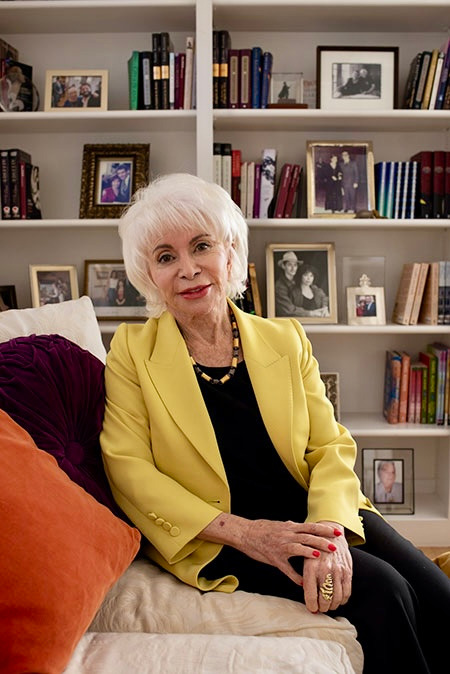
Isabel Allende, recent portrait by Lori Barra. Courtesy of the novelist.






This is a little-known “chapter” in Isabel Allende’s life. In the 1950s, while still a teenager, the future author of "The House of the Spirits" — an international bestseller whose 1993 film adaptation starring Meryl Streep and Antonio Banderas cemented her immense publishing success — lived for two years in Lebanon, between the ages of 14 and 16.
An unexpected and little-known stay that sheds new light on the journey of someone who is now one of the leading figures in contemporary Latin American literature.
Born in 1942, the daughter of Chilean ambassador Tomás Allende Pesce and niece of Salvador Allende, the Chilean president overthrown by General Augusto Pinochet in a 1973 coup, Isabel Allende has had a life shaped by exile. A committed journalist before becoming a novelist, she left Chile in 1975 and first took refuge in Venezuela, then in the United States, where she has lived for nearly forty years, in California. Yet it was in Beirut, several decades earlier, that a forgotten part of her personal story took shape. An episode that this great literary voice, now 84, shares exclusively with readers of L’Orient-Le Jour.
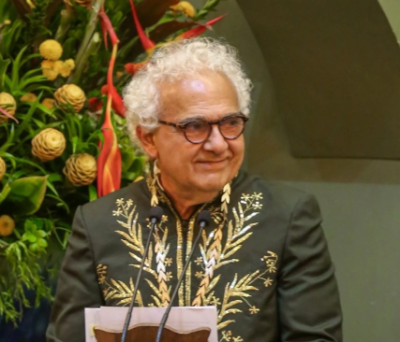
It all started with a phone call from the Chilean ambassador to Lebanon, Marcos Correa. "Did you know that Isabel Allende has a personal connection to Lebanon?" asks this archive enthusiast who loves to unearth traces of old ties between Chile and Lebanon. A few months ago, in these very columns, he revealed the correspondence between Chilean poet Gabriela Mistral (1889-1957) and Lebanese poet and philosopher Gibran Khalil Gibran, whose witness documents he discovered in the archives of the National Library of Chile.
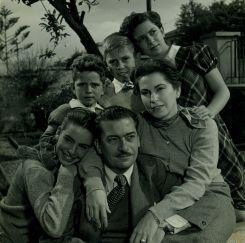
This time, it wasn't about archives, but a trail that might lead us to the Beirut roots of a living legend of world literature. A legend named Isabel Allende whom Marcos Correa met in 1994, at a luncheon in her honor given by Ramón Huidobro, director of the Palacio Septiembre, home of Chile’s Diplomatic Academy, on the occasion of her being awarded the Gabriela Mistral Order of Merit, at the rank of Grand Officer of Culture. When he cross-referenced his memories of that meeting with documents on the history of the Chilean Embassy in Lebanon, he discovered a most unusual family and diplomatic link: "Ramón Huidobro had been consul and commercial attaché of Chile in Lebanon between 1956 and 1958. And his family, who accompanied him during that time in Beirut, included his stepdaughter Isabel Allende, the daughter from his wife’s first marriage."
This Lebanese stay, noted in some biographies of the novelist, seems to have largely flown under the radar. Apparently, she had never mentioned it in interviews. Yet when asked by Marcos Correa about her years in Lebanon, she told him she had "mentioned them in 'Paula,' the only one of her books written in the first person singular. Naturally, since she recounts the story of her family and her own life as a long letter addressed to her daughter Paula, who died from a rare illness," reports the diplomat.

This sparked our curiosity and prompted us to try to contact Isabel Allende to learn more about what Lebanon had left within her.
The task was not easy. Now aged 84 and living in California for nearly forty years, the novelist is hard to reach and rarely gives interviews, we were warned. But apparently, she liked the subject of our request, because once we had cleared the hurdles of publishers and personal assistants, she readily agreed to answer L’Orient-Le Jour’s questions. She did warn us, though, that her memories, seventy years old, might be a bit blurred by time.
This is particularly true of the address where she believes she lived in Beirut, which does not exactly match the address uncovered by Ambassador Correa’s research. According to the archives, the family would have lived in the Verdun neighborhood, on Chile Street specifically, where the Chilean consulate and the consul’s apartment were located, rather than in the courthouse (Adlieh) area, as the novelist suggests.
But ultimately, the vagueness of memory doesn’t matter much. What’s striking in her answers is the vividness with which certain faces, scenes, and emotions resurface. Through her memories, we glimpse a 1950s Beirut, with its codes, its unique urban vibe, and its first political events, but also her sparkling personality and love of storytelling that have shaped her work. The proof is in the answers, which we present here exactly as she gave them to us, edited only to translate from English to French.
Dear Isabel Allende, tell us how you found yourself in Beirut in the 1950s?
My stepfather, Ramón Huidobro, was a diplomat, in charge of the consulate and Chilean affairs for the region. The office and our residence were in Beirut, in a modern building facing the traffic circle in the Adlieh/Badaro neighborhood, a central spot during the tumultuous political crisis of 1958, which led to the landing of U.S. Marines. They stayed three months and I gave my first kiss to one of those very young marines. He smelled of chewing gum and cigarette. I never forgot him, even though it was nothing like the kisses you see in the movies.
What memories do you keep of this city and of Lebanon in general?
Beirut was the Paris of the Middle East, the hub of international banks, jewelry stores, restaurants, fashion, and more. The city offered a fascinating contrast between modern and old buildings; mosques, churches, and synagogues; luxury Cadillacs and camels in the streets; the roar of traffic, Arabic music, and the call to prayer. Commerce everywhere!
At the time, girls my age had no social life: we weren’t allowed to go out alone in the street or attend any parties. My life was limited to home and school. Sometimes we went to the [public] beach but it wasn’t a pleasant experience: there were very few women and they were often harassed. Bathing took place in private clubs. But we did go to a skating rink and to the movies, although very few children’s films were shown at the time. My only real distraction was reading. My fondest memory is reading "One Thousand and One Nights," a book considered erotic and forbidden to me, hiding in my stepfather’s closet with a flashlight. That was the beginning of a lifelong passion for stories.
I attended the Lebanese British girls’ school, located in a beautiful Ottoman building in the Zoqaq al-Blat neighborhood. The headmistress, Miss Irene St. John, was my heroine. She was tall, thin, ramrod straight, unflappable, strict yet kind. I wanted to be like her, but I didn’t have what it took: I was short and hot-tempered. We began each day with prayers; all religions were accepted and spiritual practice was part of the curriculum. We lived by Victorian standards, which seems absurd in retrospect, but I loved it. My family situation was complicated and not very happy; school gave me structure, clear rules, security, and a moral code that has supported me for 70 years. We wore uniforms: a pleated skirt and a light blue or white blouse, which I also liked because nobody could show off. Vanity wasn’t an option.
There were several boarders, including a beautiful Indian girl named Shirley, with long hair and thick eyelashes, who was taken out of school at 15 because her parents had arranged a marriage for her back home. She had never met him, and he was 18 years older than she was. My best friend was Elizabeth Greenfiel, who lived with her terrible half-sister. She eventually emigrated to Canada, where she still lives. We have remained friends to this day.
Does this 'Lebanese experience' from your youth show up in any of your books?
In my third novel, "Eva Luna," one of the characters is an Arab merchant, a traditional Muslim immigrant who becomes the young protagonist's protector, a father figure. I was able to draw on much of what I saw and learned in Lebanon to develop this character. This Lebanese experience was very important to me during my formative years, and I think it influenced my writing. It taught me to observe and listen attentively, to pay attention to everything around me, to perceive the world with all my senses, and it gave me a love of stories and the written word.
This article originally appeared in French on L'Orient-Le Jour.

 7 p.m. recap: Iran warns Egypt, Israeli soldiers vote in south Lebanon, Haret Hreik responds to Kataeb