





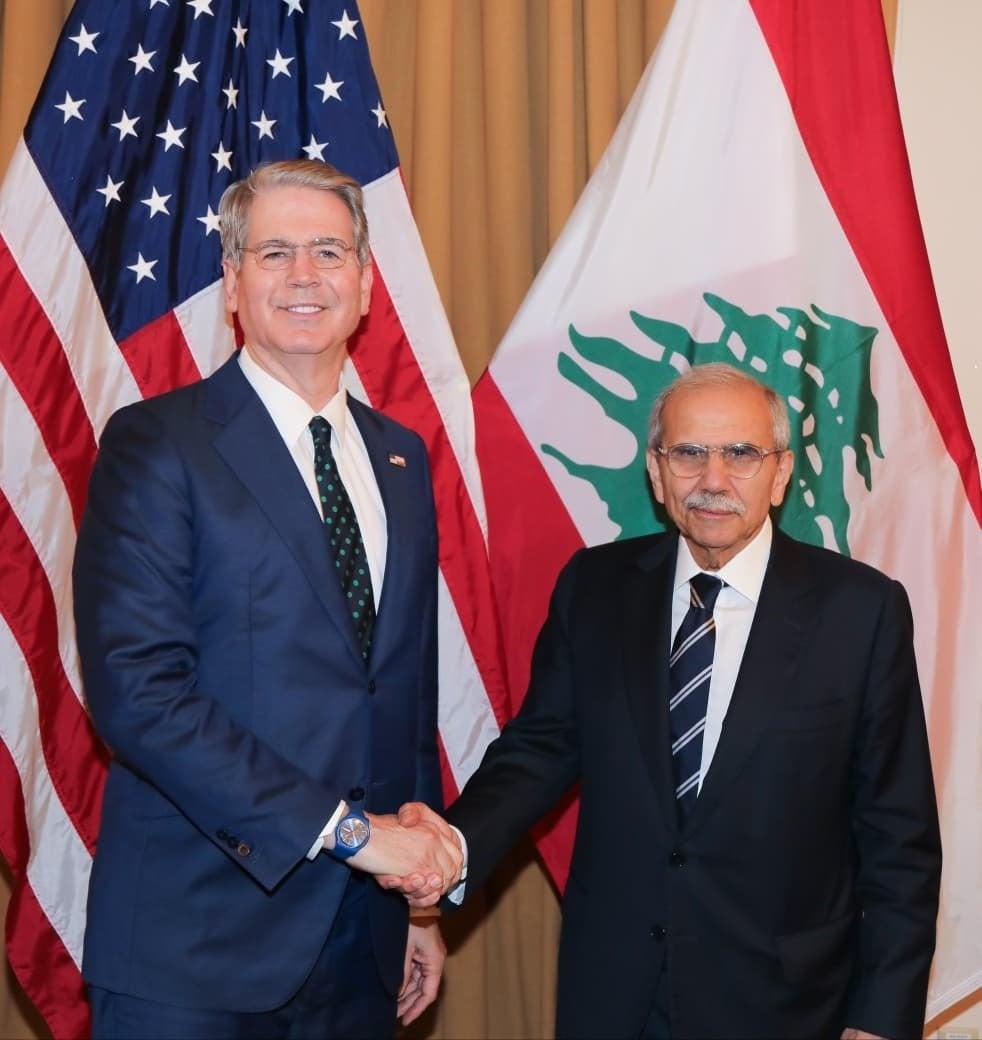
US Treasury Secretary Scott Bessent and Lebanese Prime Minister Nawaf Salam shake hands. (Credit: Photo taken from Prime Minister's office X account)






BEIRUT — Prime Minister Nawaf Salam met Monday with U.S. Treasury Secretary Scott Bessent in Washington following the United Nations General Assembly last week in New York. Finance Minister Yassine Jaber and Lebanon’s ambassador to the United States, Nada Hamadeh Moawad, were also present.
Salam and Bessent discussed economic and financial relations between Lebanon and the United States. "Salam outlined the progress made by the government on financial and banking reforms, as well as the ongoing steps to complete these reforms, address the repercussions of the financial crisis and rebuild the banking sector," the prime minister's office said in a post on X.
The two sides also discussed ongoing negotiations with the International Monetary Fund and cooperation with the World Bank. "Salam sought U.S. support to move forward on both fronts and secure the necessary backing for the reform and economic recovery program," the statement added.
The meeting also addressed efforts to combat the cash economy, money laundering and terrorism financing, with the goal of "rebuilding trust in Lebanese finance and strengthening its integration into the international financial system," the statement said.
Since Lebanon’s economic collapse in 2019, individuals and businesses have increasingly relied on cash and foreign currencies outside the banking system. The resulting lack of trust has fueled a cash-based economy, complicating efforts to recapitalize banks and restore financial intermediation.
'The Lebanon we want to build must look like you'
Salam also told young Lebanese and professionals in Washington that "there cannot be a state with two armies or a state with two decisions," assuring them that the government would continue its reforms and efforts to extend state authority across the country. Building the state rests on "two inseparable pillars": genuine domestic reform and full state sovereignty over its entire territory, he said.
Salam stressed, however, that the government's success would not be measured solely by the number of laws or projects it adopts, but also by its ability to build a country where young people can once again envision their future.
"The state's duty is not to ask them to return before it has fulfilled its own responsibilities, but to create the conditions that make returning to Lebanon a choice rather than a sacrifice," he said, according to a statement posted by the prime minister's office on X.
Salam met in Washington with young Lebanese and professionals, including members of the Lebanese Club at the World Bank and International Monetary Fund, alumni of International College and the American University of Beirut, as well as Lebanese working in various sectors. He said he wanted to meet and listen to them, particularly those who had left the country to study, work or pursue their ambitions.
According to Salam, young Lebanese are not asking for the impossible, but for a "state that respects its citizens" and allows them "to succeed through their skills," free from favoritism and clientelism, with a trustworthy justice system, an economy that creates opportunities and an administration that respects citizens and their time.
Salam said young Lebanese abroad were not "the generation Lebanon lost," but "part of the generation that must help rebuild it."
"The Lebanon the government seeks to build must look like its youth: young, ambitious, open, diverse, without barriers between its citizens and focused on the future," he added.
Referring to "the diversity of the participants," who came from different regions, religious communities and backgrounds, he said Lebanon should be a country where Lebanese identity serves as the common foundation and where neither religion, region nor personal connections determine a citizen's rights or future.
He also called on young Lebanese abroad to remain engaged in the country through their ideas, expertise, networks and investments, while asking them to hold the government accountable for its work and results.
"Hold us accountable for our work. Hold us accountable for our results," he concluded.

 7 p.m. recap: Aoun rejects leniency toward Hezbollah, Qatar eyes 2 power plants in Lebanon, Gantz bows out