





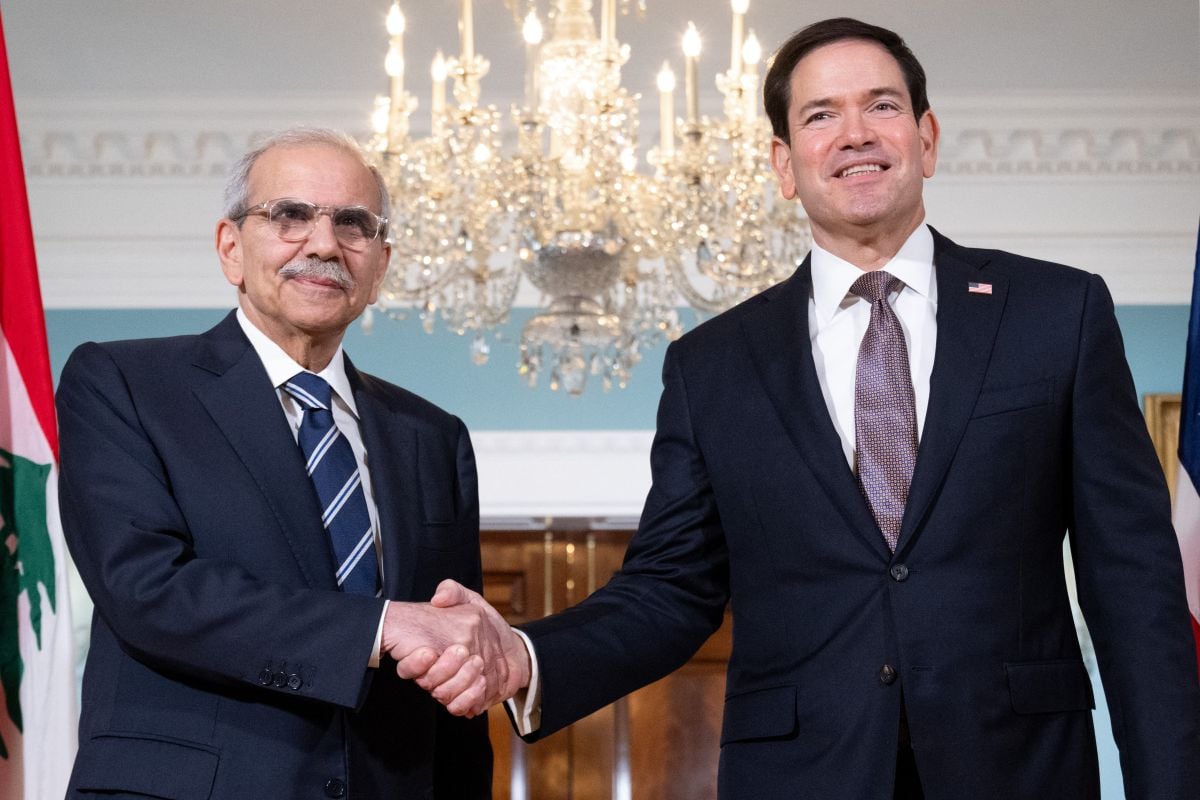
U.S. Secretary of State Marco Rubio shakes hands with Prime Minister Nawaf Salam (L) at the State Department in Washington, DC on Sept. 28, 2026. (Credit: Saul Loeb/AFP)






BEIRUT — After meeting with U.S. Secretary of State Marco Rubio in Washington on Monday, Prime Minister Nawaf Salam emphasized the importance of establishing a clear timeline for implementing the Israel-Lebanon framework agreement signed in June, according to a statement released by the Grand Serail.
The implementation of the agreement, which mainly consists of a gradual Israeli withdrawal from Lebanon in parallel with Hezbollah's disarmament, has stalled, with the next round of negotiations set to be held in early October in Rome. Meanwhile, Israel has only withdrawn from one of the three designated "pilot zones" in southern Lebanon.
The meeting at the U.S. Department of State was attended by Foreign Minister Joe Rajji, U.S. State Department Counselor Daniel Holler, Lebanon’s Ambassador to the United States Nada Hamadeh, and U.S. Ambassador to Lebanon Michel Issa.
According to the statement released by the Grand Serail, Salam stressed that Lebanon "seeks a renewed partnership with the United States to support the project of rebuilding the state and strengthening its legitimate institutions." He stressed the "need to move toward implementing the tripartite framework and translating the principles of reciprocity and phased implementation into practical steps and tangible results on the ground."
"This would lead to the restoration of Lebanon’s full sovereignty, the complete Israeli withdrawal from Lebanese territory, and the confinement of weapons to state authority across all of Lebanon," he noted.
In this context, he emphasized the "importance of establishing a clear timeline for implementing the commitments contained in the framework, ensuring progress on both the Israeli withdrawal and the extension of state authority and the state’s exclusive control over weapons." He also called for the "establishment of a credible verification mechanism to monitor implementation and ensure compliance with commitments, preventing non-implementation from being used as a pretext to obstruct the process."
Salam also stressed that the tripartite framework "is not limited to security arrangements, but also includes support for the government’s relief, recovery and reconstruction efforts, the rehabilitation of infrastructure and basic services, and creating conditions for displaced people to return to and remain in their areas."
He also stressed the "importance of continued U.S. support for the Lebanese Army and strengthening its capabilities so that it can carry out its responsibilities and extend state authority across the country."
Speaking to Lebanese television channel MTV, Salam said that his meeting with Rubio "went well."
For his part, Rubio reaffirmed the "United States’ commitment to supporting Lebanon and its legitimate institutions and to continuing its support for the Lebanese Army and strengthening its capabilities," according to the statement released by the Grand Serail. He also stressed the "importance of moving forward with the implementation of the tripartite framework in a manner that achieves stability and security."
The issue of support for the Lebanese Army, tasked since last year to disarm Hezbollah, was already at the heart of discussions on Sept. 17 in Paris, where representatives from 17 countries gathered for a preparatory conference. At the conference, President Joseph Aoun called on Lebanon’s international partners to speed up preparations for an international conference in support of the army, urging participants to establish a “roadmap” and a “clear timetable.”
The deadlock in the Lebanese-Israeli negotiations comes as Israel has been escalating its attacks on several southern villages. The Israeli army has been demolishing villages under its occupation, carrying out airstrikes, as well as artillery shelling in several districts. Earlier this month, Israel announced that it established operational control over the strategic Ali Taher ridge in the Nabatieh district.
Meetings with IMF, World Bank
Salam's visit to Washington, which comes after his participation in the 81st UNGA session in New York, also includes meetings with senior officials at the World Bank and the IMF. The meetings will focus on supporting the reform process and strengthening cooperation with the two international institutions. Salam and Finance Minister Yassine Jaber will meet U.S. Treasury Secretary Scott Bessent at 4 p.m. Washington time on Monday. This meeting was not initially included in the schedule of the visit.
The delegation, Jaber and Energy Minister Joe Saddi, will also meet at noon Washington time with the World Bank's Executive Director Abdulaziz al-Mulla, followed at 1:15 p.m. by a meeting with the vice president of the International Financial Corporation for the Middle East and Central Asia, Imad Fakhoury, and the vice president of Operations at the Multilateral Investment Guarantee Agency, Junaid Ahmad.
At 2 p.m., the delegation will meet with World Bank Vice President for Infrastructure Valérie Levkov. An hour later, Jaber and Saddi will join Salam for his meeting with World Bank Group President Ajay Banga, in the presence of Ambassador Hamadeh.
On Tuesday, at 10:30 a.m. Washington time, the delegation will meet with IMF Managing Director Kristalina Georgieva. The meeting is expected to address the progress of financial and banking reforms and the steps required to advance negotiations between Lebanon and the IMF.
On Sunday, Jaber said that the Washington meetings aim to advance talks with the IMF and strengthen partnership with the World Bank, building on the reforms Lebanon has completed, foremost among them the adoption of a law restructuring the banking sector, while efforts continue to finalize the financial gap law.
Jaber stressed that the goal is to advance negotiations with the IMF toward a Staff-Level Agreement, while also developing cooperation with the World Bank and securing additional support and financing for vital projects Lebanon needs, particularly in the energy and water sectors, reconstruction, digital transformation and social safety nets.

 7 p.m. recap: Katz threatens Beirut south suburbs; London seeks to protect Riyadh; Netanyahu discusses ‘eliminating’ Iran’s regime