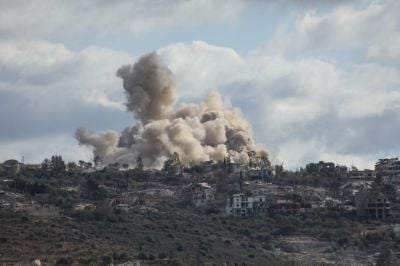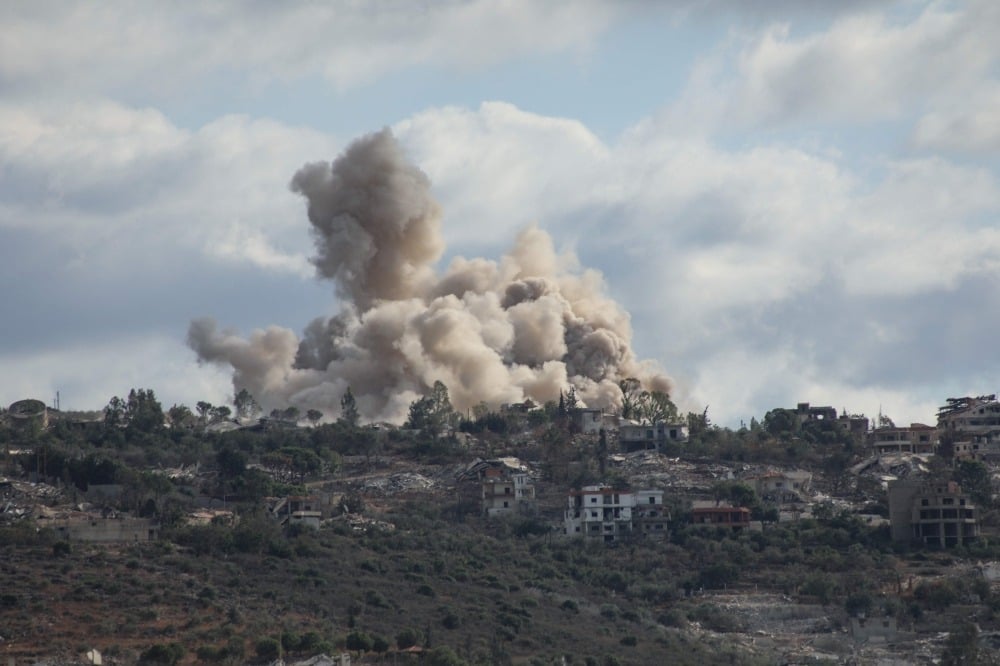
Smoke rises from the site of an Israeli-controlled explosion in the village of Majdal Zoun, seen from the neighboring village of Hannieh, in southern Lebanon, on Sept. 26, 2026. (Credit: Kawnat/Haju/AFP)






The Israeli army announced on Monday evening that it "completed a brigade-level operation in the village of Mansouri [Sour district], hours after escalating its air attacks on southern Lebanon on Monday.
Dozens of Israeli strikes and explosions were heard in the villages and valleys of the districts of Sour, Bint Jbeil, and Marjayoun at a time when Israeli warplanes and reconnaissance drones continue to violate Lebanese airspace and fly overhead.
Two more Israeli demolitions were subsequently reported late in the afternoon in the border villages of Houla (Marjayoun) and Aitaroun (Bint Jbeil). Israeli artillery fire also targeted the coastal village of Mansouri (Sour), as well as an area between the villages of Zawtar Sharqieh and Mayfadoun (Nabatieh). Earlier in the afternoon, our correspondent in the South reported that more than nine Israeli artillery shells had hit Mansouri.
Later in the evening, the Israeli army claimed that an interceptor was launched toward a "suspicious aerial target identified in the airspace where Israeli forces are operating in southern Lebanon," noting that details were under investigation.
The Israeli army's spokesperson Ella Wawiya wrote on X that "[Israeli] forces completed a brigade-level military operation in the village of Mansouri, located within the security zone, with the aim of preventing Hezbollah from re-establishing itself in the security zone."
"During the operation, the forces located and destroyed an underground route belonging to Hezbollah inside a civilian home in the village," she claimed.
Mansouri, the northernmost point of the Israeli-occupied zone in southern Lebanon along the coast, has faced methodical Israeli destruction for several months, including daily demolitions, artillery fire, and airstrikes.
Waweya added that forces from the 55th Brigade "destroyed more than 600 terrorist infrastructure sites and (...) destroyed eight underground routes."
Also on Monday, UNIFIL, whose mandate ends at the end of the year, said its head of mission and force commander, Gen. Diodato Abagnara, briefed troop-contributing countries in Beirut on "the situation on the ground in south Lebanon," as well as the mission's work under U.N. Security Council Resolution 1701 and its continued support for the Lebanese Army and local communities.
Abagnara thanked the countries for their "commitment to stability in the region" and stressed "the importance of maintaining an international presence" to help the parties fulfill their obligations under Resolution 1701 and "contribute to lasting peace in South Lebanon," as UNIFIL's mandate approaches its end.
Israeli attacks on various regions of the South have been relentless since the war re-escalated on March 2. Israel continues to destroy villages and infrastructure, without any response claimed by Hezbollah in recent months. On Sunday, Hezbollah's Secretary-General Naim Qassem stated, in a speech marking the second anniversary of the assassination of his predecessor Hassan Nasrallah in an Israeli strike on Beirut’s southern suburbs, that Hezbollah did not intend to abandon armed resistance. He also once again denounced the direct talks initiated by Lebanese authorities with the Israelis, though these discussions are currently on hold.
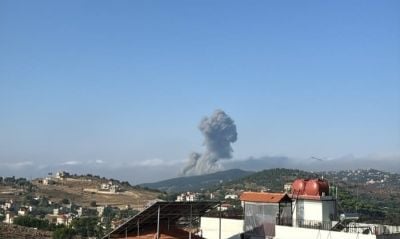
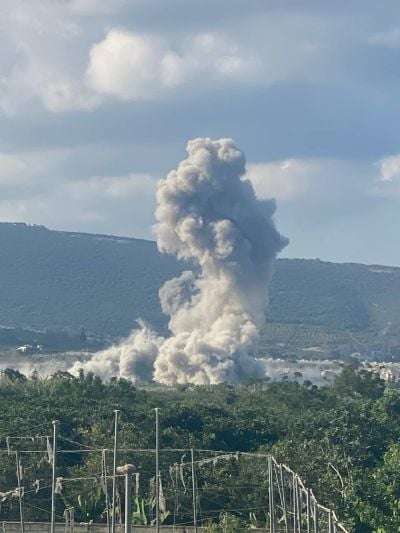
Israel carried out more than seven air strikes using high-capacity missiles, particularly in the Zibqine valley (Sour). That same valley was also heavily targeted at the same time, pounded by nearly 70 rounds of heavy artillery between 5 and 6 a.m. Explosions were heard in several other villages in the Sour district.
A house was destroyed by an Israeli strike in an area between Haddatha and Hariss. Haddatha and Srebbine were also heavily fired upon a little later. Two more strikes targeted the Debsh area west of Mais al-Jabal, and Tallousa in the Marjayoun district. The Israeli army also conducted several demolitions around Mais al-Jabal, near Marjayoun.
A few hours later, movement of Israeli troops was observed in the village of Mansouri, according to our correspondent. Meanwhile, artillery fire continued on Wadi Slouqi (Marjayoun) and the areas around Kfar Shuba and Shebaa (Hasbaya).
In the early afternoon, further strikes targeted Qantara and Zawtar Sharqieh. In the latter town, an Israeli lorry loaded with explosives was spotted, presumably intended to booby-trap buildings to later blow them up.
On the outskirts of the Wadi Zibqine valley, a unit from the Lebanese Army’s engineering regiment dismantled an Israeli spy camera fitted with a solar power system, which had been installed by an Israeli drone, according to our correspondent’s sources in the South. The occupying forces also set fire to houses and carried out a series of bombings in Mansouri.
Meanwhile, our correspondent in the Bekaa reports that the "cease-fire" monitoring committee (known as the “Mechanism”) gave the green light for the rehabilitation of the road linking Mashghara to Sohmor in West Bekaa, near the Qaraoun dam on the Litani River. This road had long been cut off following Israeli strikes on May 26. That targeting of the surroundings of Lebanon’s largest dam had raised fears of a major human and environmental disaster.
Nighttime attacks
The night was not much calmer. Israeli fire hit the areas of Kfar Tibnit and Nabatieh Fawqa (Nabatieh) after midnight, at a time when illumination bombs were dropped over Haddatha and Hariss, as well as in the skies over Wadi Slouqi. Mansouri was also targeted by particularly powerful missiles after midnight.
The previous day's Israeli strikes affected seven villages in the South, while 13 other localities were shelled with artillery. Israeli helicopters also carried out attacks in several villages, some of which saw large-scale demolitions.
Reporting contributed by our correspondent in southern Lebanon, Muntasser Abdallah.