






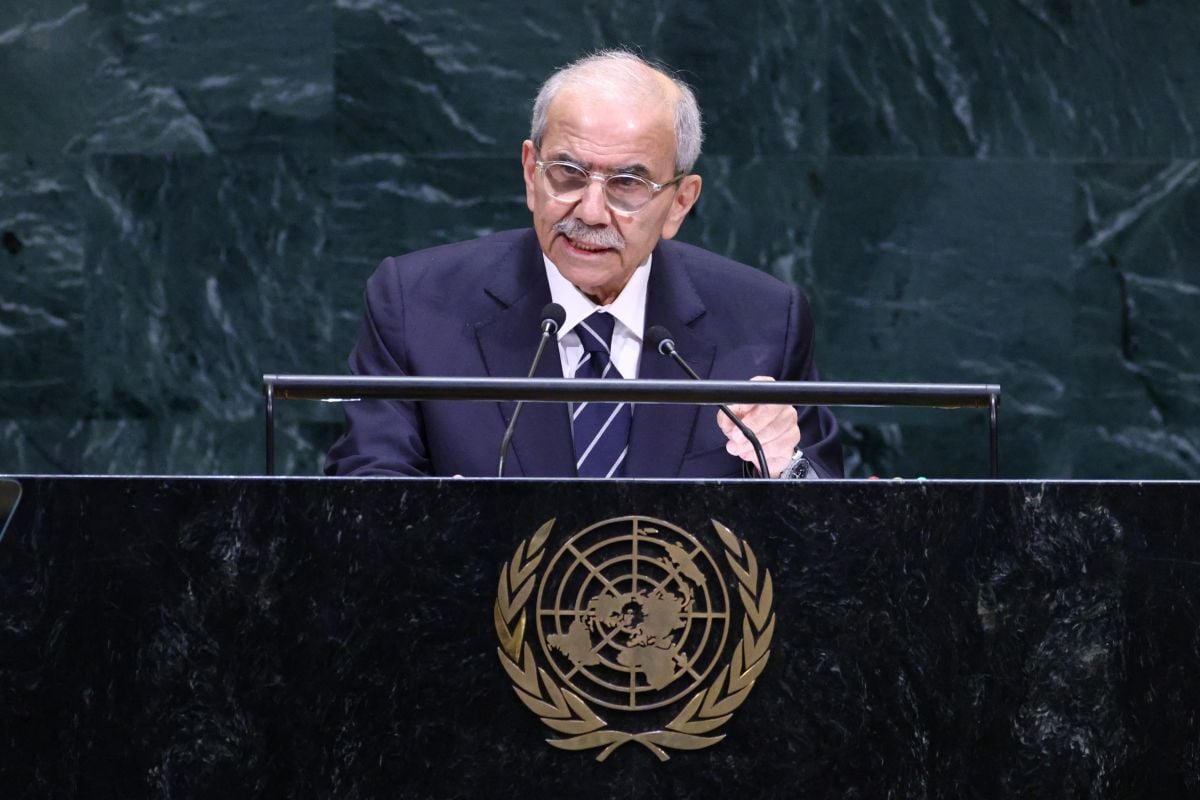
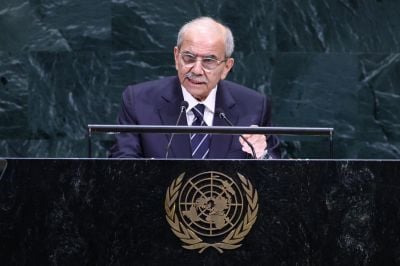
Prime Minister Nawaf Salam speaks during the 81st United Nations General Assembly at the U.N. headquarters in New York on Sept. 25, 2026. (Credit: Leonardo Munoz/AFP)






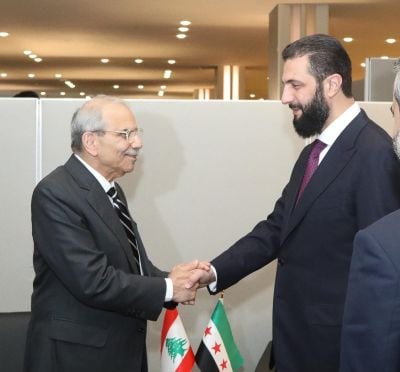
"No one speaks in the name of Lebanon": as the country remains caught between Israeli occupation, the power struggle over the monopoly on weapons, and uncertainty about the future of the United Nations Interim Force in Lebanon (UNIFIL), Prime Minister Nawaf Salam on Friday defended his vision of a fully sovereign state before the U.N. General Assembly, able to carry out the reforms needed for the country's recovery. This speech was consistent with his positions over the past two days during meetings with Syrian President Ahmad al-Sharaa and Iranian President Massoud Pezeshkian. Israeli withdrawal, monopoly on weapons, international presence in southern Lebanon, reforms, and the Palestinian issue: L’Orient-Le Jour reviews the main themes and key quotes from his speech.
For Salam, decisions regarding war and peace must fall exclusively to the institutions of the state. "No one speaks in the name of Lebanon and no one negotiates on its behalf except for the Lebanese state, through its constitutional institutions," he emphasized at a time when Iran and its local allies prefer to see the Lebanese issue included in negotiations between Washington and Tehran. "It is true that Lebanon is affected by developments around it. But that does not mean we accept it becoming an arena for others' conflicts or a hot bargaining chip in their hands. Lebanon's future will not be decided for it, and its security and stability cannot become the price of settlements made in its absence," he also said.
At the same time, he acknowledged Lebanon's responsibility to strengthen state authority and implement reforms, while calling on the international community to assume theirs as well. "We take responsibility for reforms and for extending the authority of the state to our entire territory," Salam said. "But we are entitled to ask the international community to assume its own responsibility: to ensure respect for Lebanese sovereignty and for the implementation of internationally legal resolutions."
'Israeli withdrawal from all Lebanese territory'
On the southern front, the prime minister reaffirmed his government's key demands. "We want the war to end. We want the cease-fire to be consolidated. We want Israel to withdraw from all Lebanese territory up to our internationally recognized borders, in accordance with the 1949 armistice line, as confirmed by Resolution 1701," he stated.
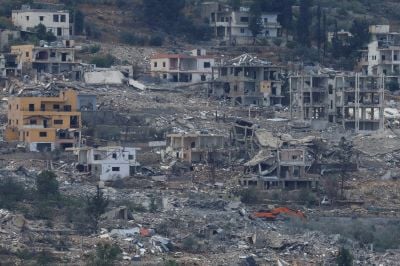
Salam also called for "the release of all detainees," as well as the return of residents to their villages and towns and the reconstruction of areas destroyed by the war. He linked these objectives to the question of sovereignty, asserting that it "is indivisible" and implies both an Israeli withdrawal and the extension of state authority over the entire territory, through its own forces, with weapons being "exclusively held by the state." The prime minister also stressed the need to translate the framework agreement into "concrete measures," according to a "clear timetable" and with a mechanism to verify its implementation. "The success of any agreement is not measured by declared intentions but by respecting commitments," he stressed. For Salam, the liberation of territory cannot be limited to the departure of Israeli forces. It must also allow "the return of residents and the revival of life in their towns and villages," at a time when the Israeli war machine is making border villages uninhabitable to create a de facto buffer zone.
'Weapons exclusively in the hands of the state'
The prime minister detailed how his government intends to implement the principle of the state monopoly on weapons. "We have not been satisfied simply with stating the principle that weapons must be exclusively in the hands of the state and that decisions of war and peace fall exclusively to its constitutional institutions," he said. He recalled that this commitment had been reflected in cabinet decisions, especially in August and September of last year, and once again in March of this year. These decisions, he explained, came after Lebanon was drawn into "a war it did not choose, one that was imposed upon it despite our repeated warnings of the risks of getting bogged down."
UNIFIL: Avoiding a 'vacuum' after its withdrawal
As the mandate for UNIFIL is set to expire at the end of the year, Salam paid tribute to the countries that have contributed to this force and called for an international arrangement to succeed it. The prime minister especially warned against the "vacuum" that UNIFIL's withdrawal could create in the absence of a new agreement. "What we wish to emphasize today is the need to avoid the vacuum that could be created by UNIFIL's withdrawal if it happens without an agreement on a new international force to replace it," he said. "Such a force should ensure the continuation of monitoring, reporting and liaison functions, and its role should complement the requirements related to the implementation of the tripartite framework."
Reforms: 'Rebuilding a state worthy of its people's trust'
Restoring trust is, according to the prime minister, one of the three main challenges facing his government, along with regaining control over national decision-making and liberating occupied territory. "Such is the equation for Lebanon's recovery," he insisted. This trust, he explained, must be built on institutions able to protect citizens' rights, an independent judiciary, and an economy that provides opportunities for the population, especially for young people.

The prime minister listed several projects his team has launched: "revitalizing the civil service, strengthening the independence of the judiciary, modernizing media law, and abolishing the death penalty." He also discussed financial reforms to restore order to the financial system and to enable the recovery of depositors' funds, as well as negotiations with the International Monetary Fund.
Returning to the Aug. 4, 2020 explosion at the port of Beirut, he also said that "the wound remains open" and that it cannot "heal without truth, justice, and accountability." "Our goal with these reforms is not to ask our people to renew their trust in the state. Through reform, we aim rather to rebuild a state worthy of its people’s trust," he concluded.
Palestine: 'There can be no regional stability' without self-determination
The prime minister concluded by devoting part of his speech to the Palestinian question, presenting it as inseparable from regional stability. "There can be no stability in the region as long as this organization remains unable to allow the Palestinian people to exercise their inalienable right to self-determination, like all other peoples of the world — no more, no less," he said, referring to the U.N.
Salam simultaneously defended maintaining UNRWA’s role and warned against the consequences of reducing its funding or questioning its mandate. Such a development, he said, would worsen the plight of Palestinian refugees. "It also increases the burden on host countries, with Lebanon foremost among them," he noted. Regionally, the prime minister reaffirmed Lebanon’s solidarity with Gulf states and Jordan "in the face of Iranian attacks that threaten regional security as well as the freedom and safety of maritime navigation."

 7 p.m. recap: Hezbollah members briefly surround police officers raiding a medicine warehouse; Qatar announces electricity project for Lebanon