





A rural childhood in Jounieh, where his parents lived off the land. A father who left him orphaned when he was barely a teenager. Then, poverty and drifting, for two years, trying to make a living. Rebellion already, against the French language that characterized a certain Christian bourgeoisie with which he broke ties early, turning to English as one chooses one's belonging. This choice would lead to others, starting with his refusal during the war to embrace the narrative of his social circle. This freedom, acquired by turning his back on everything his environment dictated, shaped his childhood and adolescence by the sea. Long days between sand and blue, beaches and orange groves, vacant lots where legendary soccer matches were played, marked as much his poetry as his palette or his love for classic cars. Along with the joyful friends who joined these great adventures, he swapped Arabic-translated Marvel comics, printed in Lebanon with no colors except those on the covers: "Superman," "Tarzan," "Little Lulu." His passion for comic books, cartoons, Westerns, and action movies fueled his desire to create his own, with a sense of derision that would become his trademark.
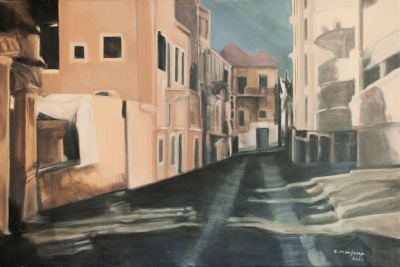
War would scatter the children of the beach, and Charles would find himself alone, "poor lonesome cowboy" like the heroes of his imagination. At the age of seventeen, he took refuge in writing poems, having no one to share his distress with. One of these texts found its way into the culture pages of the daily an-Nahar. He had sent it to the editor, Chawki Abou Chakra, who found it admirable. Two collections followed, duly published by the journal's affiliated house. When he enrolled at UL Fanar, first for management and then law, he was appalled by the students’ violence, their minds washed by warlords. He turned to English literature. Surrounded by girls, he lived on the margins of the conflicts racking his country, a pacifist, saddened observer. It was then he began writing prose — publishing novels and short stories about solitude, dark and dystopian.
What happy life means
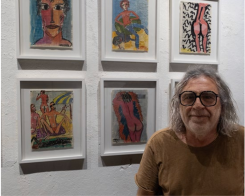
The moment he took up painting is unclear. No doubt this practice accompanied him since his first comic book readings. His touch is clearly related to them. Sheltered in Cyprus since the Beirut port explosion on Aug. 4, 2020, the artist, who rejects his home country due to endemic violence and the impossibility of reconciliation that make it appalling to him, would produce a series of paintings meant to show his compatriots what happy life means. On the beaches of Nicosia, he reconnected with his peaceful childhood, spent watching sunrises, the shore, swimmers, and sunsets.
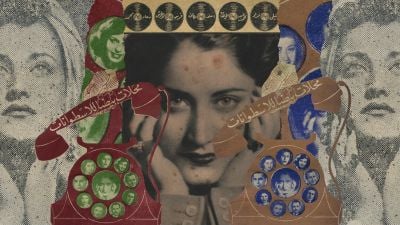
"Take your favorite drink and go to the seaside at high noon. Find a spot of shaded sand, shelter from the sweltering summer heat. Look for colors, sunglasses, or a smile. Look for pleasure, relaxation, the carefree. Look for a good time and the sweet possibility of juvenile kisses exchanged behind the rocks. Look for anything that could take you away from the dreary course of world affairs,” notes exhibition curator Wadih al-Haddad.
An invitation to voyeurism?
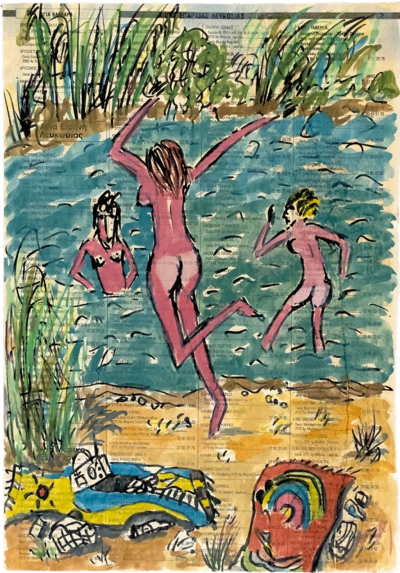
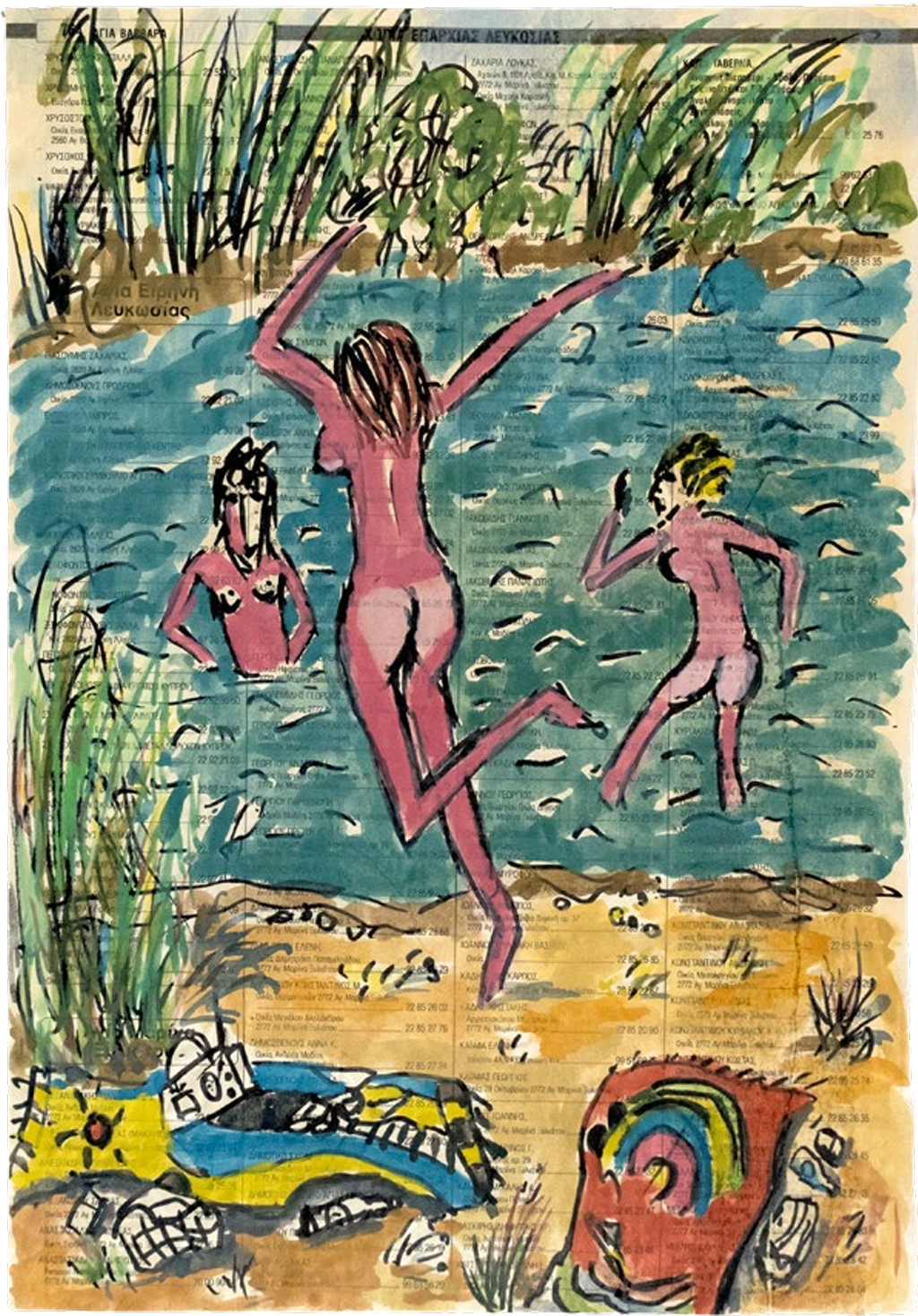
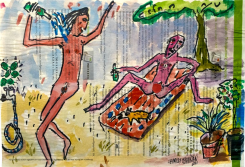
This invitation to pleasure is an appointment: “Three in the afternoon,” the exhibition's title. A bad time for UV, doctors would say, but be patient, the sun will soon begin its decline, the sea will be tepid, the waves will calm, and their reflections will become hypnotic for bathers satiated with light and water. Three in the afternoon is also a pun, based on the poster's chosen painting — three Eves frolicking in a cove, unconcerned by eyes that might be watching them. “The radio set on the sand invites you to stay a while and admire the landscape,” adds Haddad. It's almost an invitation to voyeurism: the landscape in question is full of half-naked swimmers, some not even bothering to hide their nudity, which the artist discreetly censors with marker. His aim is not so much to expose his characters to the viewer as to show the carefreeness and freedom of a primordial paradise where the taboo of nudity was still unknown.
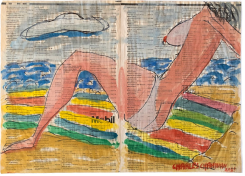
Some paintings are done in watercolor and acrylic on the yellow pages of a Cypriot phone directory, the Greek letters faintly visible beneath. The possibility of a contact? An appointment? The directory here seems a promise already fulfilled by the dreamlike dimension in color, where languid bodies and happy rear ends are spread out, under the spray of showers or the gentle ebb and flow of the waves. Sheltered by his island from the woes of war, Chahwan’s painting radiates a contagious freshness.
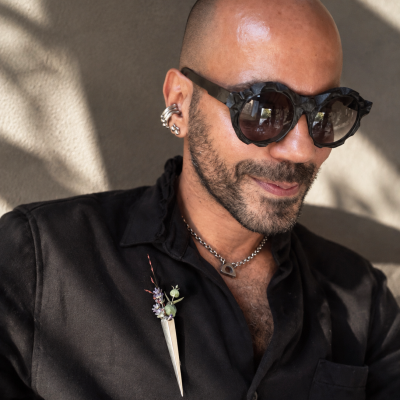
It's interesting to note that Charles Chahwan is also the father of the comic and street artist Tracy Chahwan, author of "Beirut, Bloody Beirut," and illustrator for the New Yorker. Inspired by her father's rebellious spirit, her work is marked by a radical, critical, and collaborative energy stemming from Beirut’s art scene where she was active before moving to the United States in 2019.
* “Three in the afternoon" at the Blue Rose Gallery, Shehadeh Street, Achrafieh, from 3 p.m. to 8 p.m., until Oct. 11.
This article also appeared in French on L'Orient-Le Jour.