


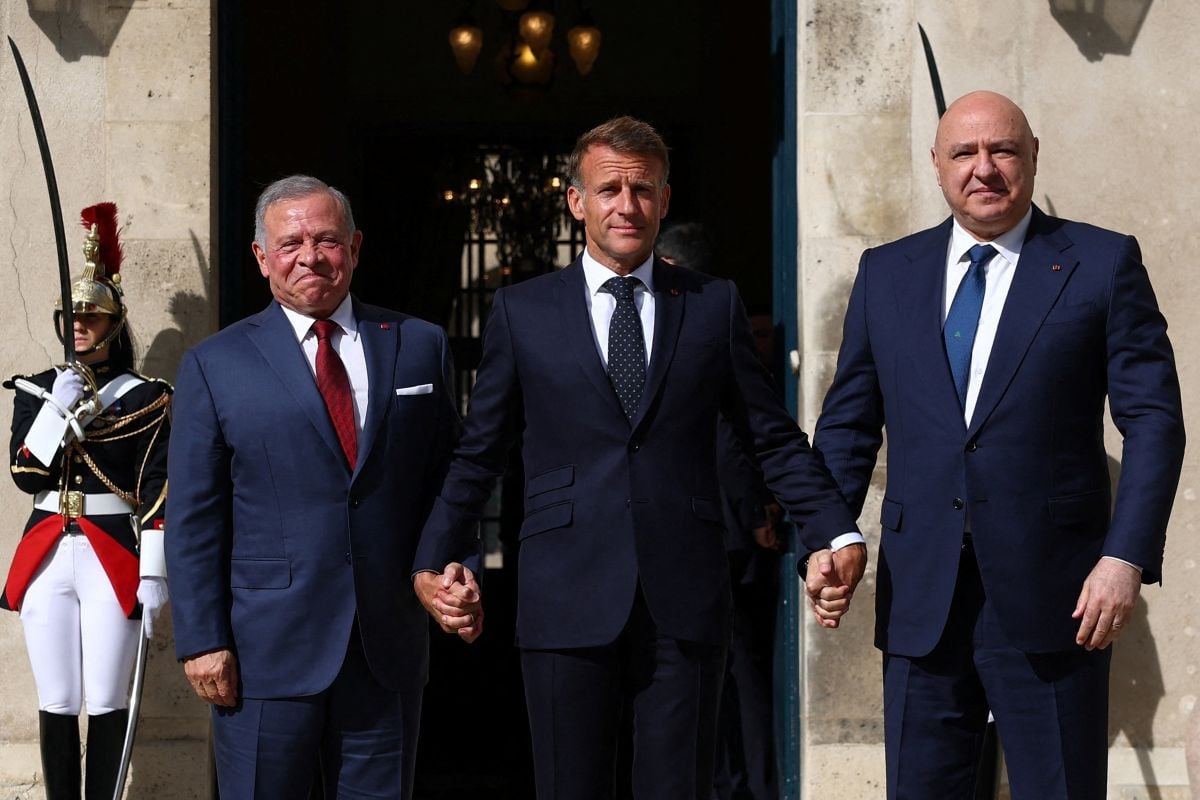
From left to right: King Abdullah II of Jordan, French President Emmanuel Macron, and Lebanese President Joseph Aoun, in front of the Hôtel des Invalides in Paris, on Sept. 17, 2026. (Credit: Gonzalo Fuentes / POOL / AFP)






BEIRUT — "Now is the time to act." Speaking from Paris, President Joseph Aoun on Thursday called on Lebanon’s international partners to accelerate preparations for an international conference aimed at supporting the Lebanese Army and Internal Security Forces (ISF). Representatives of 17 countries attended the meeting, where the Lebanese president urged participants to establish a “roadmap” and “clear timetable” for the conference, which is expected to “lay the foundation for a long-term initiative” in support of Lebanon’s military and security institutions.
For Aoun, this mobilization comes at a time when, “for the first time,” the internal drive to build a strong state in Lebanon “finds an echo and support regionally and internationally.” “This is an opportunity that may not come again,” he warned, calling on Lebanon’s friends to support the government’s efforts. Aoun also emphasized that “Lebanon is not asking its partners to assume its responsibilities for it,” but rather to “accompany this process” by supporting the military and security institutions.
Such support, he said, “is an investment that goes beyond Lebanese borders,” with Lebanon’s stability being “indissociable from that of the region.” The president insisted on the transparency of any aid provided and said he was ready to establish, with Lebanon’s partners, “a verifiable mechanism” to determine priorities, ensure commitments are met and measure the impact of the support provided. As the Lebanese state gradually rebuilds its financial capacity, he said, it “will have to assume an increasing share” of the funding.
Aoun also emphasized the need to implement the framework agreement concluded in June between Lebanon and Israel under U.S. auspices, which provides for Hezbollah’s disarmament alongside Israel’s withdrawal from southern Lebanon and the deployment of the Lebanese Army. “Agreements and commitments are not fulfilled by signature alone,” Aoun said, affirming that Lebanon “continues to honor” its commitments.
Israeli attacks continue against southern villages, dozens of which have been razed, while Israeli troops still occupy more than 600 square kilometers.
End of the UNIFIL mandate would be 'a serious mistake,' Macron says
French President Emmanuel Macron also called on Israel to “respect the implementation of the framework agreement,” saying he would speak with President Donald Trump and U.S. officials to that end. For Macron, the goal is to achieve “a gradual withdrawal from the occupied territories” so that the Lebanese state can regain control and the Lebanese Army can “take command.”
Aoun also stressed that the army’s role is “expanding” and, with it, the missions it must undertake across the country. Its role could, he said, become “more complex” with the expected end of the UNIFIL peacekeeping mission at the end of the year.
Macron, for his part, described the end of UNIFIL’s mandate as “a serious mistake,” while emphasizing that international forces that are required to remain in the South cannot “replace the Lebanese Army” but must help it carry out its mission. He also said he had worked “intensely” with Italian Prime Minister Giorgia Meloni to “prepare for the day after,” highlighting “the importance of extending the authority of the Lebanese state to the whole of its territory.”
For Macron, “supporting and helping the Lebanese Army is crucial so that it can replace the illegal Israeli presence in southern Lebanon.”
Before going to Les Invalides, Aoun was received at the Élysée Palace for a private meeting with the French president. After a formal welcome, he thanked Macron for his “concern to strengthen the authority and sovereignty of the state and to support its official, security and military institutions, especially the army and Internal Security Forces.”
Aoun and Macron also discussed “progress made in drafting proposals at the Security Council concerning the future of the international presence in the South.” Economic and energy cooperation between Lebanon and France was also addressed, notably “the resumption of oil and gas exploration in Lebanon’s offshore blocks,” according to the presidency.
A 'common regional security strategy'
Jordan’s King Abdullah II, for his part, stressed that “the Lebanese Army is the pillar of Lebanon’s security and stability,” saying that “the Lebanese people’s confidence in their army is an essential element of the country’s unity.”
Also speaking at Les Invalides in Paris, he said it was the “responsibility” of participants to “strengthen and equip the Lebanese Army as quickly as possible to regain control of the occupied Lebanese territories.”
Praising the Lebanese military’s level of readiness, Abdullah II stressed its need for additional means to strengthen security and ensure border control. He also called for providing Lebanese troops with spare parts to maintain their equipment, as well as capabilities to counter drones and monitor Lebanese airspace. He underlined the need to “fill existing gaps as quickly as possible” and said a new meeting would be held “at the end of this year” to review progress.
During a tripartite meeting at Les Invalides with Macron and Abdullah II, Aoun likewise called for the development of a “common regional security strategy based on joint energy projects as well as economic, security and political cooperation.”
He further recalled the “interconnection” of the security situation among Middle Eastern countries, as Gulf countries and Jordan have suffered regular attacks on infrastructure over the past six months, in response to Iran’s strikes on their territory.
Before leaving the French capital to return to Beirut, the president expressed hope that the needs of the army and ISF, “as presented in the reports submitted by the Lebanese delegation, receive the necessary response from the brotherly and friendly countries and parties.”
According to a statement from Baabda, he also thanked Macron and Abdullah for their support, saying he was “satisfied with the meeting.”
 7 p.m. recap: Iran defies Washington over Hormuz; Bab al-Mandeb ignites, Israel strikes the Bekaa