


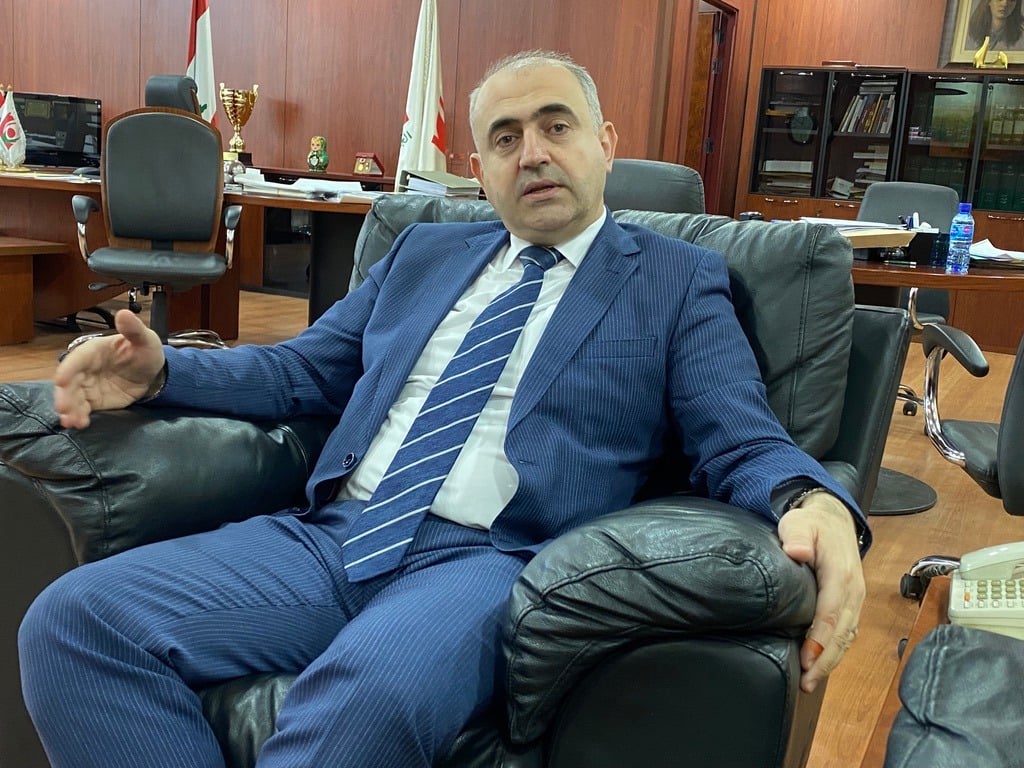
President of the Lebanese University, Bassam Badran, at his office in 2023. (Credit: Anne-Marie el-Hage/L'Orient-Le Jour)






The Cabinet on Thursday renewed Bassam Badran’s mandate as president of the Lebanese University for another five years, following a compromise among the country’s three main political leaders: President Joseph Aoun, Parliament Speaker Nabih Berri and Prime Minister Nawaf Salam.
The decision came just days before Badran’s term was due to expire on Oct. 12, despite objections from several political factions and a Constitutional Council ruling that rejected the possibility of his reappointment.
During the Cabinet meeting, Education Minister Rima Karameh and Justice Minister Adel Nassar raised questions about the constitutionality of the renewed mandate.
“Bassam Badran’s candidacy was selected from among five names, including Christian candidates, knowing that this position traditionally goes to a Shiite close to Nabih Berri,” an education source told L’Orient-Le Jour, speaking on condition of anonymity.
“The LU president is also close to the head of state,” the source added, noting that Aoun chose to make his first visit to the university’s rectorate in Mathaf after his election in January 2025.
'A blow to reforms'
The controversy extends beyond the executive branch. Ahead of Thursday’s Cabinet meeting, several MPs from the protest movement, the Lebanese Forces and the Kataeb Party had denounced the prospect of Badran’s reappointment, citing a Constitutional Council ruling that invalidated the extension of the university president’s term.
Protest MPs Michel Douaihy, Waddah Sadek and Mark Daou called for an end to “political compromises and clientelism,” while Halime Kaakour argued that a new appointment would undermine “the law, governance and reforms.”
Lebanese Forces MP Antoine Habshi, a member of Parliament’s Education Committee, also questioned the legal basis for accepting Badran’s candidacy and submitting his name to the Cabinet after the Constitutional Council, in Decision No. 8/2026, struck down the exceptional provision allowing him to seek a second consecutive term. Habshi called for “a clear legal answer, not a compromise at the expense of the law.”
Edgard Traboulsi, a Free Patriotic Movement MP and rapporteur for Parliament’s Education Committee, welcomed the decision on X. He said it gave the university president, who had “succeeded” in his mission, “the chance for a second term.” The renewal was “a fundamental reason for the institution’s recovery,” he added.
In July, Traboulsi told L’Orient-Le Jour that renewing Badran’s mandate would ensure “continuity and stability” at the public university amid security uncertainty and repeated clashes between Israel and Hezbollah.
Last July, Parliament passed legislation allowing Badran to seek a new, nonrenewable five-year term, despite the university’s bylaws barring its president from serving consecutive terms. The prospect sparked an outcry, with several parties and MPs denouncing what they called a “tailor-made” procedure to benefit the Shiite community.
Parliament ultimately made Badran’s eligibility conditional on the prior formation of the University Council, a decision-making body comprising 38 deans, professors and executive representatives. The council has not existed since 2018. Parliament also extended Badran’s mandate by six months.
MPs subsequently challenged the legislation before the Constitutional Council. In September, the council struck down two provisions of the law Parliament had passed in July: the six-month extension of Badran’s mandate and the provision allowing him alone to seek a second consecutive term.
However, the council upheld the provision setting the university president’s term at five years, renewable once but not consecutively. It ruled that the provision applied to the position rather than to the individual, thereby respecting the principle of equality.


