


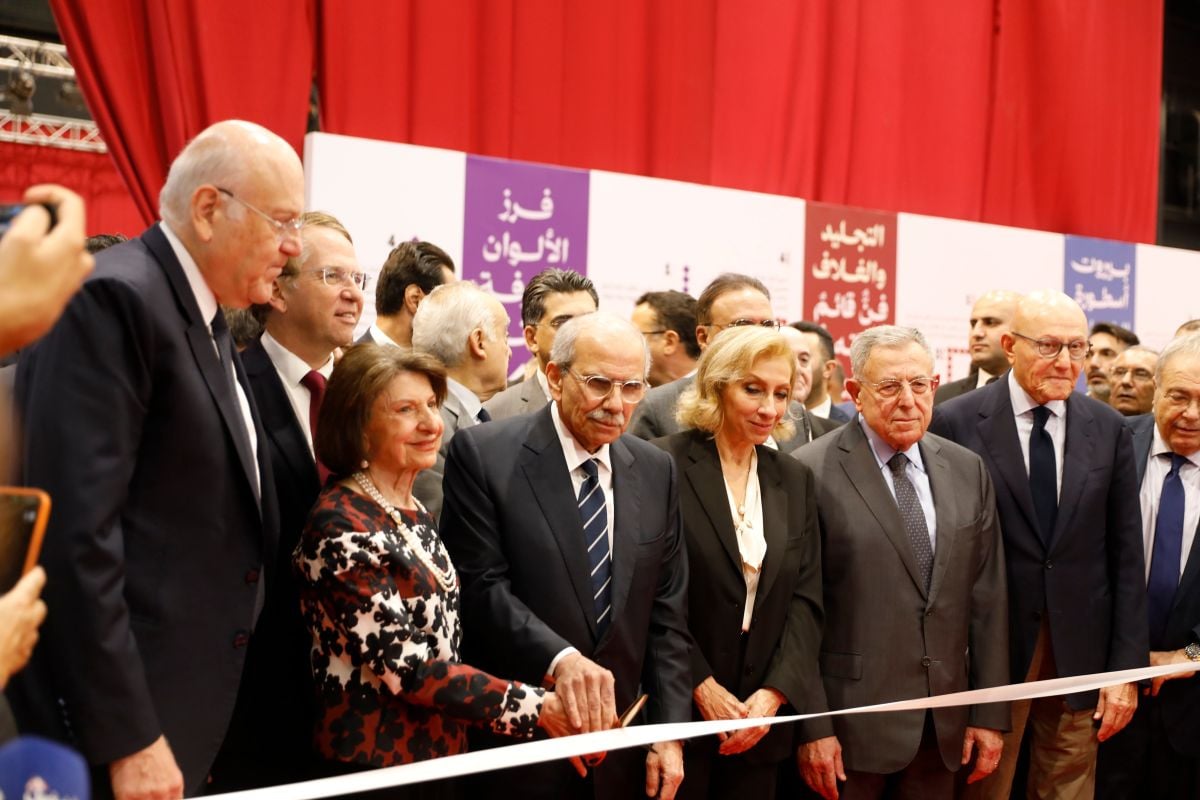
Prime Minister Nawaf Salam (center) at the opening of the 67th Beirut Arab and International Book Fair on Oct. 9 2026 at the Seaside Arena in Beirut. (Credit: Elie Bekhazi/L'Orient-Le Jour)






BEIRUT — Prime Minister Nawaf Salam opened the 67th edition of the Beirut Arab and International Book Fair on Friday with a speech packed with political undertones, emphasizing that the "struggle for Lebanon’s recovery is inseparable from our fight against ignorance, fanaticism, and isolationism," while also stating that "no national renewal is possible without respect for the law, strengthening institutions, and affirming citizenship."
He expressed his hopes for "a renaissance that restores the place of reason in the face of fanaticism, knowledge in the face of misinformation, dialogue in the face of accusations of treason, and citizenship in the face of division." At a time when Lebanese society is polarized over the issue of the arms monopoly, Hezbollah supporters are accusing the authorities, particularly Salam, of "treason."
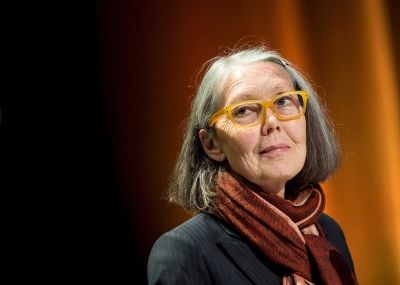
"No book can, by itself, stop a war; no novel can rebuild a village; no poem can restore an economy. But ideas shape choices, and choices determine the fate of peoples," continued Salam. Culture Minister Ghassan Salameh and the president of the Arab Cultural Club, Salwa Siniora Baassiri, were also in attendance.
The Prime Minister recalled that "there can be no lasting stability without a state that alone holds the power to decide on war and peace." Referring to the restoration of state authority, economic reforms and reconstruction, he emphasized that "these undertakings are interconnected, and the success of one does not exempt us from progress in the others."
From a cultural perspective, Salam also took pride in the "role played by Beirut." "For many decades, Beirut was much more than a city where books were printed. It was a place where ideas met, where languages intersected, and where Arab writers and thinkers found platforms that were not available to them in their own countries," he said, recalling that UNESCO chose Beirut as World Book Capital in 2009, and later named it a Creative City of Literature in 2019.
He cautioned: "We have the right to be proud of what Beirut has been, but we do not have the right to be content with that." "The Arab world has changed, new research and publishing centers have emerged, investments in cultural industries have developed, while Lebanon has been depleted by successive crises, ranging from economic collapse to the explosion at the port of Beirut, as well as wars, population displacement and the emigration of talent," he lamented.
At a time of rapid advances in artificial intelligence, Salam stated that "our need for critical thinking and the ability to distinguish opinion from information, and truth from misinformation, is only growing." "A Beirut that reads does not die, a Beirut that writes cannot be defeated, and Beirut, opening its doors to the book, will remain, as it always has been, a city of life, a capital of free speech, and an Arab beacon that does not go out," he concluded.
Syrian culture minister in Beirut
Invited to the exhibition’s opening by his Lebanese counterpart, the Syrian Culture Minister, Mohammad Yassine Saleh, presented Nawaf Salam with a Damascus sword at the Grand Serail. “It is fitting that the Damascus sword should return to its scabbard with pride following the liberation of Syria [after the fall of Bashar al-Assad’s regime in December 2024]. The battle for reconstruction and the building of institutions has begun,” declared the Syrian official. Addressing the head of government, he added: “We are partners in this reconstruction endeavor, and it is up to us to ensure that fraternal relations are fostered alongside the building of institutions.” The Syrian Minister for Foreign Affairs, Assaad al-Shaibani, whilst on a visit to Beirut, had signed an “agreement on the establishment of the High Commission for Cooperation and Partnership with Lebanon” in early July.
Earlier in the day, Saleh spoke with al-Jadeed alongside his Lebanese counterpart Salameh, exclaiming that "Beirut is absolutely beautiful, she is the sister of Damascus." "It is a major hub of literature, culture, and books," continued the Syrian official, who was invited by Salameh to the opening of the fair. The two officials discussed strengthening cultural and archaeological cooperation between the neighboring countries. "Arab culture is one, and it unites us," Salameh said. "The time has come to give [cultural] cooperation between the two countries a practical dimension."
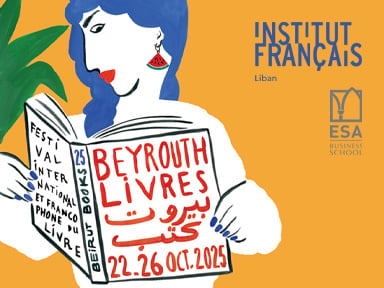
From Oct. 9 to 18, 2026, this new edition of the Beirut Arab and International Book Fair will host the fourth edition of Beirut Livres at the Seaside Arena, organized by the Institut français du Liban.
 7 p.m. recap: Iran defies Washington over Hormuz; Bab al-Mandeb ignites, Israel strikes the Bekaa