






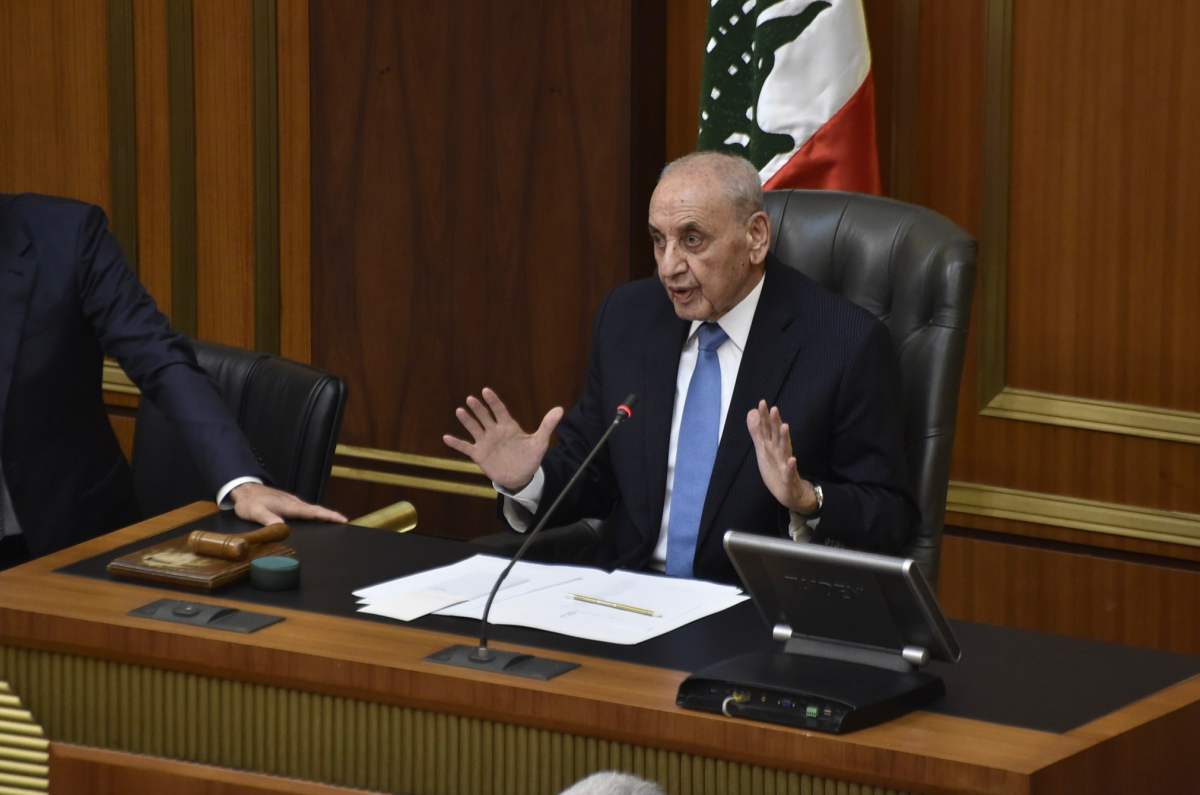
Parliament Speaker Nabih Berri moderating the speeches during the general policy debate in Parliament, Tuesday, Sept. 15, 2026. (Credit: Hussein Ibrahim/Lebanese Parliament website)






The course of events was predictable from the start of the plenary session on Tuesday. While Parliament Speaker Nabih Berri's decision to call a general policy debate at the request of Free Patriotic Movement (FPM) leader Gebran Bassil could have signaled a series of attacks against the government, possibly putting it into question, that specter now seems to be fading.
Indeed, before the debate — which will continue Wednesday — Berri allowed the prime minister to spend considerable time justifying his Cabinet's work, which had to face the resumption of war between Israel and Hezbollah in its very first year.
Though MPs voiced sometimes caustic criticisms of the ministerial team, no MP went so far as to wish for its downfall. Even Bassil described his party as a "responsible opposition."
"We are the opposition, but we know what the country cannot withstand," he emphasized, calling for "dialogue." However, he accused Berri of protecting the government. "This is a general policy debate. Next month, we’ll hold a formal government questioning session," replied the chamber's presiding officer.
Framed by Articles 131 to 135 of the Parliament’s bylaws, such a session allows one or more MPs to formally question the government or a minister on a specific matter. A confidence vote can be held following both a general discussion debate and after formal questioning (article 138).
Heated exchanges after Salam’s speech
Speaking at the start of the meeting, Salam reviewed the toll of a war “the government did not want,” mentioning the cost of damages and economic fallout (more than $20 billion for the two wars from 2023 to today), as well as the death toll, over 9,000 since 2023. He also stressed: “Our reality is very difficult, but it is not impossible to emerge from it.”
Salam also responded, even before criticisms of the government, to “those who have taken the liberty of attempting to exploit the suffering of the population to question the presence of the state, which did what it could, within the limits of its means.”
Regarding those displaced by the war — an issue dear to the Amal-Hezbollah alliance — the prime minister said his Cabinet’s objective is not “to manage population displacement,” but “to enable inhabitants to return to their lands” in the South, of which more than 600 square kilometers are currently occupied by Israel, with dozens of villages razed.
“We have set priorities and we are working to restore essential services in stricken regions,” he added. However, he said, the scale of the destruction “far exceeds the state’s current ability to cope alone.” He therefore reiterated the authorities’ need to obtain “external support and funding.”
While the government has been working since last week on the draft budget for fiscal year 2027, before it is sent to Parliament, Salam said that “the state is not being asked to spend more, but to spend better.” He insisted on “the importance of reaching an agreement with the IMF, as such an agreement is an essential lever to restore international confidence in Lebanon.”
Addressing the rising prices of basic necessities, he said he “knows the suffering of Lebanese families.” According to him, these hardships, “which are the result of accumulated crises,” have been “worsened by the war.” “But we will not resign ourselves to this reality,” he said.
When Hezbollah MP Ali Ammar tried to respond immediately to the prime minister’s remarks, independent MP Paula Yacoubian interrupted him, pointing out a violation of procedure. This sparked shouting matches, with Ammar calling on Yacoubian to “stay in her lane,” and Yacoubian retorting that he should “speak politely and respectfully.” A heated exchange then broke out between Tripoli Sunni MP Achraf Rifi and Ali Ammar, with Rifi telling Ammar to “send the Resistance that destroyed the country to Iran,” and Ammar firing back that Rifi should “stay in Israel and the United States.”
These incidents led the head of the Parliament to call on MPs to be “worthy” of the debate... and set the tone for most of the interventions that followed. The MPs’ speeches generally focused on criticisms of the war initiated by Hezbollah on March 2, while MPs from the Amal-Hezbollah alliance denounced the framework agreement signed with Israel.
The framework agreement, the state and the ‘Resistance’
Hezbollah MPs, unsurprisingly, criticized the state and the signing of the framework agreement, which calls for its disarmament to run parallel to the withdrawal of Israeli forces from southern Lebanon. “The authorities signed a framework agreement written in Israeli ink on American paper. It is those in power who put the nation in this difficult position,” said MP Hassan Ezzeddine (Hezbollah). “Betting on the weakening of the resistance is a losing bet, and Lebanon cannot be built on exclusion.”
For his part, Hezbollah-aligned MP Jamil Sayyed requested that the framework agreement be submitted to Parliament for approval.
On the Amal Movement side, Ali Hassan Khalil, an MP from the Amal Movement, warned against “discord” among Lebanese and insisted on the “institutions of the state.” “We can disagree politically and in our risk assessments, and our differences can go very far. But political disagreement must not become a break or incitement to discord among Lebanese,” he said. “More than ever, we need to open channels for dialogue. Lebanon cannot be built by targeting anyone, but through partnership, dialogue, the state and its institutions.”
Fellow party MP Inaya Ezzeddine, for her part, criticized what she called the government’s slow response to the influx of displaced people on the very first day of renewed fighting, March 2.
On the other side of the political spectrum, Kataeb party leader Samy Gemayel also confronted Salam, warning of the country’s “disintegration.” “So I am addressing Prime Minister Salam personally: you face two choices, submission or action. I’m not telling you to resign, but to govern and impose on everyone the authority of the state, the law and the Constitution — from ourselves to the very last among us,” said the MP.
Taking a more conciliatory tone, Georges Adwan (Lebanese Forces) said “the Lebanese are asking the government to continue the path it has embarked on” toward the disarmament of militias. Addressing Salam, he directed an ironic question at the government’s critics: “How dare you, and your government, seek to ensure a monopoly on weapons? This is unacceptable and you must be questioned about this, since your predecessors never did.” Beirut independent MP Fouad Makhzoumi, meanwhile, called for “clear and precise mechanisms to guarantee the monopoly on weapons remains in the state’s hands.”
Bassil, for his part, charted a middle course, criticizing both the state as “subject to foreign powers” and Hezbollah, which, he claimed, “can no longer defend Lebanon.” The Batroun MP added that he “hopes the negotiations will not be a cover for continued Israeli attacks” on southern Lebanon, and that the decision to ensure a monopoly on weapons will be made “without discord.” He then questioned Hezbollah: the party “should be asking itself how to stop the killings and destruction.”
This was the second general policy debate devoted to the Salam government, the first having taken place in July 2025, five months after its formation. At the close of those debates, the Cabinet secured Parliament’s confidence by 69 votes to nine, with four abstentions. It was then the first general policy debate held in the chamber since 2017.

 8 p.m. recap: Israel again threatens Beirut’s south suburbs; 2 ships hit near Hormuz; Riyadh football matches canceled