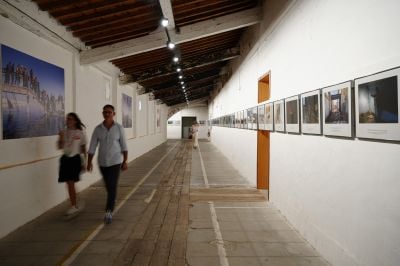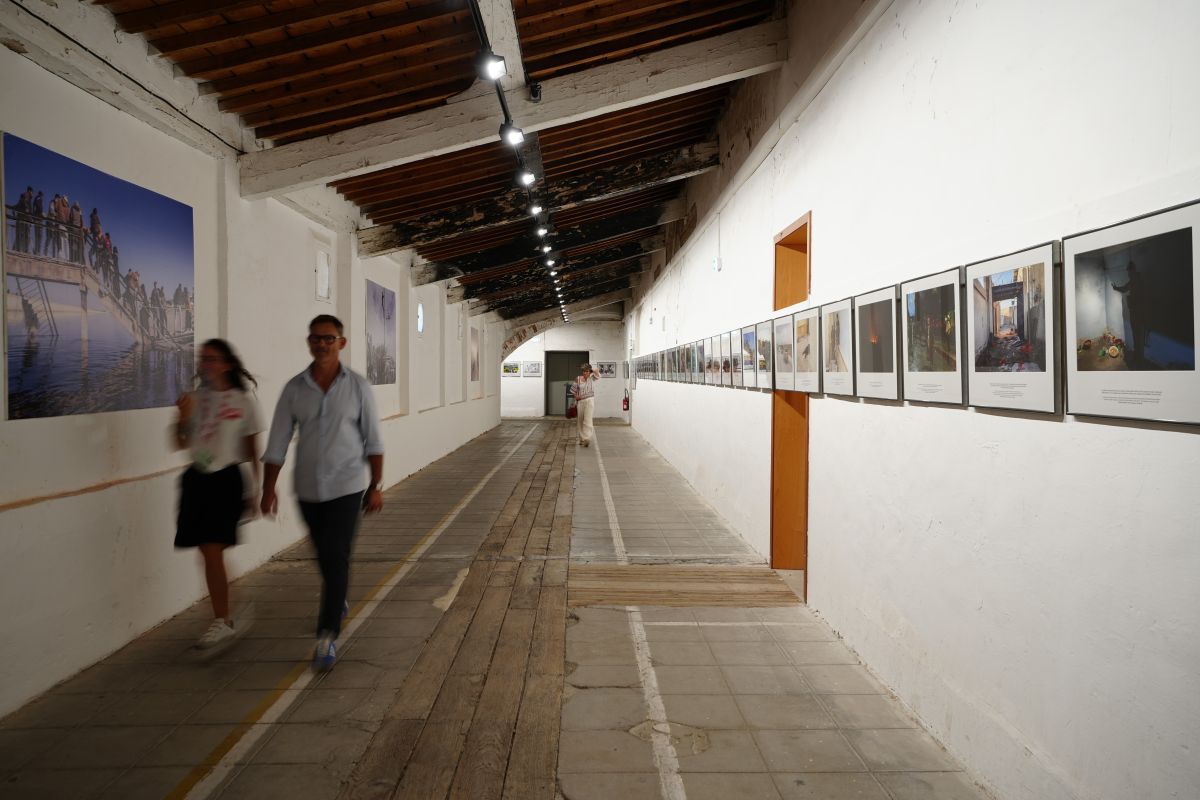
Photojournalism in the spotlight at Visa pour l'image, in Perpignan. (Credit: Mohammed Yassine/L'Orient-Le Jour)






"One war too many": that is the title of Mohammad Yassin's work, presented among the 25 exhibitions of the international photojournalism festival "Visa pour l’Image" in Perpignan, in the south of France. A leading photographer for L’Orient-Le Jour, nicknamed "the Comet" for his speed in reaching the scenes where news unfolds, he documents the war that broke out in March 2026 between Israel and Hezbollah.
"I had never seen anything like this in 17 years of reporting," he confides. This "thing" is the scale of destruction and the number of victims. It is also the eruption of fighting in a country already suffering from a severe economic crisis: "The war came to finish us off!"
"We wanted an exhibition about Lebanon by a Lebanese photographer. We saw a TV program where Rima Abdulmalak presented Mohammad Yassin’s photos, and that was it …" says Delphine Lelu, the festival’s director, her voice full of emotion. Jean-François Leroy, founder and president of "Visa pour l’Image," for whom she worked as right-hand woman, has just passed away after a battle with cancer. He died last Monday, the opening day of this 38th edition, as if he wanted to make sure one last time that the event he called his baby got off to a good start. For nearly four decades, he unwaveringly supported photojournalists and defended their freedom, considering these values guarantees of democracy.
Life amid chaos
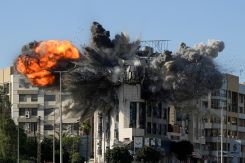
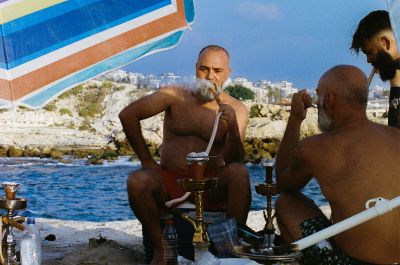
The journey opens with powerful scenes that reveal the chaos descending on Lebanon. In one shot, a man stands amid a landscape of desolation littered with burned-out cars on Corniche Mazraa.
"April 8, 2026, was the toughest day for Lebanon," Yassin recalls softly, as if to offset the violence of his story. "We went there the next day and I found this man. He was in the middle of a field of ruins, in a ray of sunlight. I didn’t even think. The photo alone expressed what we were going through."
Yet life persists, as captured in a beautiful shot of children playing ball among lines of hanging laundry. They are in the courtyard of one of many schools in Beirut that welcomed families displaced from the South.
Elsewhere, a column of cars stretches to the horizon, filling the highway. The overloaded vehicles are heading south. Entire families returned home the day after the cease-fire with Israel was signed on April 17, 2026.
"I’ll never forget that day," he confides. "It took us eight hours to reach the South. I was with my journalist colleague, Lyana Alameddine. We took turns driving. She talked to people while I took photos. To get that image, I climbed onto the roof of a packed pickup truck. The saddest part is that most of those people made the trip back the other way after just two days." In fact, Israel has never respected the cease-fire.
The exhibit ends with a strikingly beautiful photo, sadly emblematic of the cultural and environmental tragedy affecting southern Lebanon. At dusk, the fortress of Beaufort stands in all its majesty, while a white streak crosses the landscape — a phosphorous bomb dropped by the Israeli army after firebombs were launched on the land surrounding the citadel.
Yassin took this photo from Nabatieh, when the city was cut off from the rest of the country.
Civilians on the front line
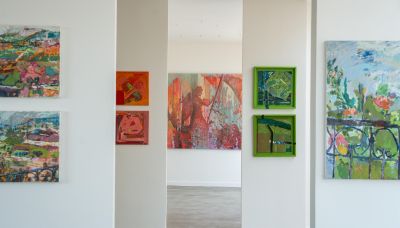
At the Couvent des Minimes, the heart of the festival, Yassin's work is surrounded by two other exhibitions, dedicated respectively to Israel and Iran. "War Diary" by Yoray Liberman documents civilian life throughout Israel during the war with Iran. Although the tragedy is not comparable to that in Lebanon, once again, civilians appear as the primary victims. In Beit Shemesh, people standing before the debris of an Iranian bombing that killed nine have the same stunned faces as elsewhere in the Middle East. Antiwar protesters clashing with police can also be seen.
On Iran’s side, Hashem Shakeri shows daily life during wartime. Scenes of young people dancing underground are juxtaposed with women mourning the death of Ayatollah Ali Khamenei. We move from the joyful, colorful birthday party of a little girl in the suburbs of Tehran to a memorial for murdered children, with their portraits on display. Again, civilians among ruins caused by bombings form a recurring motif. The Iranian photographer brilliantly portrays a country where small moments of happiness slip into tragedy, making life at least marginally bearable. Of course, all the contradictions of Lebanese daily life are found here as well.
The decision to bring these three perspectives together proves especially astute.
Sudan: Giving people a name
One floor down, Abdulmonam Eassa takes us to Sudan and opens our eyes to one of modern history’s great tragedies: a peaceful civilian revolution cut short in a country that has sunk into endless war and one of the world's worst humanitarian crises, all amid international indifference. The Syrian photographer, who grew up under Bashar al-Assad's regime, left his country for France in 2018. Two years later, he went to Sudan to try to understand the revolution, living there for 18 months.
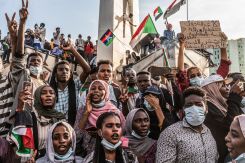
"I fell in love with these people. They are wonderful, educated, with an extraordinary youth who dreamed of a free country under civilian control."
In his photos, Abdulmonam Eassa gives each person a name: Esraa, the tea seller atop a mountain in Jabal Marra, Darfur, and Jackson, the proud rebel posing for the camera.
"Oppressors don’t like to appear in pictures, but the oppressed gladly allow themselves to be photographed. Jackson saw his village massacred at age 18. He joined the fight to protect his people. He was at ease and very open. He’s been fighting for years."
"Sometimes, I’m upset by how international media treat Sudan’s news. They just give numbers and statistics. I think the Sudanese deserve better. They deserve to be considered human beings, like any other citizens of the world. That’s why I always ask the names of the people I photograph and details about their stories."
The photographs are displayed in chronological order. First, you see peaceful protests for women’s rights and a teacher mourning a colleague’s murder, before violence slowly takes over. Still, Abdulmonam Eassa rejects the label "civil war."
"The Sudanese revolutionaries who overthrew Omar al-Bashir are not involved in the current war. The fighting is between the regular army and paramilitaries created by the former dictatorship. Placing the images in chronological order shows that the people tried to do something but could not achieve it. When war broke out, Westerners left Sudan the very first day. Embassies were emptied, foreigners left. Later, we learn that international powers are supplying weapons to fuel the conflict. The whole world has abandoned these people."
A rare and precious festival
"War in Sudan: a nation trapped" is a strong, powerful exhibition about a country rarely discussed. This is precisely one of "Visa pour l’Image"'s missions: to do justice to forgotten realities through its exhibitions as well as during the evening projections.
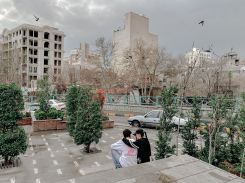
The entire year’s news flashes before our eyes during the festival’s first week of nighttime screenings. We go from tributes to Robert Redford, who passed away, to floods in Sumatra, from the dramatic health effects of coal mining in India to a Chinese company’s manufacturing of AI-powered sex dolls. One report even takes us into a chapter of the Ocean Viking’s journey, a rescue ship for migrants in the Mediterranean ... So many social, environmental, geopolitical, and artistic topics that tell the story of our planet. Narratives that run counter to the sensationalism flooding our screens daily.
"Visa pour l’Image" is without a doubt a rare and precious event, at a time when fake news is ever-present and no one knows where artificial intelligence will lead us.
Khames Alrefi: The photographer from Gaza awarded the Humanitarian Golden Visa
Khames Alrefi lives in Gaza, documenting the daily life of its people. His work won the 2026 Humanitarian Golden Visa awarded by the International Red Cross. Unable to obtain a visa to travel to France, he is absent from the festival, but his images speak for him. They are gathered under the title “Civilians 2026: the First Victims.
The Azzam family decimated, their bodies shrouded in white. Rubble with the sea on the horizon. Meals being distributed amid the chaos. Food dropped by parachute. The body of a man killed while waiting for food aid. A mother embracing her son killed during a food distribution. A stream of people walking along a battered road, returning north in the enclave after a cease-fire, the unchanging sea stretching alongside them … these scenes from Gaza have been repeated for nearly three years. They are unbearable.
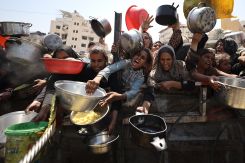
And yet we cannot look away, even as media outlets, one after another, lose interest and abandon the people of Gaza.
Civilians are paying a heavy price, and the photographer is among them. Beyond war reporting that shows the scale of destruction and the countless victims, Khames Alrefi reveals a daily life centered on constant survival. Men, women, and children run every day to fetch water. Entire communities are exhausted by repeated displacements. Weary faces, bodies emaciated from hunger — this is a population facing planned annihilation. The images are there. No one will ever be able to say they didn’t know. And in his photos, Alrefi shows the humanity and dignity that remain in his people against all odds.
Depardon: Focus on the next generation
Exhibited for the first time at "Visa pour l’Image," Raymond Depardon, 84, received a Lifetime Achievement Golden Visa in Perpignan honoring his entire career. In an interview with AFP, the photographer and filmmaker explained his long absence from the festival as stemming from his generation's mistrust of awards: "We used to avoid honors," fearing that showing photographed people — "often in pain" — would bring bad luck.
Depardon was especially worried about the "catastrophic financial situation" of news agencies — "Magnum first and foremost" — and the lack of funding for photography. "These photos are so important," he insisted, noting that a presidential campaign must be covered with a "wide angle, not a telephoto," getting as close as possible to the candidates and voters.
Impressed by images of migrants trying to reach Ceuta, which he would have liked to photograph "not with a telephoto lens, but from within, with them," he finally paid tribute tp a "wonderful new generation" of photojournalists. Professionals who are, in his words, "stubborn and proud," able to stay on the ground for long periods.