


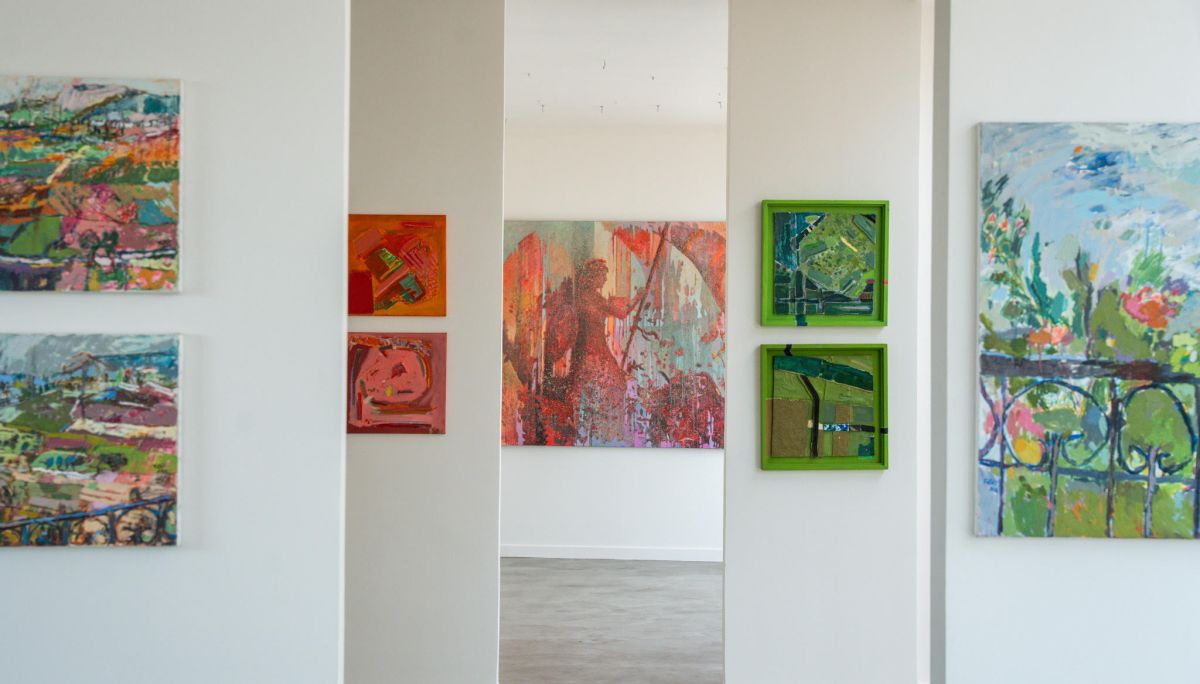
A range of works and colors evoking the South. (Credit: Mowie Aoun)






What remains when the hubs of our creativity are gone? When our studios have become inaccessible and people have been forced to leave their land? Art knows how to bloom elsewhere, wherever hands are outstretched. Born of this reality, the exhibition "Under One Sky" sets its course for Beirut, providing displaced artists from southern Lebanon a space to return to their practice, reconnect with a community, and, perhaps, glimpse a sense of stability. For two weeks, the premises of No Chef in the Kitchen opened their doors to seven artists from the South, offering them a place to work, experiment, and create. They join a selection of ten other artists to form an exhibition of seventeen perspectives, gathered under one sky despite differences, losses, and upheavals.
A call for unity
This initiative is not just about solidarity. It aims to "bring people together." In the face of isolation brought by war, it defends the need to return to others, to gather, to come together.
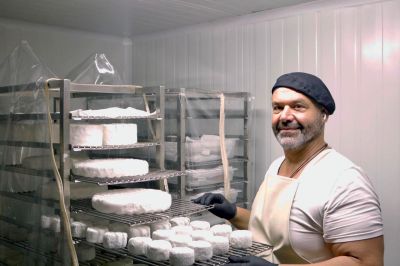
In adversity, it draws from what is most fundamentally human: the need to find each other and build community when everything seems to conspire to pull us apart. This desire is especially rooted in Dar Zefta, founded in 2017 and the first cultural foundation in southern Lebanon through Zefta Art House. Conceived as a place dedicated to creation, but also to discussions and gatherings, this structure is part of a dynamic that goes beyond the artistic field alone: it seeks to make culture a living space, able to welcome the voices of a territory and preserve its connections.
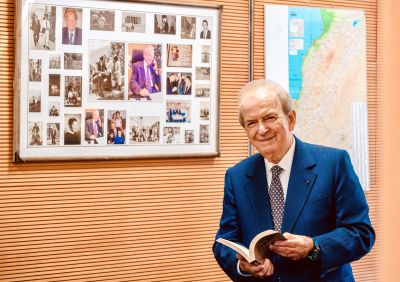
Behind the scenes of this project is curator Mowie Aoun, who left the capital and intends to return in 2025 to his native South, aiming to "restore perspective to those whose future has suddenly narrowed." Supported by the European Union, Expertise France, and Live Love Lebanon, the project seeks to offer artists a creative matrix, as well as something harder to measure: the possibility to imagine themselves in the future again. The exhibition also pays special attention to the role of women in this artistic landscape. "Nearly 60% of the selected artists are women," says Mowie, a choice intended to support their practice and offer them visibility and a creative space in a context where professional and artistic opportunities are deeply weakened.
A palette of Souths
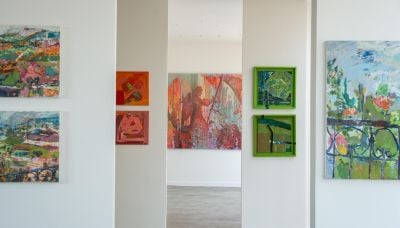
In the gallery, the works on display until Aug. 30 first draw attention by their colors. Shimmering hues, rural landscapes, crimson horizons, silhouettes, and female figures form an ensemble that at times seems to come from the mind’s eye. As if the artists were reconstructing with images of a South whose memory they still carry: a territory as dreamed as it was experienced, as once known and as it might one day be again. There is, in these works, something that goes beyond representation. They do not directly document the war; rather, they seek to reinvent or preserve what war threatens to erase. The landscape becomes a memory, a longing, and a promise.
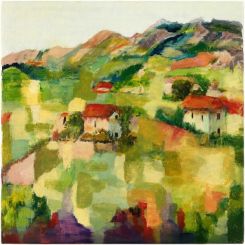
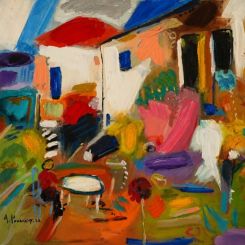
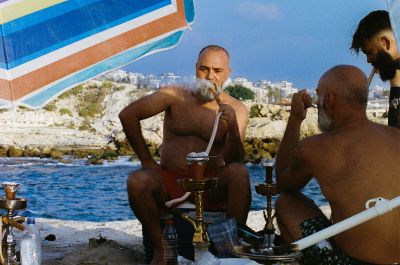
Color becomes a way to resist erasure. For Amal Matar, the landscape emerges almost instinctively. "Without thinking in front of my canvas, I draw hills, mountains, the sea… especially that of southern Lebanon," she explains. In the face of war and distance, these landscapes become carriers of "intense nostalgia," a way to rediscover, through painting, a territory they are now deprived of. For Ali al-Housseini, painting is above all a way of seeing. "Today, my work reflects what my eyes see," he says. His pieces draw heavily from the landscapes where he grew up. "As an artist from southern Lebanon, I see the South as a beauty in itself: its nature, its mountains, its houses." The homeland thus becomes both a source of inspiration and a space for memory, where, long after departure, the enveloping warmth of summer and the taste of Lebanese gatherings persist.
Under the same sky, the artists of "Under One Sky" are offering not just an exhibition. They offer an embrace where people come together — to create and to hope. A world where the South is no longer viewed only in terms of what has been lost, but also in terms of what can still be born.
"Under One Sky," until Aug. 30, at the No Chef in the Kitchen gallery, rue Pasteur.
This article originally appeared in French on L'Orient-Le Jour.

 7 p.m. recap: 1 person killed near border with Lebanon; 200 kilos of explosives carried by mules; Riyadh shuts its airspace