






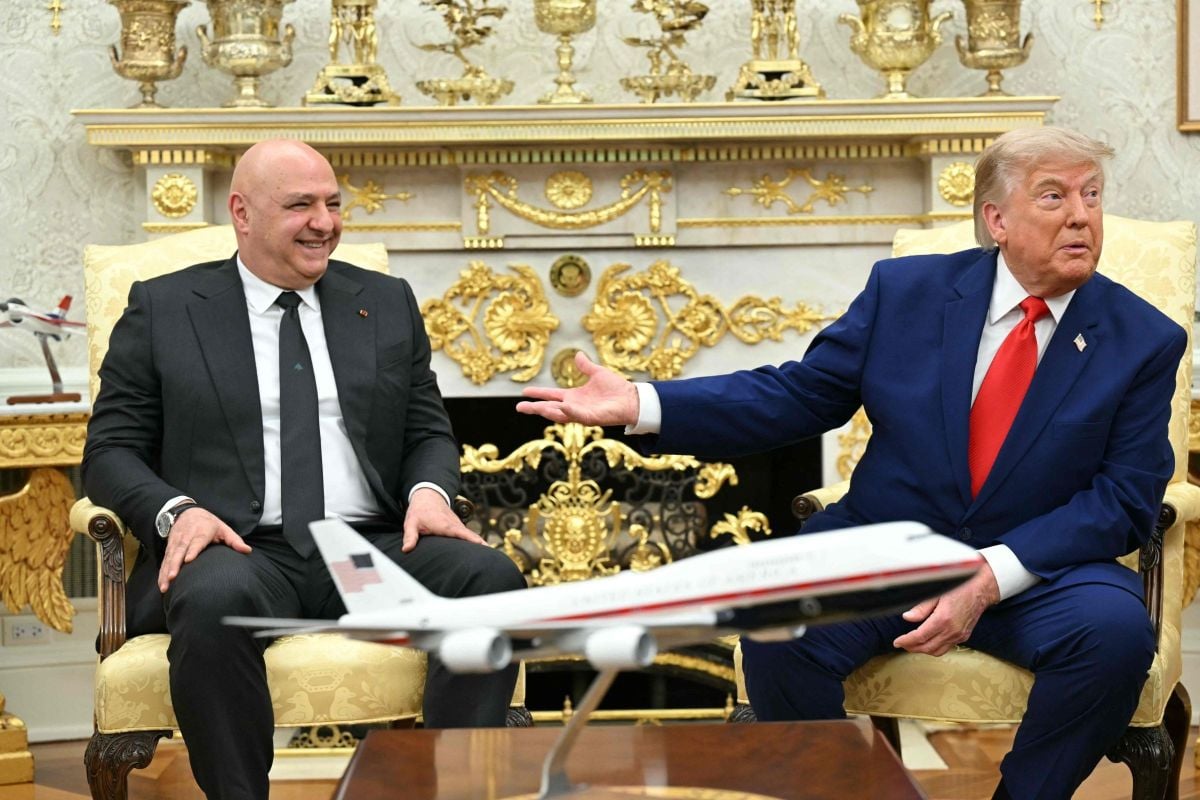
U.S. President Donald Trump speaks during a meeting with Lebanese President Joseph Aoun in the Oval Office of the White House in Washington, July 21, 2026. (Credit: Saul Loeb/AFP)






Anthony Elghossain is a lawyer and writer. He advises organizations on geopolitics, U.S. foreign policy and the rule of law.
Washington is a city of magnificent intentions. With that bittersweet truth in mind, Americans and Lebanese alike must focus on long-range policies and necessary institutional work rather than settle for the usual podium poetry, parchment guarantees, and glib soundbites.
Back in 1842, Charles Dickens visited the new American capital while writing his “American Notes for Circulation,” essentially a poor man’s “Democracy in America” mashed up with an even poorer man’s “Innocents Abroad”. Taking in empty blocks, unfinished buildings, streets without ornaments, and ornaments without streets, Dickens marveled at the great boulevards leading from nowhere to nowhere. So, he rechristened the city, which architects and planners had called the “city of magnificent distances,” as the “city of magnificent intentions.”
So goes American policy, particularly in the Levant. Never quite as visionary or as cynical as embittered allies and self-serving adversaries have believed, U.S. officials have paved many a road with good, even magnificent intentions. And, yet, we all know where such roads have led…

Struggling to find a ‘sweet spot’ in US-Lebanon policy
Powwowing in the White House or speechifying shoulder to shoulder in the Rose Garden, American and Lebanese leaders have failed to achieve their stated objectives for decades. They have shared glorious poetry from the podiums. They have offered up grand schemes at the daises. And they have scribbled and signed parchment guarantees on their tables, desks, and benches.
Even when they have had the best of intentions, though, presidents in Washington and Beirut have been unable and unwilling to reconcile their declared designs with deeper interests (Americans), limited capabilities (Lebanese), and inadequate commitment (often due to American fickleness, Lebanese skittishness, or both).
Struggling to make sense of Lebanon in the 1950s, 1980s, and 2000s, U.S. officials have never quite found the sweet spot in Beirut. Notwithstanding their own flaws, crimes, and sins, Lebanese leaders have repeatedly bet their futures — and the future of Lebanon, as they imagined it — on American support, intervention, and salvation. After enjoying every moment of hope, they have reckoned with deep disappointment.

Nor have Lebanon’s lessons been just about Lebanon. Beyond being a “morass” in which statesmen, officials, and troops alike have struggled, the “precarious republic” has symbolized America’s strategic schizophrenia over the years. As U.S. leaders have struggled with policy towards Lebanon at a given moment, they have also shaped schools of thought for the future. For instance, the since-famed Powell Doctrine really had its roots in Lebanon: specifically, a framework that U.S. defense secretary Caspar Weinberger developed during the mid-1980s while battling in the bureaucracy over whether and how to “integrate” policy, diplomacy, and force while intervening in Beirut.
Of course, adversaries have also learned the lessons of Lebanon in those days. After American leaders allowed rejectionists with guns and bombs to dictate their policies, undercutting partners that they had intermittently tried to pull away from and push towards Damascus and Tel Aviv, they spent the rest of the decade contorting themselves to avoid decisive action against adversaries.
Instead, they settled on cockamamie scheme after cockamamie scheme — none as infamous as the Iran-Contra Affair — that only validated attacks, abductions, and the like. Beholding a superpower slouching towards capitulation, terrorists elsewhere felt inspired to wage war against the United States. Osama Bin Laden, for instance, saw “the decline of the American government and the weakness of the American soldier” in Beirut. America, he sensed, “is ready to wage cold wars but unprepared to fight hot wars. This was proven in Beirut when the Marines fled...”
Lessons of Lebanon
Agents in their own arena, the Lebanese have also learned lessons while dealing with America. They remember, perhaps too well for their own good, how American leaders have made midnight promises only to cut out in the morning. While they have their own reasons to restore the state, manage the entrenched elite, and handle Hezbollah, Beirut’s leaders will not race towards conflict with an organization that may still wreak havoc in Lebanon.
After all, besides having longer political memories and gazes than their U.S. counterparts, these folks personally lived through — and have often struggled with the consequences of — America’s strategic schizophrenia. Never mind the factional chiefs, who spend decades in power as U.S. officials and diplomats rotate in and out of their lives for about three years (some embracing their files, others openly declaring that they “don’t care about Lebanese internal politics” and others itching to “get somewhere that matters”). Even leaders of institutions have seen the Americans step into and out of their lives, with Lebanese president Joseph Aoun, premier Nawaf Salam, and speaker Nabih Berri all having entered public life in the 1980s.
For every May 17, 1983, there has been a Feb. 6, 1984. For every March 14, 2005, there has been a May 7, 2008. And so on… What some have made in moments of triumph, others have unmade through patient, persistent, brutal countercampaigns: stacking the state full of rejectionists, paralyzing institutions and enterprises, or just attacking communities or killing leaders in their way.
Two pictures and a promise do not make policy
Struggling with yet another war, Lebanese leaders have again gone to Washington. And they have come back with more of the same, at first glance: grand images and messages unraveling in the longer sweeps of time between this event, that gathering, or the other shindig.

Dusting off the old hymnbook, the American president recalled the glory of bygone years and expressed sympathy for the bedeviled republic known as Lebanon. “It has been a very badly treated place and country,” Trump declared at the White House, “and we’re going to have it … treated with the respect it deserves. We’re going to solve a lot of problems.” With Aoun sitting next to him, Trump also used a bit of bravado to send a message on Iran.
Lebanese leaders did their part, to be sure. Striding into the White House and planting a Lebanese flag in a pilot zone, Aoun and Salam presented — or tried to present — powerful images of the state asserting itself at home and abroad. They certainly sent signals of intent: They’ll press ahead even as rejectionists, opportunists, and apologists nip at their heels. Praising Trump, as leaders from Brussels to Seoul have learned to do, the Lebanese president painted another author of war as a “man of peace.” At a Lebanese embassy gathering, Aoun then asked for the tools to “finish the job.”
Notwithstanding the niceties, U.S. leaders announced no revamped security program, no development package, and no international conference while the Lebanese were in Washington. Having promised that their partners would not leave empty-handed, though, they announced a policy change: direct flights to and from U.S. airports and Beirut. Notably, though, they issued a directive to begin a process, which may result in a policy change yet not necessarily address technical, legal, and commercial issues beyond the U.S. government’s control.
Beyond that, while Trump sent a strong message to Iran while Aoun was in Washington, he has already eroded it with poor policy formulation and execution — none as frustrating as the warped Rumsfeld Doctrine that the president has applied to Iran.
Not nothing. But not enough…
Although images and messages matter, the Lebanese need more than two pictures, a promise, and a goodwill gesture. Even setting aside other crises and challenges, which they were managing admirably in the year between wars, new Lebanese leaders must deliver the benefits of their policies. They must do so in contested communities and spaces at home, particularly if they seek to establish authority and cultivate legitimacy in all of Lebanon rather than building a statelet for some people in some places while surrendering the rest to their fates.
From paper promises to policies on the ground
Away from grandiose declarations in Washington, scuttled dialogues in Rome, and skirmishes in southern Lebanon, U.S. and Lebanese partners have begun exploring persistent operational work and institutional initiatives that are real reasons for hope. Not princes of fire, heralds of doom, or masters of graft, Aoun and Salam have differed from predecessors in one key respect: They’re willing to work — period. Meanwhile, American leaders have come to understand that “pulling the Lebanese government [back] into the Western orbit before it’s ready, and then leaving it to sink on its own, wouldn’t be much of an improvement” over current or previous policies. And so, while Americans and Lebanese alike have bungled their way through crucial junctures, they may have the attitudes and underlying understanding needed to lift Lebanon out of the abyss into which it had fallen well before Hezbollah’s latest inanity and Israel’s latest folly.

As the Lebanese president and premier have made significant progress in difficult circumstances, including on hundreds of key initiatives within their own government, U.S. officials have been putting building blocks in place for a revamped policy towards Lebanon. Over the past few months, for instance, U.S. lawmakers have drafted general and special measures to boost Lebanese state institutions. They have also engaged partners and stakeholders to develop solutions-oriented options for the future, such as by developing training programs and partner exercises to improve capabilities. Even better, they made available baseline assistance to Lebanese partners while offering more help based on Lebanese performance, American assessments, and/or mutual need. Therefore, they have opted to offer incentives to help the Lebanese help themselves, rather than settling for counterproductive contingencies. They have also reengaged allies, partners, and enterprises to get involved in Lebanon again.
At long last, American and Lebanese leaders are breaking some of the vicious cycles in their relationship. With more foresight, diligence, and commitment, they may put their magnificent intentions into practice. In so doing, they may pave a road — a long road, to be sure — of the hell they’ve made in the Levant.