


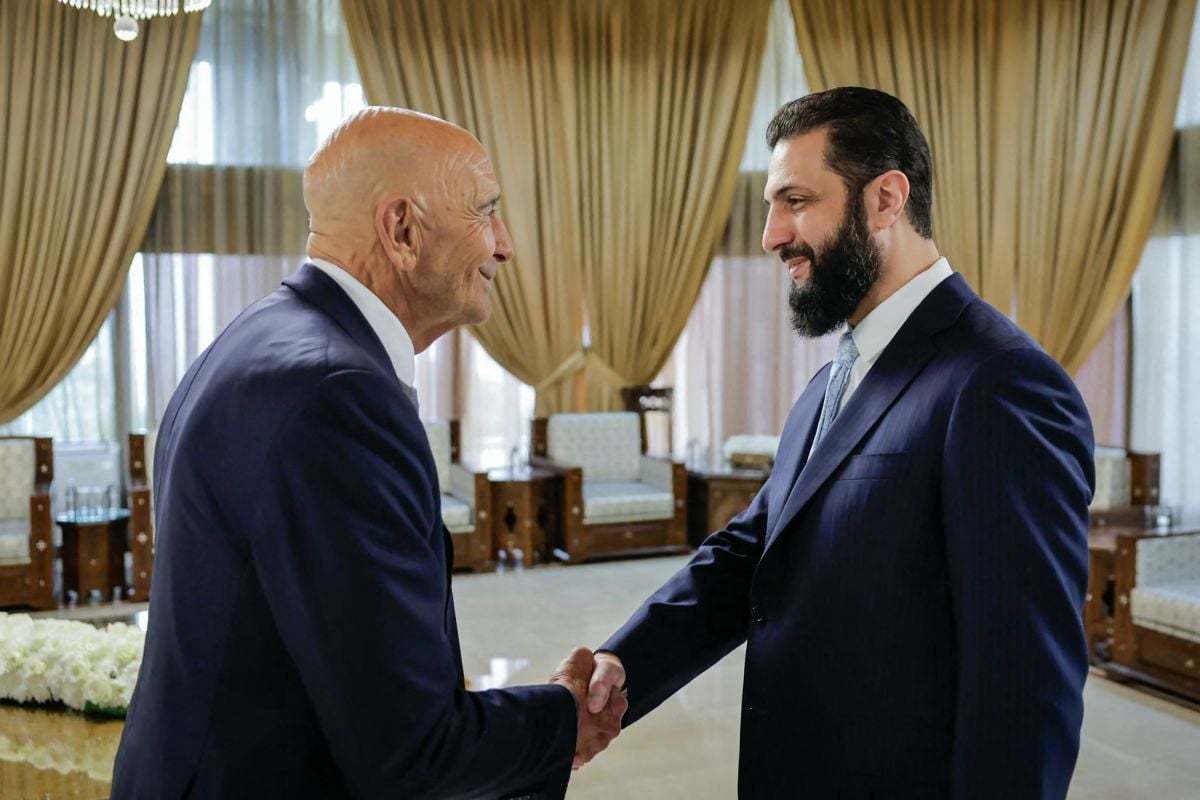
Handshake in Damascus between the American envoy to Syria, Tom Barrack (left), and Syrian President Ahmad al-Sharaa, on Jan.18, 2026. (Credit: Photo Handout / Syrian Presidency Telegram Page / AFP)






BEIRUT — Tom Barrack, who has repeatedly sparked controversy since becoming the U.S. special envoy to Syria and ambassador to Turkey, backtracked Sunday evening on comments he made Friday regarding the Israeli occupation of the Golan Heights and the potential inclusion of Iran and Hezbollah in negotiations between Israel and Lebanon.
Barrack’s remarks, made in an interview with Lebanese-Australian entrepreneur Mario Nawfal, drew criticism not only from Israeli officials — Defense Minister Israel Katz accused him of taking positions “contradicting the line of President Donald Trump” on the Golan — but also from Lebanese leaders. MP and former minister Ghassan Hasbani wrote an open letter to the diplomat Sunday, arguing that any solution to the conflict “must go through the state.”
Regarding the Lebanon-Israel negotiations, Barrack had said that “two people are missing from that [negotiating] table,” referring to Hezbollah and Iran. However, in a statement to the Associated Press on Sunday, he insisted that the United States “does not negotiate with Hezbollah” and said he had only sought to point out that the group’s weapons — whose handover to the state is an Israeli precondition for withdrawal from southern Lebanon — “are provided and financed by Iran,” complicating negotiations over their fate.
"I was describing the difficulty of the issue; I was not proposing a new negotiating table," the diplomat said. "Hezbollah is a foreign terrorist organization as designated. We do not negotiate with them, and nothing I said suggests otherwise," he insisted.
Addressing his criticism of Israel’s “occupation” of the Golan Heights, which he said violated U.N. resolutions, Barrack said Sunday that his remarks were “a description of the territory’s historical status and not an endorsement of the United Nations’ position.”
“United States policy on the Golan was set by President Trump in 2019 and is unchanged,” he said.
Israel captured the Syrian Golan Heights during the Arab-Israeli war in June 1967 and annexed the territory in 1981. The U.N. and most of the international community consider the Golan to be occupied Syrian territory and do not recognize its annexation. In 2019, however, then-President Donald Trump recognized Israeli sovereignty over the territory.
Barrack, who served as the U.S. special envoy to Lebanon for several months before Ambassador Michel Issa was appointed, has sparked several controversies in recent months. He notably warned against a return to “Bilad al-Sham,” referring to a “Greater Syria” encompassing Lebanon, if authorities failed to implement concrete reforms and disarm Hezbollah. He also aggressively confronted journalists during a press conference at Baabda Palace.