





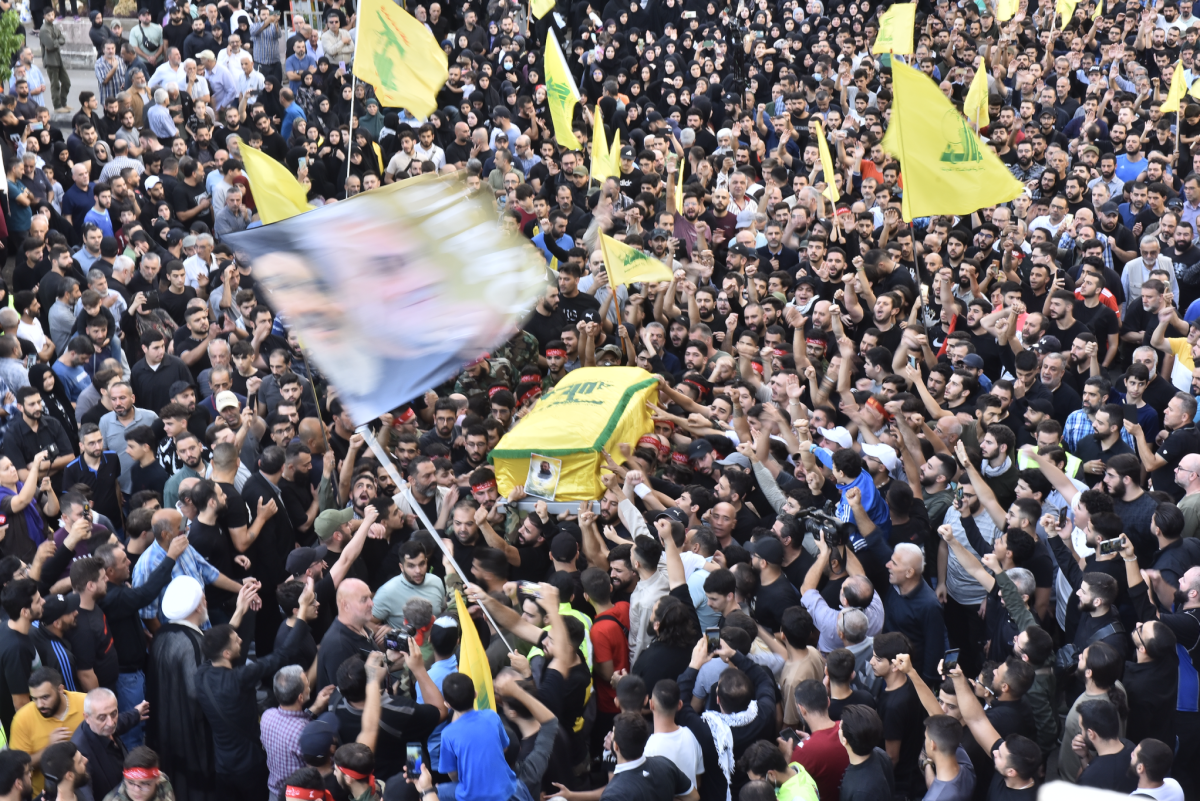
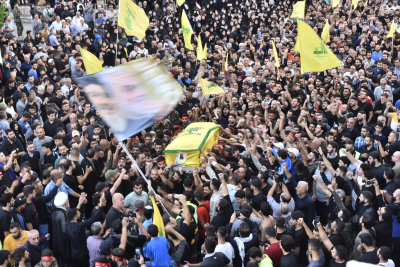
Hezbollah members during the funeral of a party member killed following Israeli bombings in southern Lebanon, on October 21, 2023, in the southern suburbs. Archive photo Mohammad Yassine






The United States on Thursday issued a new round of measures against Hezbollah, sanctioning financiers and re-listing the organization among sanctioned entities for its ties with the Quds Force, the unit of Iran's Islamic Revolutionary Guards Corps (IRGC) responsible for foreign operations. This move opens a long debate about Hezbollah's hybrid nature, a party directed from Tehran but which maintains hundreds of thousands of supporters in Lebanon.
For Washington, the Treasury Department's decision is a way to settle the debate, labeling the militia as an Iranian group. "Because the top of the party is Iranian, it is clearly not ready to engage in serious dialogue with the government regarding weapons," a U.S. diplomatic source, who requested anonymity, told L'Orient-Le Jour. However, this decision "is in no way intended to alienate or question the Lebanese identity" of the party's popular base, the source added. "On the contrary, decision-makers in Washington recognize that the Shiite community must be part of the solution," the source said. According to this source, from Washington's perspective, the sanctions — which also targeted several businessmen forming a financing chain between Iran, Turkey, and Lebanon — aim to "neutralize Hezbollah's political economy" and present the Lebanese state as an alternative political and economic offer.
Berri, the 'facilitator'
"For now, Beirut must be the only one supporting the displaced. Afterwards, it will have to lead the reconstruction process. This will help bring the Shiite community back into the fold of the state," the diplomatic source asserted. "This requires supporting the government while cutting Hezbollah's illicit financial networks and neutralizing its institutions, such as al-Qard al-Hassan," the source added. The source also said that Washington expects the Lebanese government and its central bank to participate in these efforts at both legislative and judicial levels. The United States particularly wants Lebanon to speed up the implementation of the disarmament plan, including in Beirut, especially given the current volatile regional context.
Regarding Parliament Speaker Nabih Berri, whom some in Beirut and Washington hope to see sanctioned, the source said that the United States perceives him as a "facilitator" rather than an obstacle, particularly as he "recognizes that the Shiite need reconstruction rather than weapons." "Nabih Berri clearly wants the success of the framework agreement between Lebanon and Israel and of the pilot zones, even if he doesn't say so openly," the source noted. "He plays an important role in the Ali Taher sequence, as he was disappointed that Hezbollah refused to hand over the hill to the Lebanese Army to avoid another outbreak of violence," the source added. Berri's office was reportedly informed in advance of the United States' intention to impose new sanctions against his ally. According to our information, following the American Task Force for Lebanon's tour this week, decision-makers in Washington have shown more "understanding" toward Berri, as well as the Lebanese Army, led by Rodolph Haykal. "We are ready to understand and help, but that does not mean they can remain idle. We have expectations," the source said.
'Proud' of the link with Iran
In the same vein, Massaad Boulos, adviser to President Donald Trump, said Thursday on his X account that the measures taken by Washington "shows our resolve to cut off these terror financing networks." He also said that Iran "uses" Hezbollah "to sow chaos across the Middle East, undermine Lebanon's sovereignty, and threaten our regional allies."
For its part, Hezbollah responded Friday, asserting that it does not need a "certificate" to prove its Lebanese and national identity. This decision by the U.S. Treasury is "just another episode in the ongoing policies pursued by U.S. administrations to target the Resistance ... with the aim of protecting the security of the Israeli enemy, consolidating its occupation of southern Lebanon, and paving the way for it to implement its projects and expansionist ambitions in the region," Hezbollah said in a statement. For Hezbollah, Washington "continues to treat Lebanon with a tutelage mindset" and "seeks to provoke unrest inside Lebanon and divert the confrontation with the Israeli enemy in another direction" instead of "forcing this enemy to withdraw from southern Lebanon," a territory Israel occupies for nearly 700 squared kilometers.
Regarding its ties with Tehran, Hezbollah refers to a "close and brotherly relationship with the Islamic Republic of Iran," which the movement says it is "proud" of. Iran "remained by [our] side at all stages and during all crises and was among the first countries to help rebuild what was destroyed by the Zionist aggression during the July 2006 war," the statement reads.
"The U.S. administration lacks any moral or legal legitimacy to classify others or issue them certificates of patriotism," Hezbollah declared, citing "the [American] unlimited support for the genocide in Gaza, its cover for the crimes of the Israeli enemy and murders and destruction committed in Lebanon, Yemen and Syria, and its aggression against the Islamic Republic of Iran." "All these unjust sanctions and classifications will not deter us from our commitment to the path of resistance," Hezbollah concluded.
This article was originally published in French in L'Orient-Le Jour.

 7 p.m. recap: Iran warns Egypt, Israeli soldiers vote in south Lebanon, Haret Hreik responds to Kataeb